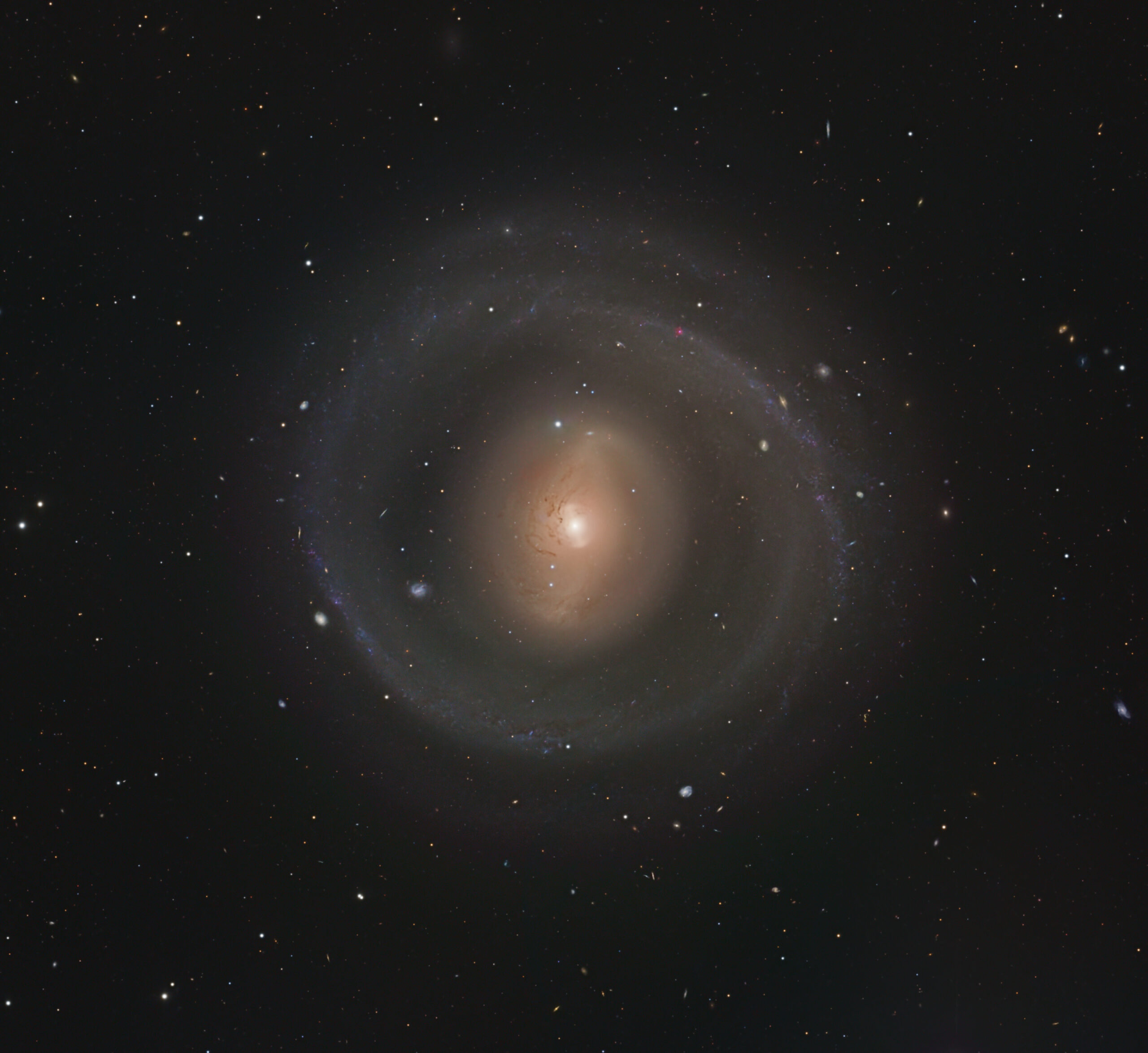
A galaxy reshaped from within, its bar sweeping gas outward into a ring of newborn stars
NGC 1291 in Eridanus is one of the clearest examples of a ringed lenticular galaxy in the southern sky, classified as an outer-ringed barred lenticular of type (R)SB0/a(s), poised on the boundary between the smooth lenticulars and the earliest spirals
It lies roughly 35 million light-years away and extends about 19 arcminutes across in deep blue survey plates, which at that distance corresponds to a physical span of nearly 195,000 light-years
At its heart sits a bright, compact nucleus wrapped in a warm golden bulge, laced on one side with fine dark filaments of dust that wind in toward the center, and beyond it lies a broad, smooth lens of old stars with a bar embedded within it, while a second, much smaller bar turns inside the first, making NGC 1291 one of the best known double-barred galaxies
Farther out, separated from the lens by a dark, nearly empty gap, a vast outer ring encircles the entire system, faint and pale, yet studded with blue knots of young star clusters and a scattering of glowing pink hydrogen clouds, the only places in this otherwise ancient galaxy where stars are still being born, and radio surveys reveal this ring as part of an extended reservoir of neutral hydrogen
The ring is a resonance structure, gas driven outward by the slow rotation of the bar has collected where its orbits fall into step with the bar’s pattern, piling up in a narrow band where it can finally cool, compress and form new stars
NGC 1291 is a portrait of a galaxy in late life, no longer shaped by collisions or mergers but by the patient internal motions of its own bars, a process astronomers call secular evolution, slowly reorganizing the galaxy over billions of years until only its outermost ring still burns blue
Imaged in LRGB and Ha on the Planewave CDK 1000, Camera Moravian C5A 100M, at Observatorio El Sauce, Chile
Image Acquisition and Processing: Mike Selby