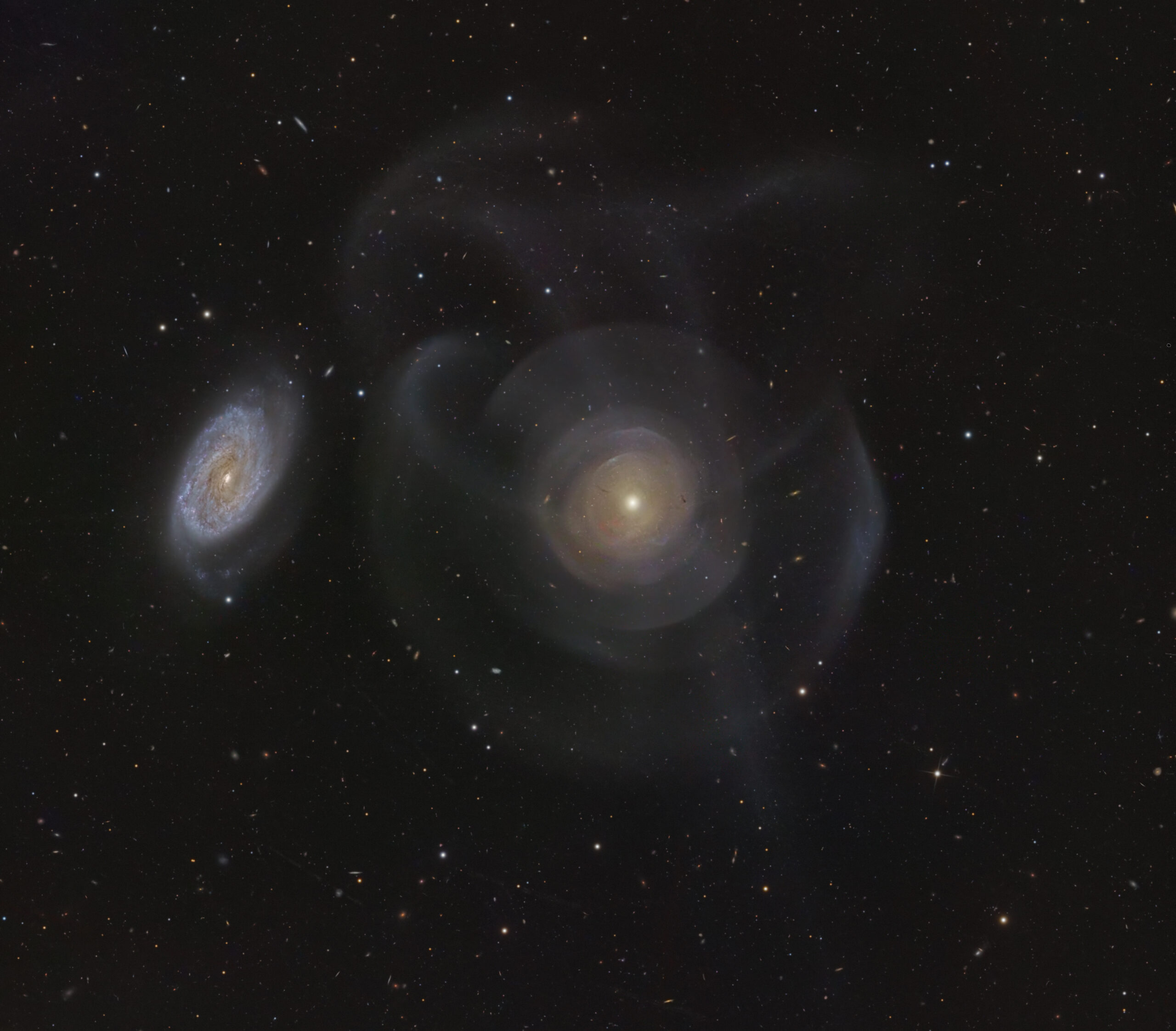
Ripples frozen in starlight — a galaxy still wearing the scars of a meal it finished long ago
NGC 474, also catalogued as Arp 227 and UGC 864, is a lenticular galaxy in Pisces, classified SA0⁰(s) with an outer ring structure noted as (R′)SA(s)0⁰. It lies about 91.5 million light-years away, subtends roughly 10 arcminutes on the sky, and spans close to 266,000 light-years across its full extent, more than twice the diameter of the Milky Way, shining at an apparent magnitude of 11.3
What sets this galaxy apart is the system of concentric shells and arcs wrapped around an otherwise smooth, featureless lenticular body. The inner envelope is bright and nearly circular, but beyond it the light breaks into successive sharp-edged shells and long, curving tidal loops that reach far out into the field, sweeping north over both galaxies and trailing away to the east. These shells are not made of gas or dust but of old stars, which is why they carry the same warm, neutral tone as the core rather than the blue of young star formation. NGC 474 is one of the best examples of a shell galaxy in the sky and was the reason Halton Arp included it in his Atlas of Peculiar Galaxies as an example of a galaxy with concentric rings
To the west, and appearing on the left in this image, is its companion NGC 470, a spiral galaxy with strongly defined blue arms and active star formation, separated from NGC 474 by only about 5.5 arcminutes on the sky, a projected distance of roughly 146,000 light-years. The two share nearly the same recession velocity and form a physical pair, with NGC 470 showing signs of distortion in its own outer disk from the ongoing gravitational interaction
Shells like these form when a small galaxy is captured and torn apart on a nearly radial orbit into a larger one. Its stars are flung outward, reach the top of their orbits, and pile up at turning points, producing the phase-wrapped ripples we see as concentric arcs. Simulations suggest the shells of NGC 474 record a merger that took place around a billion years or more ago, while NGC 470 continues to tug at the outer halo today, stripping cold gas from its outskirts. The image captures two stages of the same process in a single field, an old merger written in shells and a new interaction still under way
Imaged in LRGB on the ASA AZ 1500, Camera Moravian C5A 150M, at Observatorio El Sauce, Chile
Image Acquisition and Processing: Mike Selby