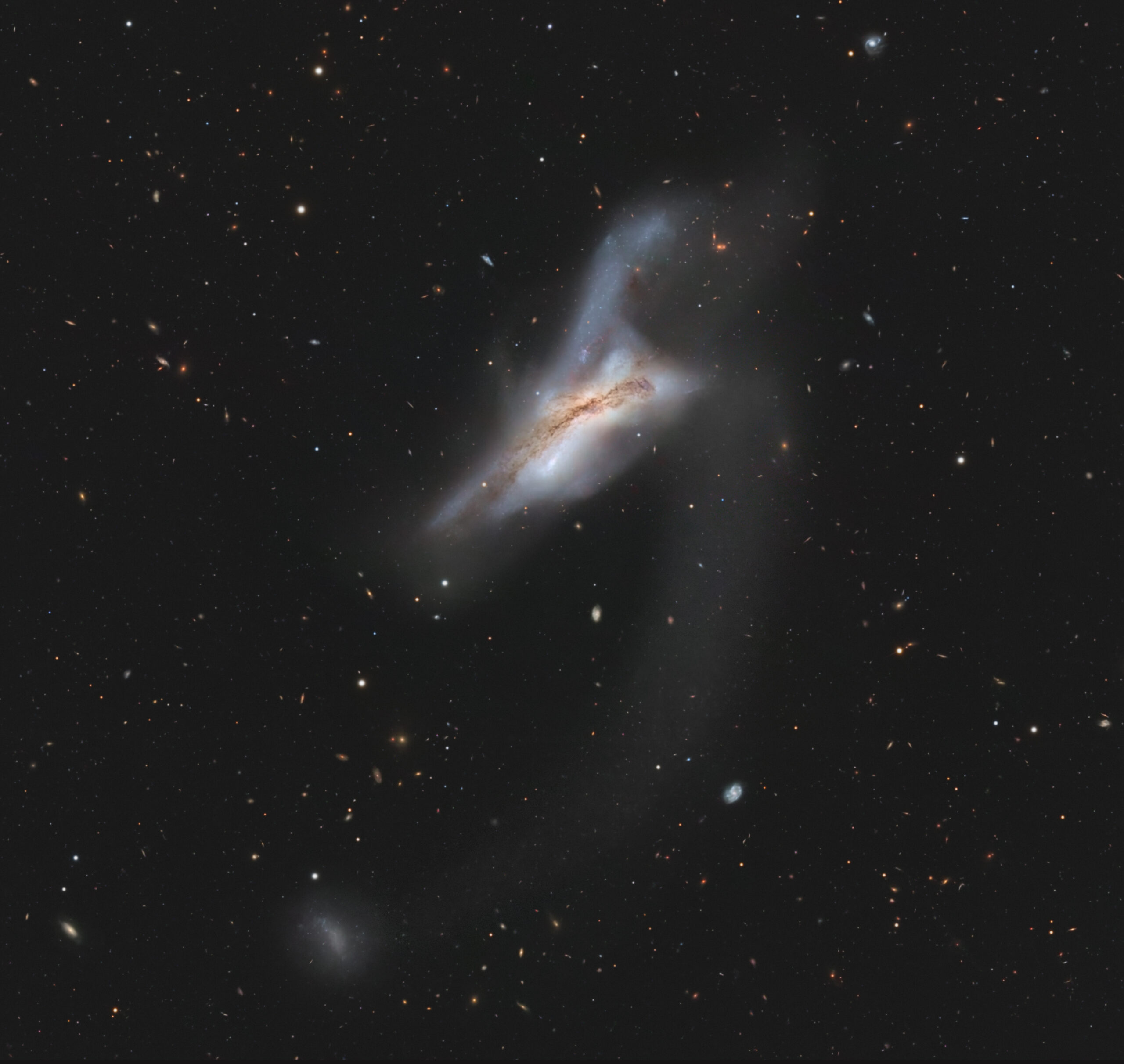
Two galaxies caught mid-collision, their stars drawn out into a stream that reaches toward a dwarf companion
NGC 520, also catalogued as Arp 157, UGC 966 and VV 231, lies in the constellation Pisces and is classified as a peculiar galaxy pair with HII starburst activity, two disk galaxies in the act of merging, placed seventh in the Toomre sequence as the archetype of an intermediate-stage merger and described by Halton Arp as the second-brightest very disturbed galaxy in the sky
The mean redshift-independent distance places the system about 71 million light-years away, with a heliocentric recession velocity of 2281 km/s; its catalogued apparent diameter of 5.0′, which includes the tidal extensions, corresponds to roughly 104,000 light-years, and it shines at magnitude 12.2
A dense dust lane cuts diagonally across the bright central body, its brown-orange filaments silhouetted against the starlight and concealing the primary nucleus, which hosts a compact rotating disk of molecular gas and the current starburst; the second nucleus, about 40″ away or roughly 14,000 light-years in projection, lies exposed beside the lane and is dominated by the light of A-type stars, the signature of a starburst that has already faded; a broad blue plume of young stars sweeps away from one end of the body, a fainter grey envelope and looping shells surround the whole, and the field behind is strewn with hundreds of far more distant galaxies
From the other end a long tidal tail streams outward, bends sharply and continues as a faint arc of old starlight that reaches the extended halo of the dwarf galaxy UGC 957, some 6′ from the main body, a projected separation of about 125,000 light-years; radio observations show that UGC 957 shares the velocity of the system and is threaded by an enormous ring of neutral hydrogen encircling the merger, though whether the dwarf is a pre-existing companion drawn into the encounter or a condensation born from the tidal debris remains unsettled
Simulations indicate that the encounter began about 300 million years ago between one gas-rich and one gas-poor disk; the stellar disks have already blended into a common envelope while the two nuclei remain distinct, a brief phase that precedes final coalescence into a single remnant, so NGC 520 preserves a stage that the Antennae have yet to reach and that the Milky Way and Andromeda may one day pass through, and in the radio and infrared it is as luminous as the Antennae themselves
Imaged in LRGB on the ASA Astrosysteme AZ 1500, Camera Moravian C5A 150M, at Observatorio El Sauce, Chile
Image Acquisition and Processing: Mike Selby