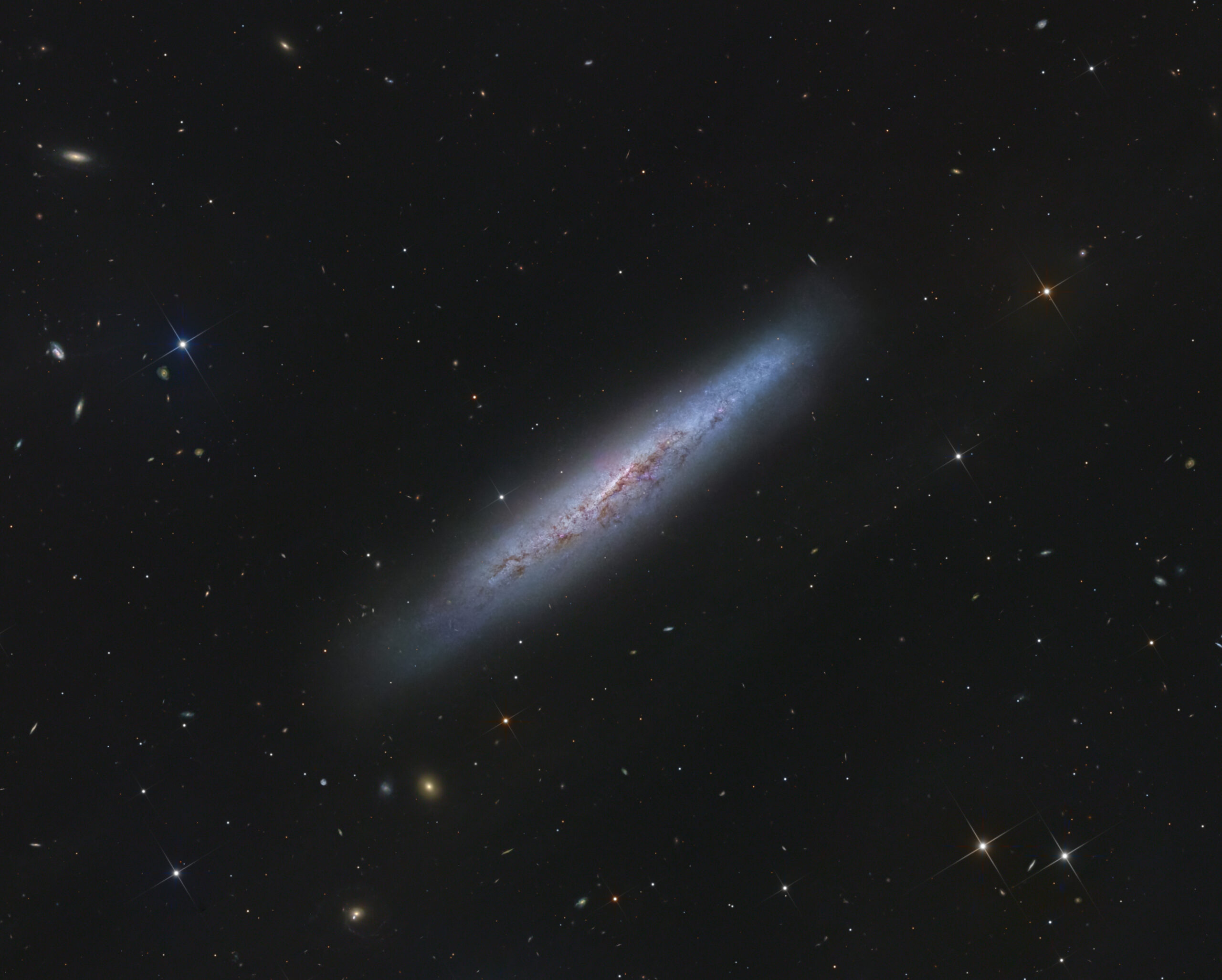
Seen almost perfectly edge-on, NGC 7090 hides its spiral arms behind a thin blade of stars and dust, while pink knots of ionized hydrogen betray the star formation going on inside
NGC 7090 is a barred spiral galaxy of type SBc in the southern constellation of Indus, its disk tilted just one degree from a perfectly edge-on view
It lies about 25.7 million light-years away and stretches some 12.8 arcminutes across the sky, corresponding to a disk roughly 95,000 light-years in diameter, and shines at visual magnitude 10.5
The disk is remarkably thin and flat, with a modest central bulge and a mottled lane of dark dust threading through the bright midplane. The most striking feature of this image lies at the edge of the galaxy. Below the bright disk, and separated from it by a clear gap, a long band of dark dust runs parallel to the galaxy for much of its length, silhouetted against the faint outer glow of the stellar halo. This is a real structure belonging to NGC 7090 itself, not dust in our own Milky Way, which lies far from this line of sight. Because the galaxy is not quite edge-on, the nearer face of the disk is tipped very slightly toward us, and the dust in its outer layers projects below the bright midplane rather than hiding within it, appearing to float just outside the disk where there is still enough faint starlight behind it to reveal it in silhouette. Along the disk itself, pink and magenta knots of ionized hydrogen mark regions of active star birth, and the luminous stellar disk extends well beyond the dust into a faint blue outer halo. The field is rich in background galaxies, several of them small spirals and ellipticals hundreds of millions of light-years farther away
NGC 7090 lies close to NGC 7064, another nearby edge-on spiral in Indus, and the two share similar distances and recession velocities
Galaxies like this one are natural laboratories for the exchange of gas between a disk and its halo. Star formation across the disk of NGC 7090 drives a complex network of ionized gas filaments, bubbles and shells that rise above the plane, and the galaxy hosts several transient ultraluminous X-ray sources, the signatures of compact objects accreting matter at extreme rates. The dust we see in silhouette, both in the midplane and in the band below it, is the raw material from which the next generation of stars will form
Imaged in LRGB on ASA AZ 1500, Camera Moravian C5A 150M, at Observatorio El Sauce, Chile
Image Acquisition and Processing: Mike Selby