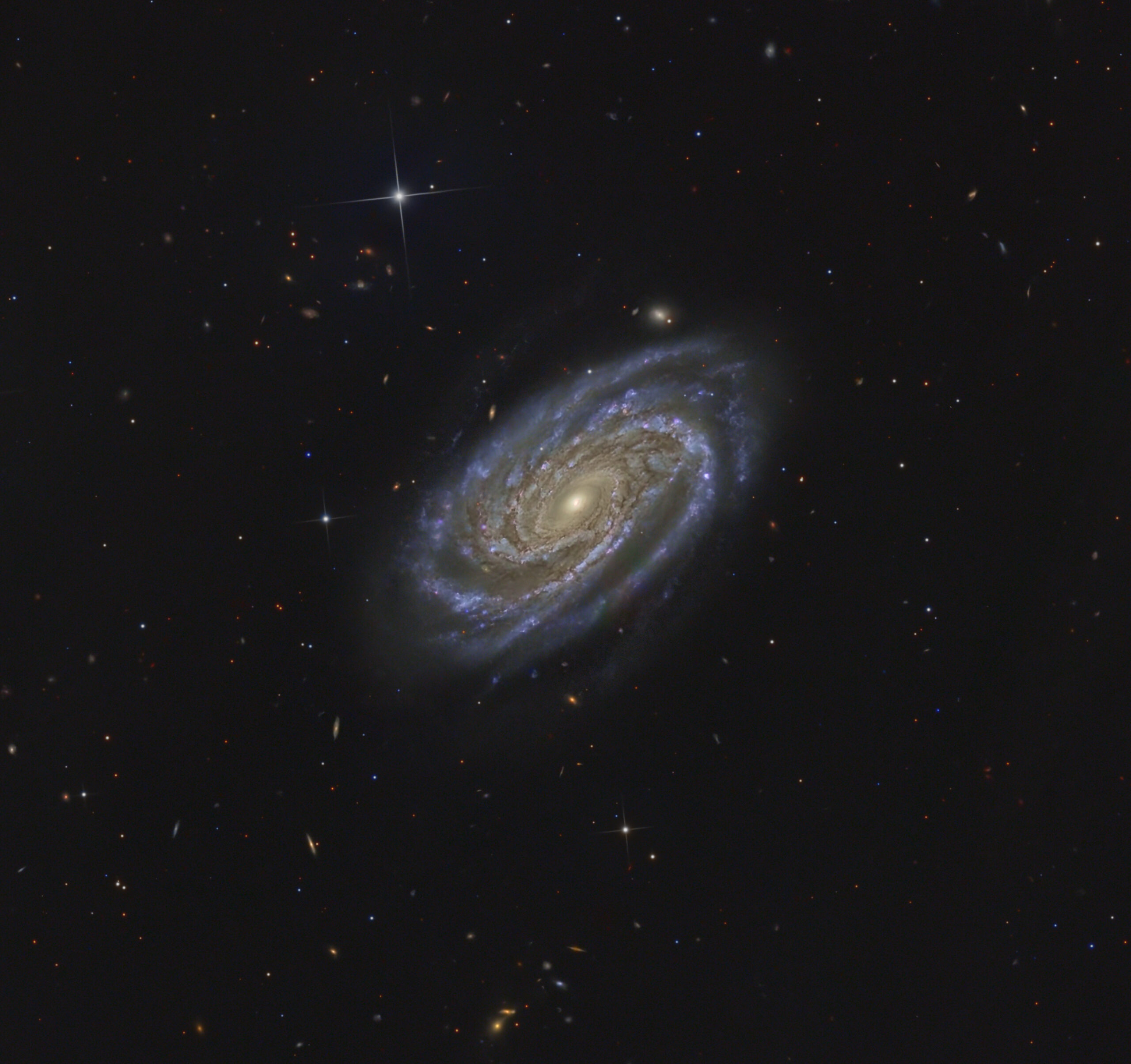
NGC 7038
A grand spiral anchoring a galaxy cluster at the heart of the Pavo–Indus Supercluster
NGC 7038 is a spiral galaxy in the constellation Indus, classified SAB(s)c, indicating a weak central bar from which two dominant arms unwind in an s-shaped pattern rather than emerging from a ring
Its distance, from the mean of redshift-independent measurements, is 200 million light-years. The disc spans 4.5 arcminutes on its major axis, corresponding to a physical diameter of about 261,000 light-years, roughly two and a half times the size of the Milky Way, with a visual magnitude near 12.5
A compact, warm-toned bulge anchors two principal arms, tightly wound near the centre and opening steadily outward. Broad dust lanes trace the inner edges of both arms and thread through the bulge in dark filaments that give the core its mottled texture. Along the outer arms the colour shifts to blue, with chains of star-forming knots and HII regions marking the arm ridges, and a faint extended disc continues beyond them where the spiral pattern dissolves into diffuse starlight
NGC 7038 is one of the two brightest members of the galaxy cluster Abell 3742, alongside the lenticular NGC 7014. The cluster sits near the centre of the Pavo–Indus Supercluster, one of the major mass concentrations of the nearby universe, and the surrounding field is scattered with fainter cluster members and distant background galaxies
The galaxy has hosted three recorded supernovae, SN 1983L, the Type II SN 2010dx and the Type Ia SN 2018hsa, reflecting the vigorous star formation visible along the arms. Despite living in a dense cluster environment where discs are often stripped or quenched, NGC 7038 has retained a large gas reservoir and remains an actively star-forming late-type spiral
Imaged in LRGB on the ASA Astrosysteme AZ 1500, Camera Moravian C5A 150M, at Observatorio El Sauce, Chile
Image Acquisition and Processing: Mike Selby