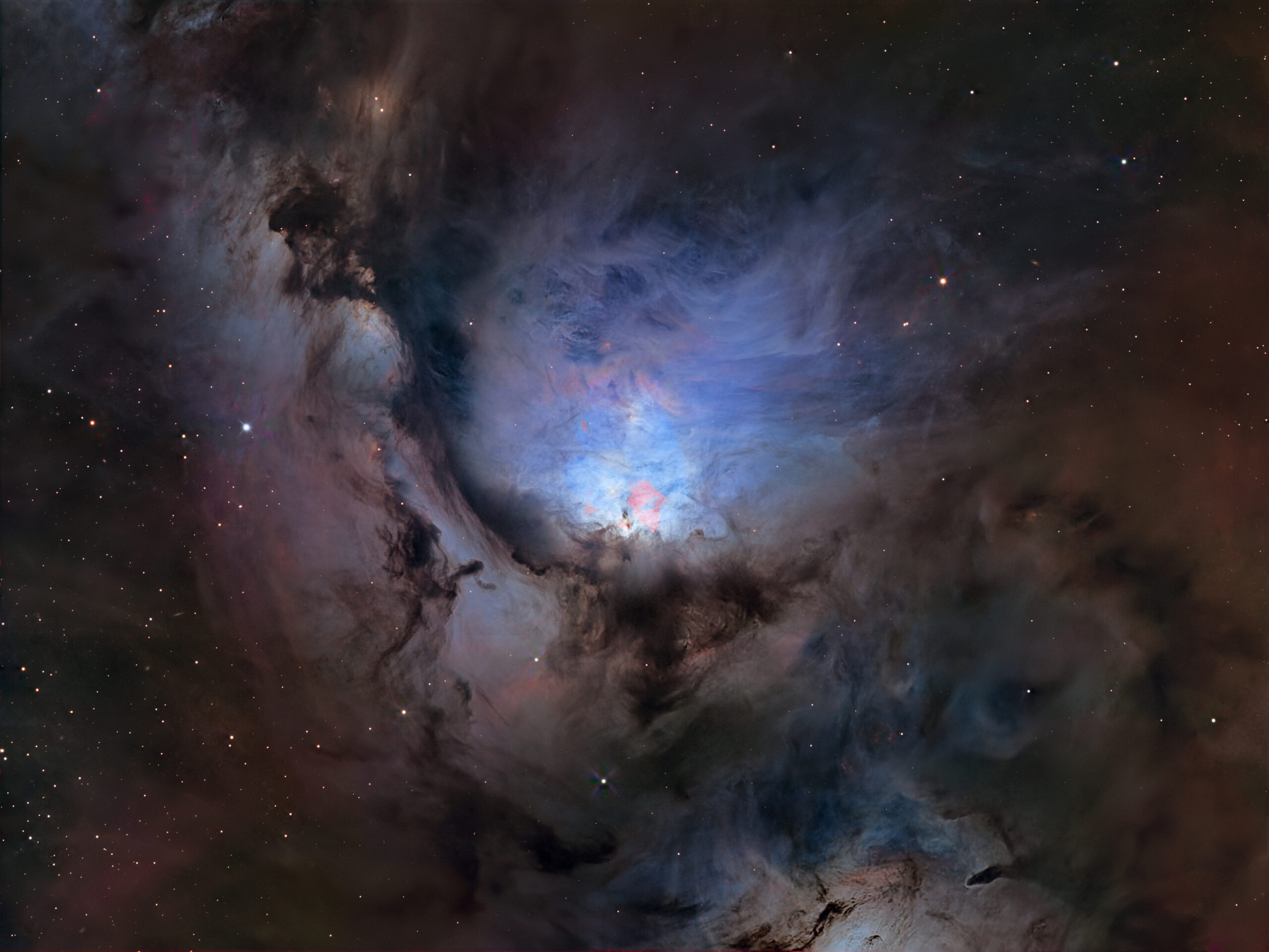
A chamber of light carved into Orion’s dark heart
M78 is the brightest reflection nebula in the entire sky, a luminous cloud of interstellar dust roughly 1,350 light-years away in the constellation Orion, part of the vast Orion B molecular cloud. Unlike an emission nebula, which glows with its own ionized light, M78 shines by reflection alone, its dust grains scattering the light of two hot young B-type stars buried within it, HD 38563 A and HD 38563 B. Because fine dust scatters blue light more efficiently than red, the nebula takes on the same cool blue hue that colors our daytime sky, wrapped here in lanes of darker, warmer dust that wind through the cloud
First recorded by Pierre Méchain in 1780 and soon added to Charles Messier’s catalogue, M78 was long thought to be simply a pretty patch of haze, until Vesto Slipher, studying its spectrum in 1919, showed that its light was merely borrowed starlight scattered off dust, confirming its nature as a reflection nebula. Its soft, ghostly form has since earned it the affectionate nickname Casper the Friendly Ghost
Yet beneath that quiet surface, M78 is anything but still. Infrared surveys reveal a nursery of embedded protostars still gathering mass within the dust, and scattered through the cloud are Herbig-Haro objects, the glowing shock fronts where jets of gas launched by newborn stars slam into the surrounding material at enormous speed. The small reddish knots near the heart of the nebula mark where this hidden star formation breaks through the obscuring dust
This region has produced one of the most dramatic events amateur astronomers have ever caught in real time. In early 2004 a new fan-shaped nebula suddenly appeared nearby, when a deeply embedded young star erupted in outburst and lit up the dust around it, an object now known as McNeil’s Nebula, a reminder that even a cloud as serene as this one is alive with the violent, luminous work of building new stars
Imaged in LRGB and Hydrogen-alpha on the CDK 700, Camera Moravian C5-100, at Observatorio El Sauce, Chile
Image Acquisition and Processing: Mike Selby