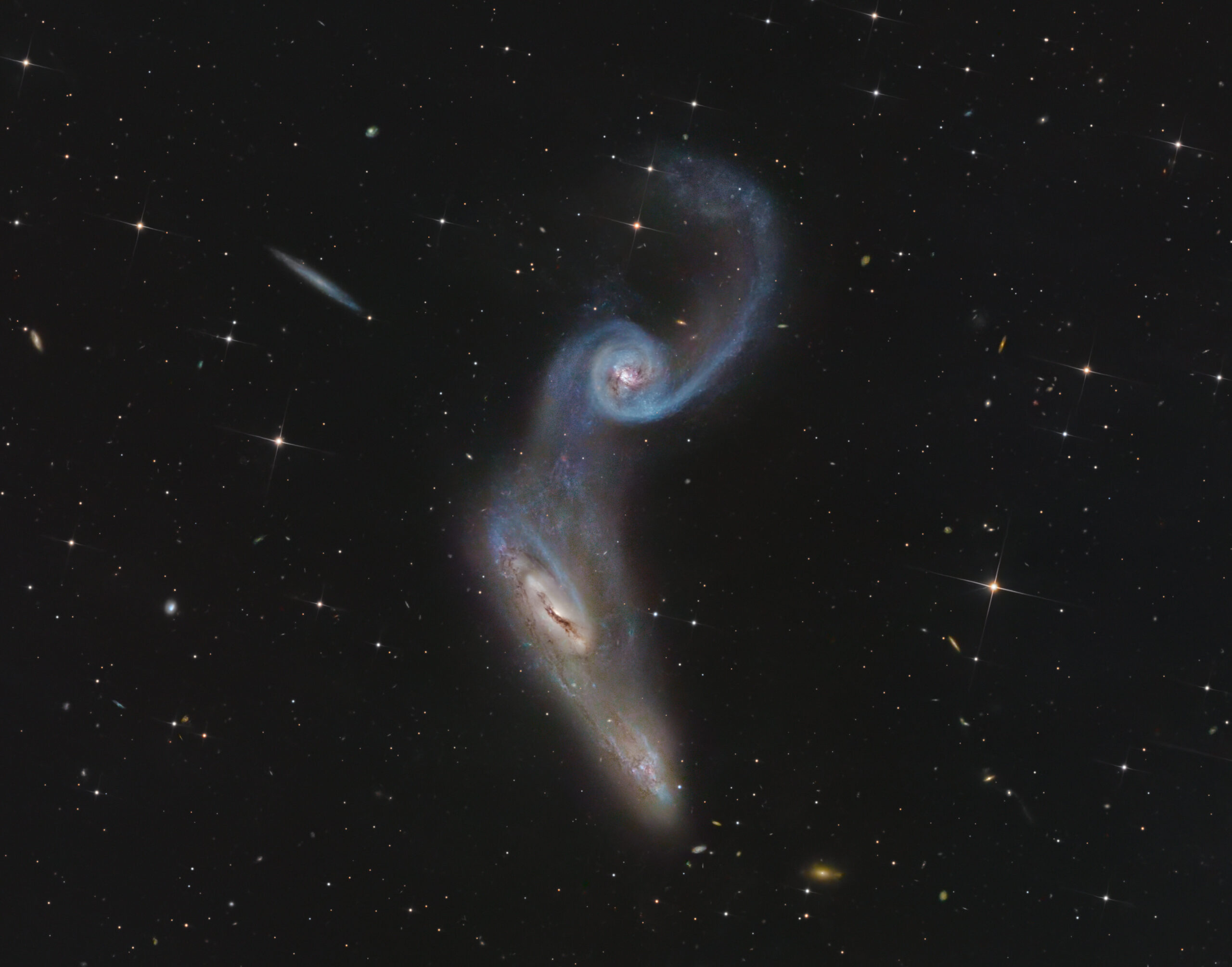
Where two galaxies are torn apart, a third is being born
Arp 245 is a striking interacting system in the constellation Hydra, formed by the peculiar spiral galaxies NGC 2992 and NGC 2993 caught roughly 100 million years after their first close passage. The larger galaxy toward the lower part of the image is NGC 2992, classified Sa pec and hosting a Seyfert 2 nucleus, seen at a steep inclination with its disk bisected by a prominent dust lane and visibly warped by the encounter. The galaxy toward the upper part of the image is NGC 2993, also classified Sa pec, its spiral arms stretched and distorted by the interaction. The two are linked by a diffuse tidal bridge spanning the space between them, direct evidence that they have already passed close to one another
NGC 2992 lies approximately 82.8 million light-years away and spans about 4.0 arcminutes, corresponding to a true diameter of roughly 96,400 light-years, comparable in scale to the Milky Way. NGC 2993 lies a little beyond it at about 99.5 million light-years, measuring some 1.4 arcminutes across for a diameter near 41,000 light-years. Their nearly identical recession velocities confirm that the two galaxies are genuinely bound together rather than aligned by chance
The most dramatic feature is the great tidal tail sweeping northward from NGC 2992, curling across the upper part of the frame — a long plume of stars and gas drawn out during the close passage. At its tip lies one of the most remarkable objects in the system, a condensation of stars and gas known as Arp 245N, a tidal dwarf galaxy in the act of forming from the debris stripped out of NGC 2992. Here a new, self-gravitating galaxy is being assembled from material torn from its parent, a rare chance to watch galaxy formation unfold in the present rather than the distant past. NGC 2993 shows its own distorted arms and a separate tidal structure, seen in neutral hydrogen as a great ring
Arp 245 is caught at an early stage of its encounter, the tails still young and developing barely a hundred million years after closest approach. Over the coming hundreds of millions of years the two galaxies will continue to interact, their orbits slowly decaying, while the tidal dwarf at the tail’s tip follows its own path through intergalactic space. This image captures a brief and dramatic moment in that unfolding process — two galaxies reshaped by gravity, and a third taking form in the stream of stars drawn out between them
Imaged in LRGB on the ASA Astrosysteme AZ 1500, Camera Moravian C5A 150M, at Observatorio El Sauce, Chile
Image Acquisition and Processing: Mike Selby