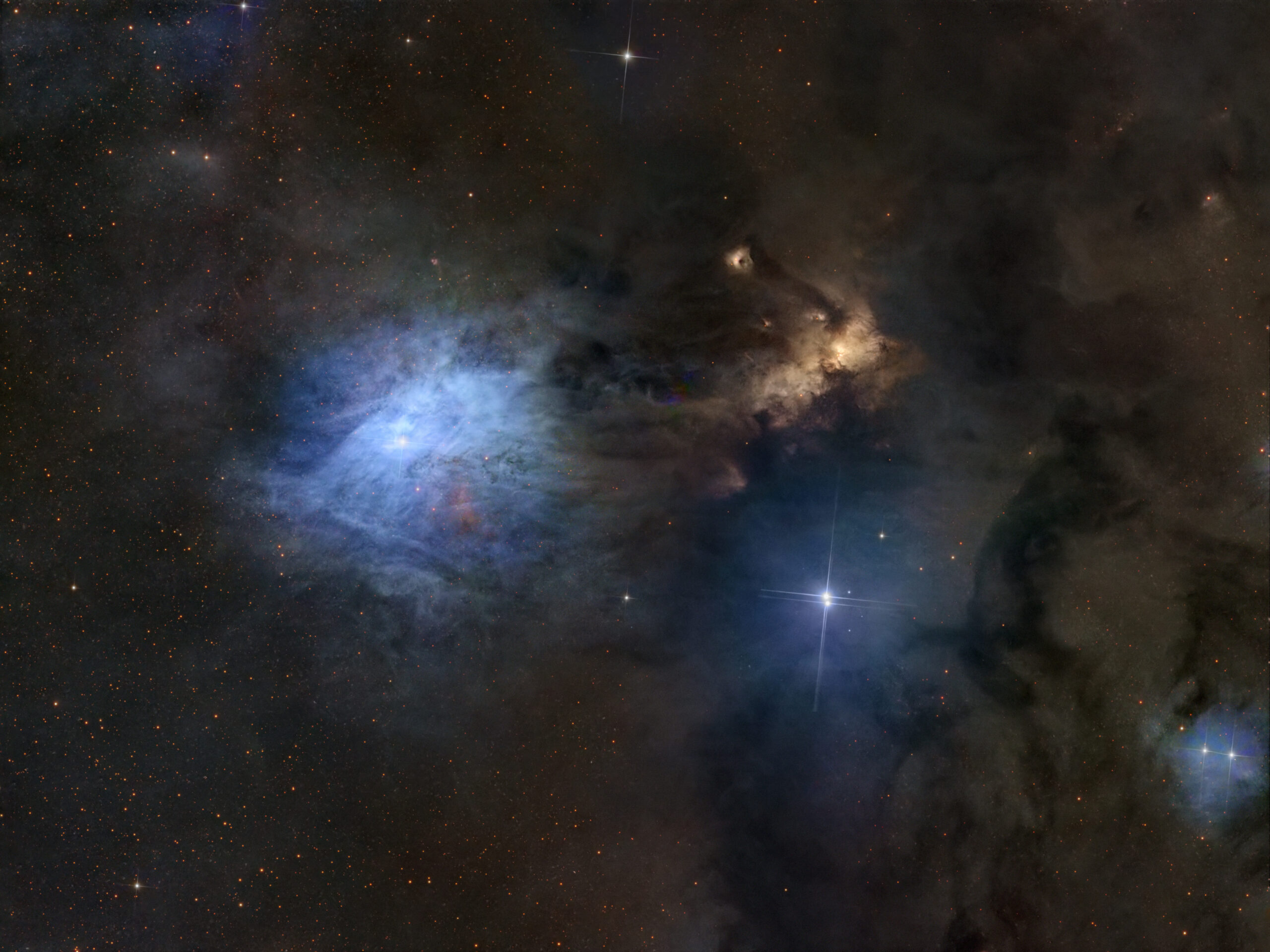
Blue light scattered, red light buried, stars forming in the dust of their own birth cloud
VdB 123 is a blue reflection nebula in Serpens Cauda, embedded within the dark folds of the Serpens Molecular Cloud, one of the nearest and most active low-mass star-forming regions in the sky. Catalogued by Canadian astronomer Sidney van den Bergh in his 1966 survey, it is illuminated by the 9.75-magnitude B7V star HD 170634, whose blue-white light is scattered by surrounding interstellar grains in the same way our daytime sky scatters sunlight toward blue
The Serpens cloud lies at a directly measured distance of roughly 1,400 light-years, established through VLBI trigonometric parallax of young stars embedded in the Serpens Core rather than indirect spectroscopic estimates that long made this distance one of the more contested figures in the literature. The nebular complex spans a field of order one degree on the sky, corresponding to a physical extent of tens of light-years at this distance, threaded throughout by the dense obscuring dust of the molecular cloud
The frame is a study in contrast between two illumination mechanisms. At left, HD 170634 sits within the cool blue glow of VdB 123, the classic signature of dust scattering shorter wavelengths most efficiently. To the upper right, a warm golden-toned bipolar nebulosity glows from light that has been heavily reddened as it filters through the densest dust, this is the Serpens Reflection Nebula, illuminated by the deeply embedded pre-main-sequence star SVS 2. The intervening dark lanes are not empty space but cold opaque molecular gas, cataloged among the dense Serpens dust structures, silhouetting the rich Milky Way star field behind
The clustered knots of nebulosity in the upper portion of the field mark a true cradle of star formation, the same region where the James Webb Space Telescope recently imaged a grouping of aligned protostellar outflow jets emerging from newborn stars. Bipolar outflows here, including those associated with SVS 2, trace the magnetically collimated ejection of material as protostars accrete and grow
What makes this region scientifically compelling is that it captures star formation in the act, the blue reflection nebula lit by an already-formed B star, the reddened bipolar source marking a protostar still buried in its natal dust, and the dark cloud itself holding the reservoir of gas from which the next generation of stars will condense, all within a single frame
Imaged in LRGB on the ASA Astrosysteme AZ 1500, Camera Moravian C5A 150M, at Observatorio El Sauce, Chile
Image Acquisition and Processing: Mike Selby