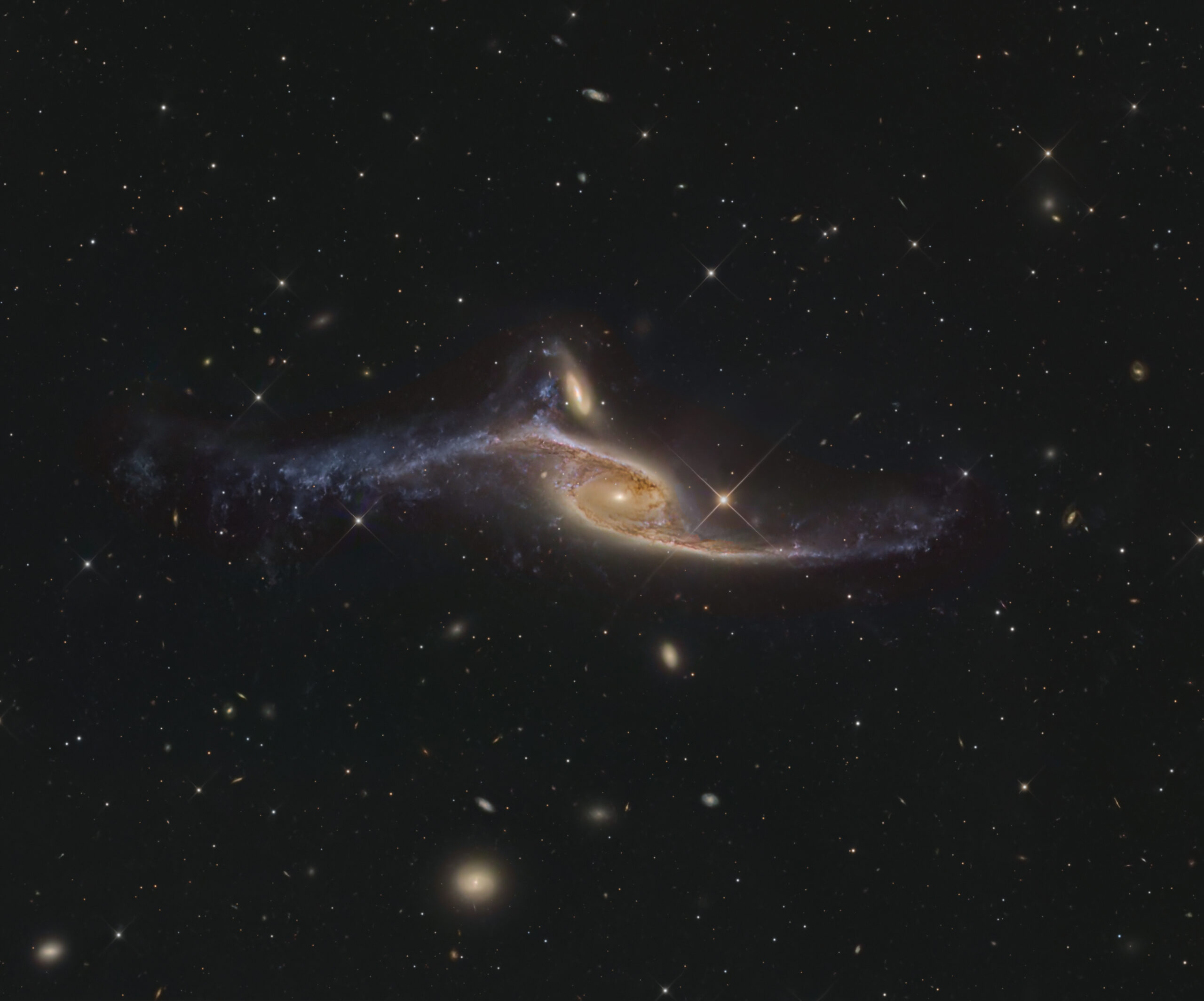
A spiral stretched across 600,000 light-years of deep space, and the interaction with the smaller galaxy IC 4970 caused this
NGC 6872, also catalogued as ESO 073-IG 032, VV 297a, and AM 2011-705, is a peculiar barred spiral classified as SB(s)b pec in the southern constellation Pavo
The NED Hubble flow distance corrected for Virgo, Great Attractor, and Shapley infall is 75.5 Mpc, placing the galaxy at roughly 246 million light-years, with an apparent major-axis diameter of 10′ and a derived physical extent exceeding 600,000 light-years tip to tip, making NGC 6872 one of the largest spiral galaxies known, though now surpassed by extreme low-surface-brightness systems such as Malin 1, whose diffuse disk extends well beyond a million light-years
The dramatic morphology is the direct result of an ongoing gravitational encounter with IC 4970, the small lenticular companion visible just north of the bulge, whose passage through the disk has drawn the northeastern arm out into a strongly extended tidal stream studded with blue knots of triggered star formation, with compression along the arm fueling young OB associations and ionized hydrogen regions that trace the full length of the structure, while the opposite southwestern arm is itself extended into a shorter counter-tail, the whole system displaying the bilateral asymmetry characteristic of a recent prograde passage
At the far northeastern tip of the long arm, deep multiwavelength imaging has identified a candidate tidal dwarf galaxy, a self-gravitating stellar system condensing from the debris pulled out by the interaction, an example of hierarchical galaxy formation operating on observable timescales rather than in the cosmological past
The bright elliptical at the lower edge of the field is an unrelated foreground galaxy, and the scattered faint smudges across the frame are more distant background systems visible through the high galactic latitude window that Pavo provides at -32 degrees below the galactic plane, well clear of the obscuring dust of the Milky Way
Imaged in LRGB on the ASA Astrosysteme AZ 1500, Camera Moravian C5A 150M, at Observatorio El Sauce, Chile
Image Acquisition and Processing: Mike Selby