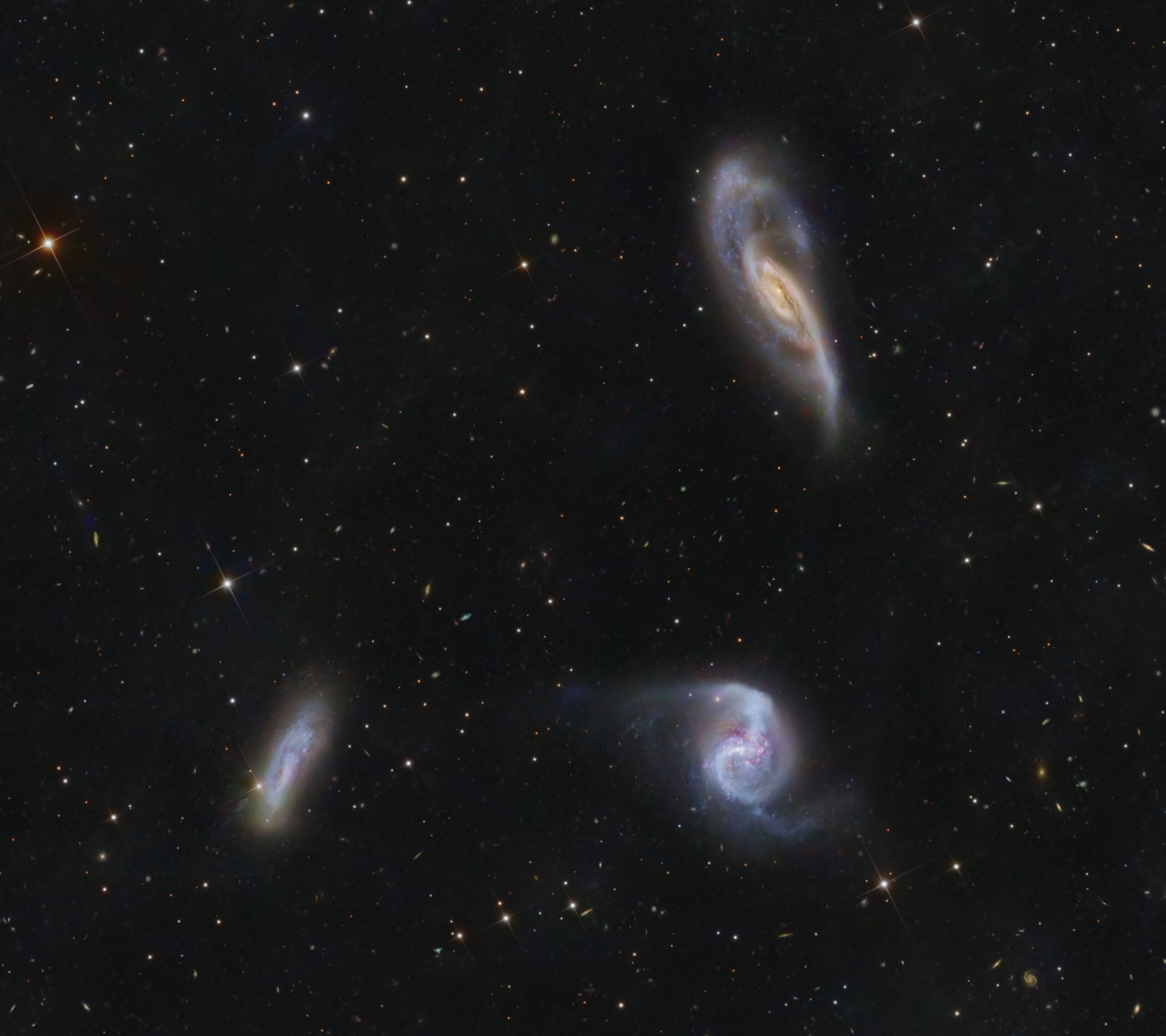
NGC 5916, 5915 and 5916A — a gravitationally bound triplet in Libra caught mid-interaction, one disk flung into a sweeping tidal arm while its neighbors look on
NGC 5916, NGC 5915 and NGC 5916A form a physically associated triplet of interacting galaxies in the constellation Libra, their mutual gravity already at work distorting disks and drawing out tidal material
At a distance of approximately 120 million light-years, the group gathers three very different systems: NGC 5916, the largest, an SB(rs)a peculiar barred spiral at upper right spanning an RC3 diameter of 3.2 arcminutes, about 113,000 light-years across; NGC 5915, an SB(s)ab peculiar barred spiral of apparent magnitude V 12.3 at lower right, roughly 55,000 light-years across; and NGC 5916A, also catalogued as PGC 54779, the small elongated member at lower left, about 48,000 light-years across — the recession velocities of the two NGC members agree closely, 2323 and 2272 kilometers per second, confirming the triplet as a genuine bound association rather than a chance line-of-sight grouping
The most arresting member sits at lower right, NGC 5915, a face-on spiral whose disk has been visibly wrenched by the encounter: a bright knot of pink HII regions and blue star clusters marks a starburst core, while a single luminous arm sweeps up and over the disk in a great curving plume — the unmistakable signature of tidal forces tugging on a thin, rotating disk, and the reason both NGC members carry the peculiar designation
By contrast NGC 5916 at upper right retains a more ordered form, an inclined barred spiral with a warm bulge and dust-laced arms threaded by knots of blue star formation, while NGC 5916A at lower left shows a softer, more diffuse body with a faint surrounding envelope — three galaxies illustrating how differently disks of different mass and structure respond to the same gravitational perturbation
Bright OB associations and pink emission knots trace ongoing, interaction-triggered star formation across the brighter members, and faint tidal debris drifts between them in the deep exposure, the early bridges and streams that mark the opening act of a slow gravitational entanglement
The surrounding frame is scattered with far more distant galaxies of every type, but the eye stays with the triplet itself — a compact stage of galactic interaction caught in the act, three independent disks that gravity has bound into a single unfolding encounter
Imaged in LRGB on the ASA Astrosysteme AZ 1500, Camera Moravian C5A 150M, at Observatorio El Sauce, Chile
Image Acquisition and Processing: Mike Selby