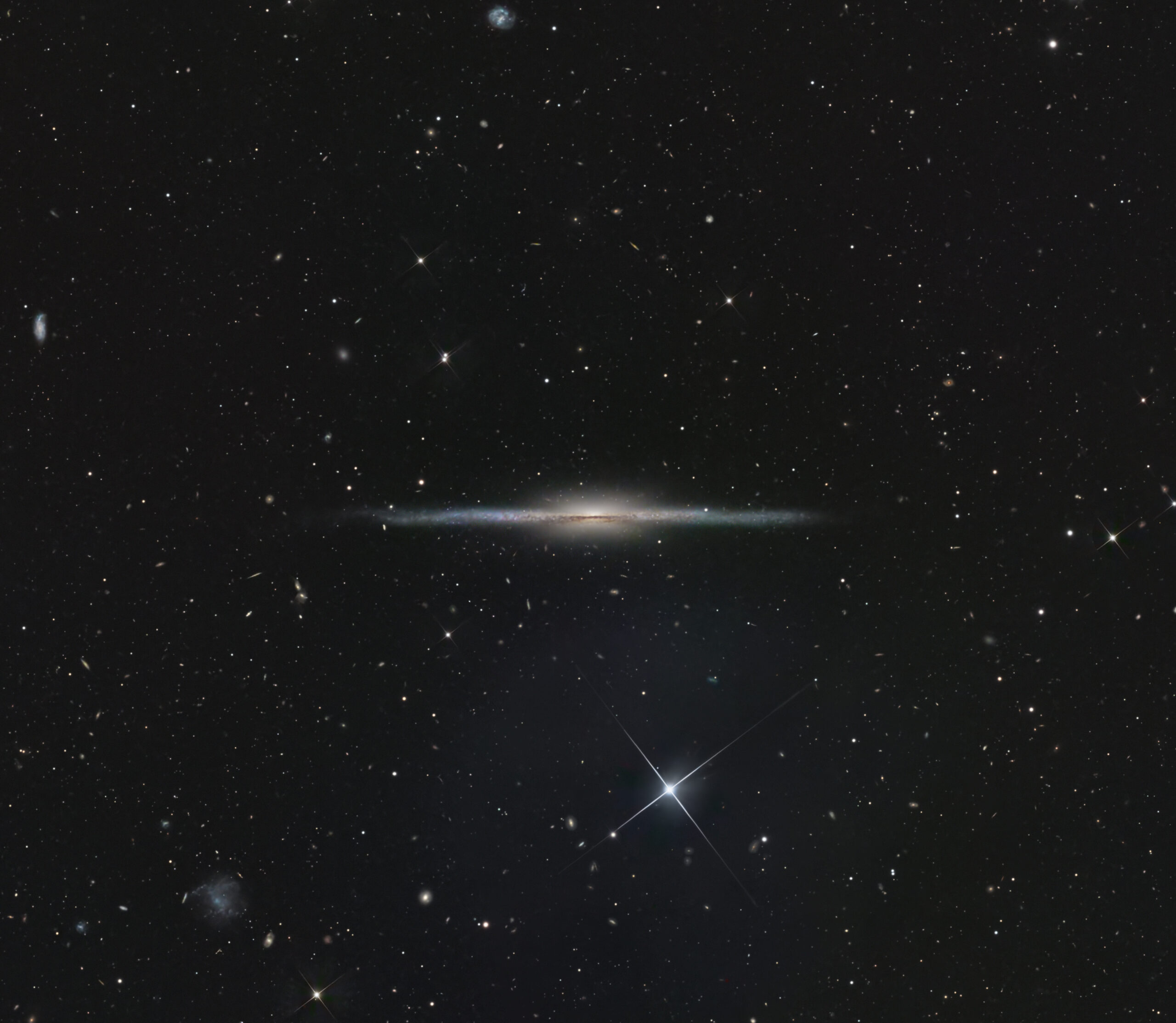
NGC 4289 — a razor-thin late-type spindle in Virgo, its needle-flat disk slicing across a deep field of resolved background galaxies
NGC 4289 is a SA(s)cd spiral galaxy in the constellation Virgo, seen essentially edge-on, catalogued as PGC 39886, UGC 7403, and as a member of the Virgo Cluster Catalog under VCC 0449
At a NED mean redshift-independent distance of ~139 million light-years and a Hubble-flow CMB distance of ~143 million light-years — the two figures in close agreement — with a small apparent size of just 4.3 × 0.5 arcminutes, a faint apparent magnitude of B 14.3, and a recession velocity of 2618 kilometers per second, the slender disk spans roughly 162,000 light-years across, more than half again the diameter of the Milky Way; the faintness is a direct consequence of its geometry and type, a low-bulge late-type disk whose light is spread thin along a slender edge-on profile rather than concentrated in a bright core, and at an absolute magnitude of only −18.8 it is intrinsically a modest, low-luminosity system despite its large physical size
Viewed at near-perfect 90-degree inclination, NGC 4289 presents an exceptionally flat, needle-like disk with only a modest rounded central bulge, the hallmark of a late-type spindle galaxy with a low bulge-to-disk ratio, and a fine dark dust lane threads the full length of the midplane with mottled brown dust visible in silhouette against the inner glow
The disk carries a distinctly bluish cast flanked by resolved knots of OB associations extending well out on both sides, consistent with the ongoing star formation flagged by NED’s HII notation, while the absence of any boxy or peanut-shaped bulge marks this as a pure dynamically cold disk seen on edge
NGC 4289 sits within the Virgo Cluster region but well off the dense core, and the surrounding frame is populated by its own deep background — a small bluish face-on spiral near the top, a ragged blue dwarf or irregular system in the lower-left quadrant, and dozens of distant edge-on and elliptical galaxies scattered across an unusually clean field made possible by the galaxy’s high galactic latitude of +65.5 degrees, where foreground Milky Way extinction falls to A_V 0.05 magnitudes
A galaxy like this is the reason edge-on spirals are so prized — the thin star-forming disk, the fine dust lane and the minimal bulge stack cleanly along the line of sight, while the transparent high-latitude window opens onto the distant galaxies scattered across the surrounding sky
Imaged in LRGB on the ASA Astrosysteme AZ 1500, Camera Moravian C5A 150M, at Observatorio El Sauce, Chile
Image Acquisition and Processing: Mike Selby