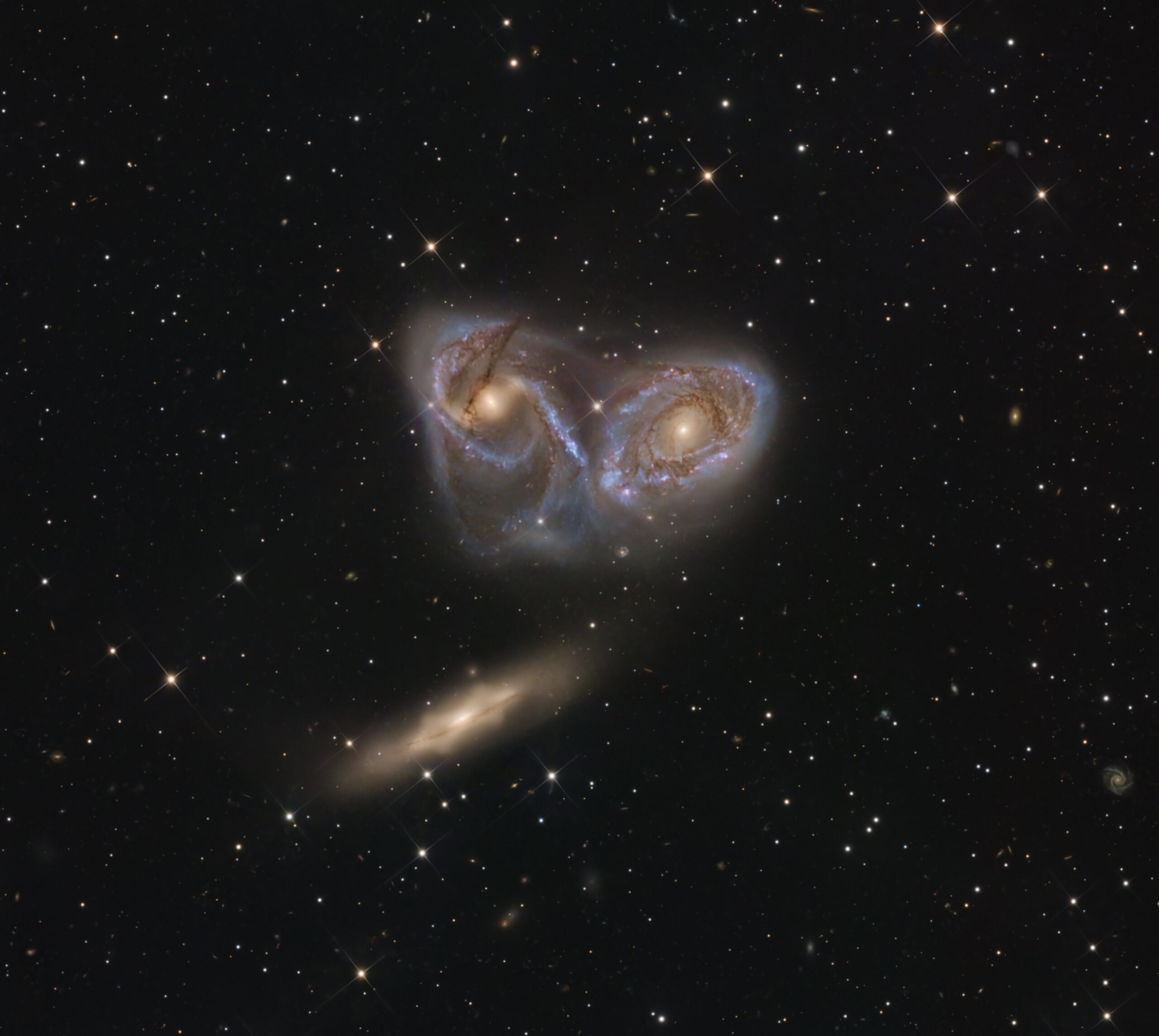
NGC 6769, 6770 and 6771 — the Devil’s Mask, a bound triplet locked in mutual distortion as stripped stars and gas knit a common envelope across the pair
NGC 6769, NGC 6770 and NGC 6771 form a strongly interacting triplet in the southern constellation Pavo, listed as VV 304 in the Vorontsov-Velyaminov atlas and the brightest members of the IC 4845 group, LGG 427
At a distance of ~199 million light-years, the system pairs two roughly equal face-on spirals, NGC 6769, a tightly wound SAB(r)b peculiar spiral at upper right at apparent magnitude V 12.6, and NGC 6770, an SBb peculiar spiral at upper left with a LINER active nucleus, while NGC 6771 lies below as an SB0-a lenticular about half as bright, seen nearly edge-on; recession velocities cluster near 3800 kilometers per second for the upper pair and around 4400 for NGC 6771, confirming a genuine physical association
The two spirals are so close that gravity has torn stars and gas from both disks and spread the stripped debris into a single faint luminous envelope wrapping the pair — and it is this apparition that names the system, for the shared halo arcs over the two glowing bulges like a brow above a pair of eyes, lending the interacting pair the eerie symmetry of a face staring out of the dark, a resemblance the European Southern Observatory captured in 2004 when it dubbed the triplet the Devil’s Mask
Bright blue OB associations and pink HII complexes trace the arms of both spirals, the signature of star formation triggered by the encounter, while a faint tidal plume drifts downward toward NGC 6771 and hints at the tenuous bridge linking all three; below them, NGC 6771 shows a warm edge-on disk anchored by a distinctly boxy bulge — a rare morphology, the dynamical fingerprint of a bar seen edge-on and of vertical heating from past interactions
Stretched by the encounter to an ESO-LV blue diameter of 6.6 arcminutes, NGC 6769 alone spans roughly 384,000 light-years, nearly four times the Milky Way, a measure of how far tidal forces can distend a galaxy and a textbook stage of a slow merger caught midway between three independent disks and the single remnant they may one day become
Imaged in LRGB on the ASA Astrosysteme AZ 1500, Camera Moravian C5A 150M, at Observatorio El Sauce, Chile
Image Acquisition and Processing: Mike Selby