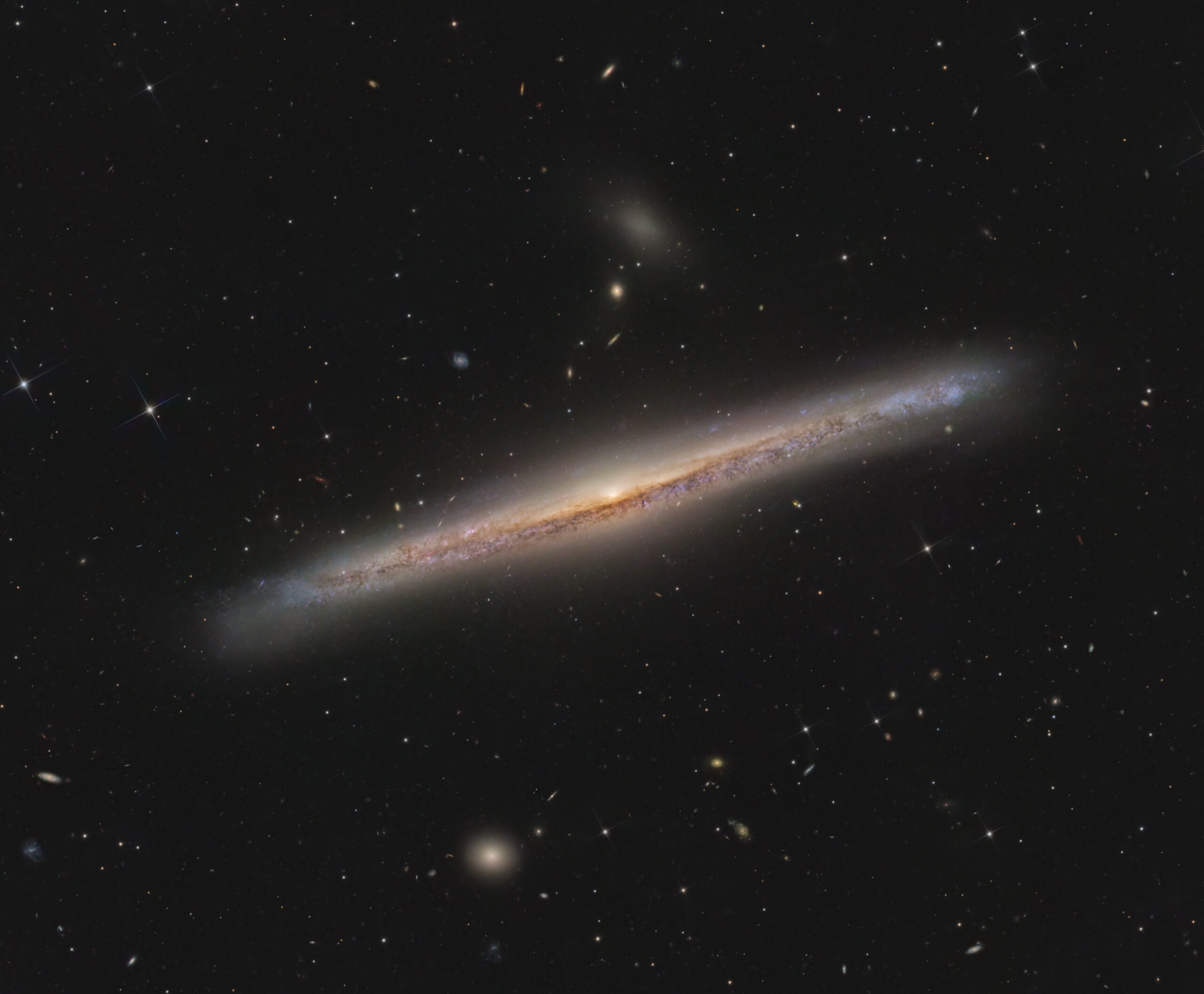
An edge-on island in Virgo — 600 globular clusters strung along its rim
NGC 5170 is a large, nearby edge-on spiral galaxy in the equatorial constellation of Virgo, classified morphologically as SA(s)c: sp — an unbarred spiral with loosely wound arms, viewed almost exactly through its disk plane
The galaxy lies at an NED mean redshift-independent distance of 26.80 ± 1.49 Mpc, approximately 87.4 million light-years, with a heliocentric recession velocity of 1,501 km/s — its ESO-LV “Quick Blue” angular diameter of 11.5 arcminutes corresponds to a derived physical diameter of about 89.9 kpc, roughly 293,000 light-years across, nearly three times the disk of the Milky Way — it shines at apparent visual magnitude 12.4, with an absolute magnitude of −21.6 marking it as a luminous, massive galactic system, and its disk is tilted at roughly 86° to our line of sight, producing the knife-edge profile that defines its visual character
The structural signature of NGC 5170 is its long, broad equatorial dust lane bisecting a luminous yellow bulge and an extended thin disk — faint warping is visible at the outer extremities, where the disk flares slightly out of the equatorial plane, a feature characteristic of isolated, low-surface-brightness spirals with massive dark halos — blue knots of ongoing star formation populate the disk, particularly toward the northwestern tip, where younger stellar populations and HII regions break through the absorbing dust, sustaining a measured star formation rate of about 1.37 solar masses per year, more than double the Milky Way’s current rate
The lenticular galaxy pair near the upper edge of the field and the smaller elliptical companions scattered across the frame belong to the same projected region of the Virgo II Groups, a chain of galaxies and small clusters trailing southward from the Virgo Supercluster
NGC 5170 sits at high galactic latitude (b ≈ +44°), giving it an unusually clean foreground free of Milky Way stars — this transparency has made it a target of choice for studies of its globular cluster system, which numerical and HST imaging studies estimate at approximately 600 ± 100 globulars, far richer than the Milky Way’s roughly 150 — the galaxy is also notable for its massive dark halo of around 3.4 × 10¹² solar masses and its thin, low-surface-brightness disk, modeled as one of the cleanest examples of a quiescent, dynamically cold spiral in the local universe
Imaged in LRGB on the ASA Astrosysteme AZ 1500, Camera Moravian C5A 150M, at Observatorio El Sauce, Chile
Image Acquisition and Processing: Mike Selby