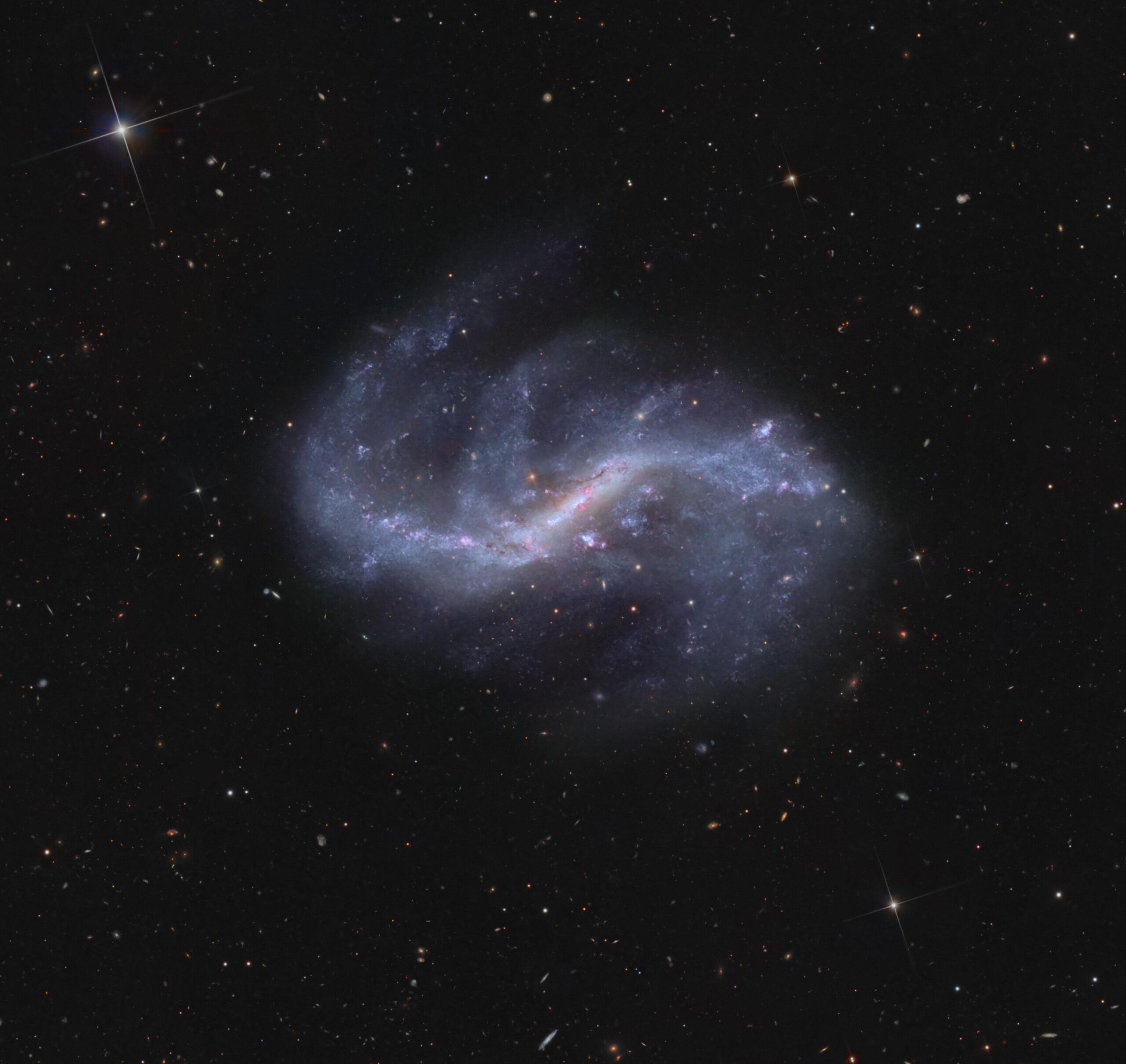
A barred spiral pulled out of shape — the lopsided “Sea Slug” of the Virgo II Groups
NGC 4731 is a distorted late-type barred spiral galaxy in the constellation Virgo, classified as SB(s)cd — a system with a strong, elongated central bar, no inner ring, and loosely wound spiral arms emerging from the bar ends. Its appearance is striking and unmistakably disturbed, with the two arms developing in profoundly asymmetric fashion under the influence of past or ongoing gravitational interaction. The galaxy hosts a low-luminosity active nucleus and is catalogued as a Seyfert 2 system.
Located at a Hubble-flow distance of approximately 88 million light-years, NGC 4731 spans about 162,000 light-years across, with an apparent angular size of roughly 6.3 × 2.1 arcminutes and an apparent blue magnitude near 12.0. Its inclination of around 71 degrees presents the disk at a moderate tilt that emphasises the elongation of its bar and the dramatic divergence of its outer arms.
The structure is dominated by a long, luminous central bar that runs across the inner disk, threaded with knotty dust lanes and punctuated by bright pink H II regions marking active star formation at the bar’s tangent points and along its leading edges. From the northeast end of the bar, a thin, almost straight stellar filament extends far outward before bending gently back — a striking signature of tidal stretching. The opposite arm, emerging from the southwest end of the bar, is broader and more diffuse, fanning out into a soft, shell-like outer envelope that fades into a faint halo of disturbed disk material. Scattered blue knots of young stars and pink emission complexes populate both arms, while the underlying disk shows an asymmetric brightness distribution consistent with a system whose dynamics have been substantially reshaped.
NGC 4731 belongs to the NGC 4697 Group, part of the Virgo II Groups extending southward from the Virgo Supercluster. Its small irregular companion NGC 4731A lies just outside this field of view to the south, and gravitational interactions with that companion — as well as with the nearby galaxy NGC 4967 — are thought to be responsible for the galaxy’s extraordinary tidal asymmetry and the unusually extended, lopsided arms that give it its informal nickname, the “Sea Slug.”
In NGC 4731 we see a galaxy mid-transformation — its bar still driving gas inward to fuel star formation and a modest active nucleus, while its outer disk is simultaneously being stretched, torqued, and reorganised by external gravitational forces. The result is a system caught between secular bar-driven evolution and externally driven tidal sculpting, illustrating how barred spirals in group environments can develop the most extreme and beautifully irregular morphologies in the local universe.
Imaged in LRGB on the ASA Astrosysteme AZ 1500, Camera Moravian C5A 150M, at Observatorio El Sauce, Chile. Image Acquisition and Processing: Mike Selby