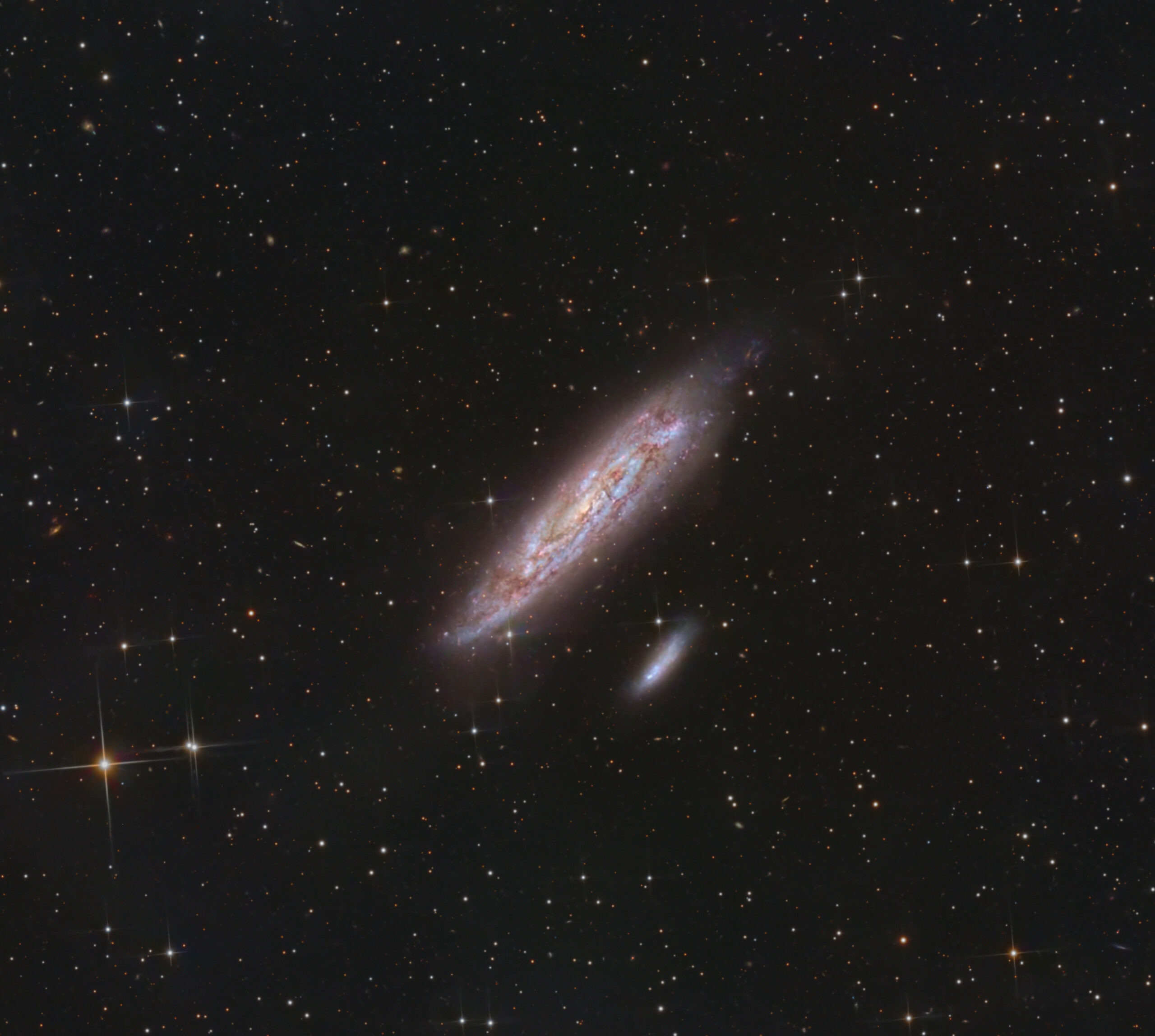
Dust, fire, and starlight on a tilted disk — with a small companion in tow
NGC 4835 is a luminous intermediate spiral galaxy in the constellation Centaurus, classified as SAB(rs)bc — a mixed-family system with a weakly developed bar, an inner pseudo-ring, and moderately wound spiral arms. The galaxy is presented at a steep inclination of roughly 75 to 80 degrees, foreshortening the disk into a long elongated form and revealing its internal structure in striking cross-section.
Located at a distance of approximately 75.6 million light-years, NGC 4835 spans about 88,000 light-years across, with an apparent angular size of roughly 4.0 × 0.9 arcminutes and a visual magnitude near 12.4. Modest in brightness for its size, it nevertheless resolves into a richly textured disk under deep, high-resolution imaging.
The structure of NGC 4835 is dominated by a complex dust lane that cuts across the near side of the inclined disk, partially obscuring the elongated central bulge and producing the characteristic dark spine seen in steeply tilted spirals. Strung along the disk on either side of the dust are numerous bright pink H II regions — emission complexes marking active sites of massive star formation — interleaved with clusters of young blue stars that trace the underlying spiral pattern. The disk shows a mild asymmetry in surface brightness, with the southwestern end appearing slightly flared and more loosely structured than the northeastern end. The compact, slightly elongated core glows with a warmer, yellow-tinted stellar population and is suspected of harbouring a low-luminosity active galactic nucleus.
Immediately south of NGC 4835 lies its small companion PGC 516792, a faint edge-on Sd-type spiral viewed perfectly side-on. With a heliocentric velocity of 2228 km/s — only about 47 km/s greater than that of NGC 4835 — the pair share the same velocity space and lie at compatible distances, marking them as genuine members of the loose galaxy grouping catalogued as LDC 939. PGC 516792 lies at approximately 100 million light-years, spans about 24,000 light-years across, and shines at total corrected blue magnitude 14.3 with an absolute magnitude near −18.1 — a small, low-mass disk galaxy roughly four times smaller than its larger neighbour. Despite the proximity in projection, neither galaxy shows obvious signs of tidal disturbance, suggesting that any gravitational interaction between them remains gentle, distant, or of long duration.
Together, the pair occupies a quiet southern region of the sky and embodies the ordinary, slow evolution of disk galaxies in low-density environments — steady star formation in NGC 4835’s tilted disk, the unhurried turning of its smaller neighbour, and the slow gravitational dance of a small galaxy group continuing largely undisturbed by major mergers or close encounters
Imaged in LRGB on the ASA Astrosysteme AZ 1500 Camera Moravian C5A150Mat Observatorio El Sauce, Chile.
Image Acquisition and Processing: Mike Selby
www.throughlightandtime.com
www.instagram.com/throughlightandtime/
www.facebook.com/masterdarksastro/