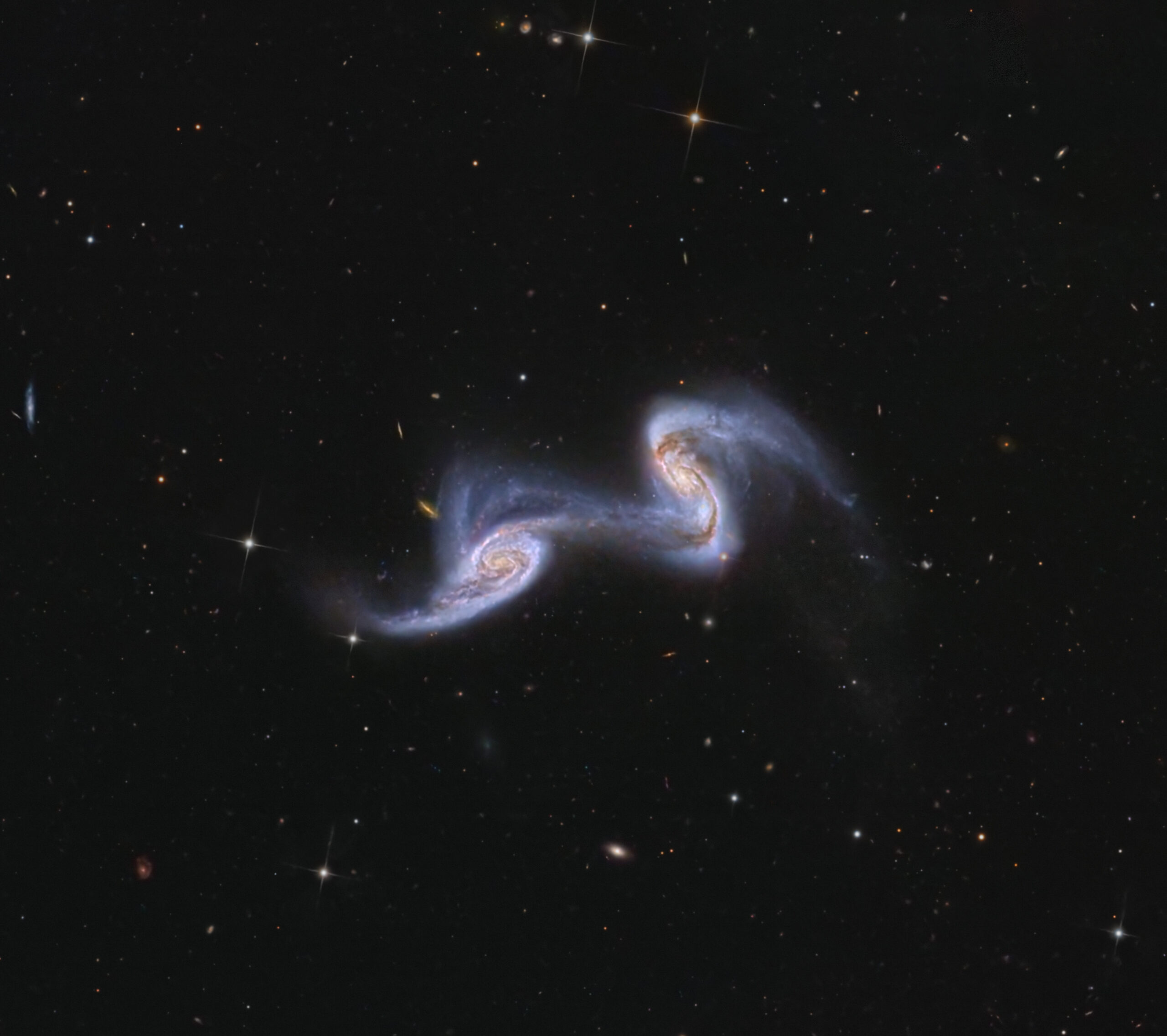
A luminous bridge of stars and gas links two spiral galaxies on a path toward merger
NGC 5257 and NGC 5258 form the interacting system Arp 240 in the constellation Virgo. “Arp” refers to the Atlas of Peculiar Galaxies, compiled by Halton Arp, which catalogs galaxies with unusual or distorted structures—typically the result of gravitational interactions. NGC 5257 is classified as SAB(s)b pec, a weakly barred spiral galaxy whose structure has been significantly disturbed by tidal forces from its companion. Its spiral arms are stretched and asymmetric, and a prominent tidal bridge connects the pair, marking the ongoing exchange of stars and gas between them
NGC 5257 lies approximately 341 million light-years away. It has an apparent size of about 1.6 × 0.8 arcminutes, corresponding to a physical diameter of roughly 159,000 × 79,000 light-years. The system is also identified as an HII luminous infrared galaxy, indicating enhanced star formation triggered by the interaction, particularly along the distorted arms and within the connecting bridge
The tidal bridge is the defining feature of this system—a stream of material drawn out by gravity as the galaxies orbit one another. The spiral arms of NGC 5257 appear unusually open and irregular, with prominent blue star-forming regions tracing areas of compression and instability. The core remains intact but is dynamically influenced, with gas likely funneled inward, sustaining elevated star formation.
The pair is gravitationally bound and is expected to merge over the next several hundred million years. As the interaction progresses, their structures will become increasingly disrupted before ultimately coalescing into a single, more massive galaxy, preserving only faint traces of their original spiral forms
Imaged in LRGB on the ASA Astrosysteme AZ 1500 at Observatorio El Sauce, Chile.
Image Acquisition and Processing: Mike Selby