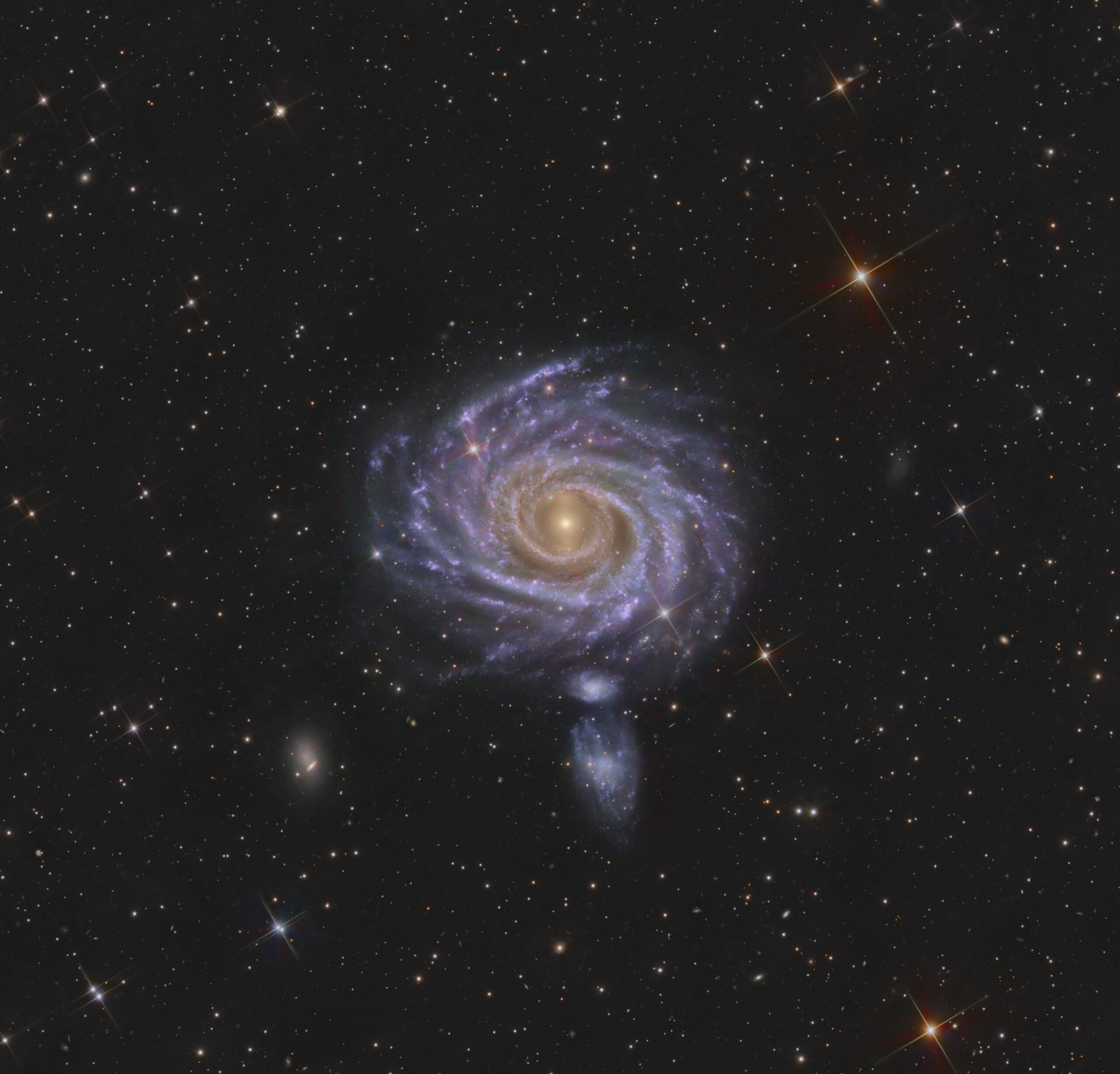
A luminous spiral shaped by ongoing star formation, quietly evolving in the depths of Vela
NGC 3261 is a barred spiral galaxy classified as SB(rs)b, located in the constellation Vela
Its structure reveals a well-defined central bar feeding into moderately wound spiral arms, with a subtle inner ring-like feature guiding material outward into the disk. The galaxy is also an Hα emission-line system, indicating active star formation distributed along its spiral arms
At a mean redshift-independent distance of approximately 88 million light-years, NGC 3261 spans an apparent size of 3.2 × 2.8 arcminutes, corresponding to a physical diameter of roughly 82,000 light-years. This places it somewhat smaller than the Milky Way, yet still a substantial spiral with clearly organized structure
The spiral arms are rich in young, blue stellar populations, interspersed with darker dust lanes that trace the underlying density waves. Numerous star-forming regions punctuate the arms, contributing to the galaxy’s textured and slightly knotty appearance. The central bulge, dominated by older stars, shows a warm golden tone that contrasts with the cooler outer disk, reflecting the underlying stellar population gradient
A small companion galaxy appears just below the main disk, and a faint distorted structure extends further downward, suggesting a minor interaction or tidal influence. While not a dramatic merger, these features hint at gravitational interplay that may have subtly influenced the spiral pattern and triggered localized star formation
Imaged in LRGB on the ASA Astrosysteme AZ 1500 at Observatorio El Sauce, Chile.
Image Acquisition and Processing: Mike Selby