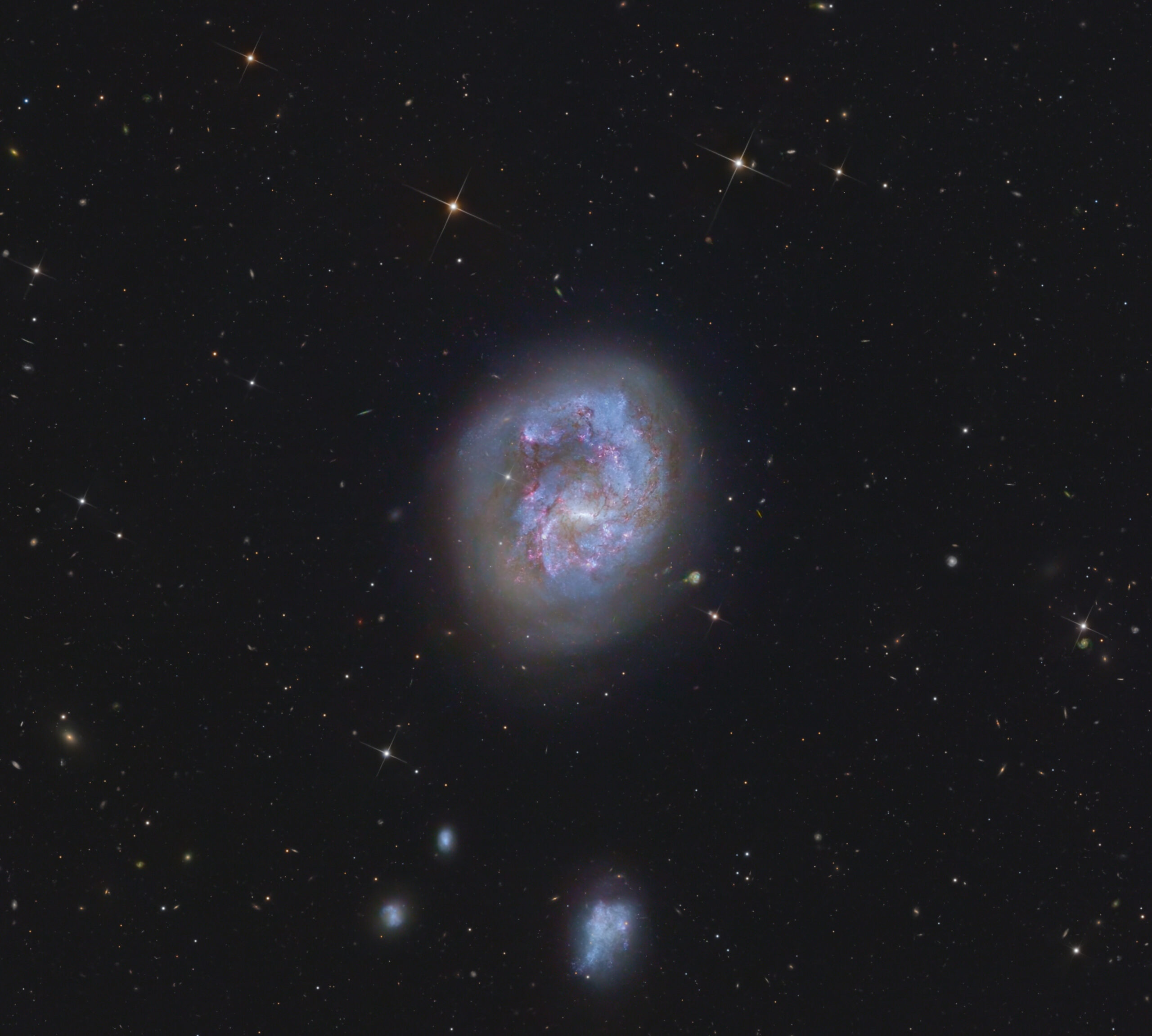
A spiral galaxy pulled off balance, its structure reshaped into a sweeping tidal arc
NGC 4027 is a barred spiral galaxy of morphological type SB(s)dm pec, located in the constellation Corvus. Its striking asymmetry is driven by an ongoing gravitational interaction with its companion NGC 4027A, visible just below, which has disrupted the galaxy’s original spiral pattern
At a distance of approximately 83 million light-years, NGC 4027 spans about 3.2 × 2.4 arcminutes, corresponding to a physical size of roughly 75,000 light-years. While modest in scale, it stands out as one of the clearest nearby examples of a tidally distorted spiral galaxy
Its defining feature is the dominant, elongated spiral arm, which wraps around the galaxy in a pronounced arc, giving rise to its “ringtail” appearance. Unlike a regular spiral arm, this structure shows a subtle change in curvature, reflecting its origin as a tidally driven feature rather than a stable density wave. Along this arc, patchy clusters of blue star-forming regions appear unevenly distributed, the result of localized gas compression triggered by the interaction. On the opposite side, the secondary arm is weak and truncated, leaving the galaxy effectively in a one-armed, or m=1, configuration
The inner structure also reveals the disturbance: the bar is slightly offset, and the transition from core to disk is unusually soft, suggesting that the stellar distribution has been dynamically heated and redistributed. Dust lanes appear fragmented rather than continuous, further indicating that the gas disk has been disrupted. Beyond the main structure, the outer halo is asymmetric, extending farther along the dominant arm while dropping off more abruptly elsewhere, hinting at the early stages of a tidal envelope. There is also a subtle elongation toward NGC 4027A, a faint signature of the gravitational connection between the two galaxies
NGC 4027 provides a vivid example of how tidal forces can transform a galaxy, driving it away from symmetry and into a dynamically evolving state. The emergence of its single dominant arm captures a transient phase in galactic evolution, where gravitational interaction reshapes both structure and star formation across tens of thousands of light-years
Imaged in LRGB on the ASA Astrosysteme AZ 1500 at Observatorio El Sauce, Chile.
Image Acquisition and Processing: Mike Selby