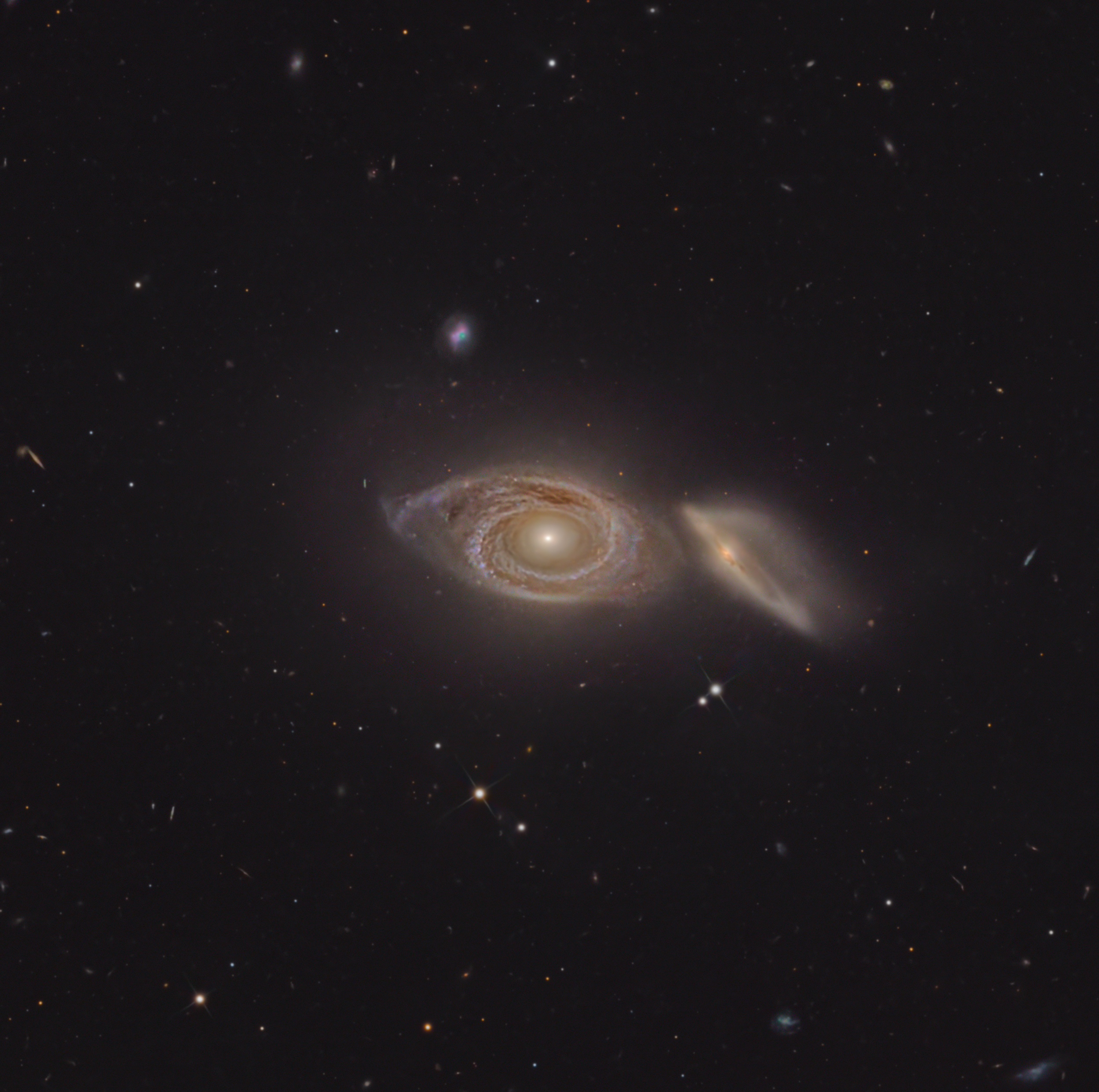
A spiral galaxy caught in the first pull of a gravitational encounter
NGC 3667 is an interacting spiral galaxy system in the constellation Crater, morphologically classified as (R′)SA(rs)ab?, showing a well-defined central bulge and moderately wound spiral arms that are now visibly distorted by a nearby companion, commonly referred to as NGC 3667B. The interaction between the two galaxies is subtle but clearly present, with tidal forces beginning to reshape the outer disk and create faint extensions of material between them
Based on NED redshift-independent measurements, NGC 3667 lies at a distance of approximately 277 million light-years. Its angular size of 1.5 × 1.1 arcminutes corresponds to a physical diameter of about 121,000 light-years, placing it among the larger spiral galaxies. The companion, NGC 3667B, with an angular size of 1.4 × 0.6 arcminutes, spans roughly 113,000 × 48,000 light-years, indicating a substantial galaxy rather than a minor satellite
The interaction is expressed through asymmetries in the spiral structure, where the arms appear uneven and slightly stretched, along with a diffuse luminous envelope surrounding both galaxies. These features reflect tidal forces redistributing stars and gas, a process that can eventually trigger star formation and reshape both systems over time. The companion itself shows a smooth, elongated structure, likely influenced by the same gravitational exchange.
Beyond the pair lies a dense background field of distant galaxies, many visible as faint elongated smudges—each one a far more distant system, adding depth and context to the scene and emphasizing that such interactions are part of a much larger cosmic environment
Imaged in LRGB on the ASA Astrosysteme AZ 1500 at Observatorio El Sauce, Chile.
Image Acquisition and Processing: Mike Selby