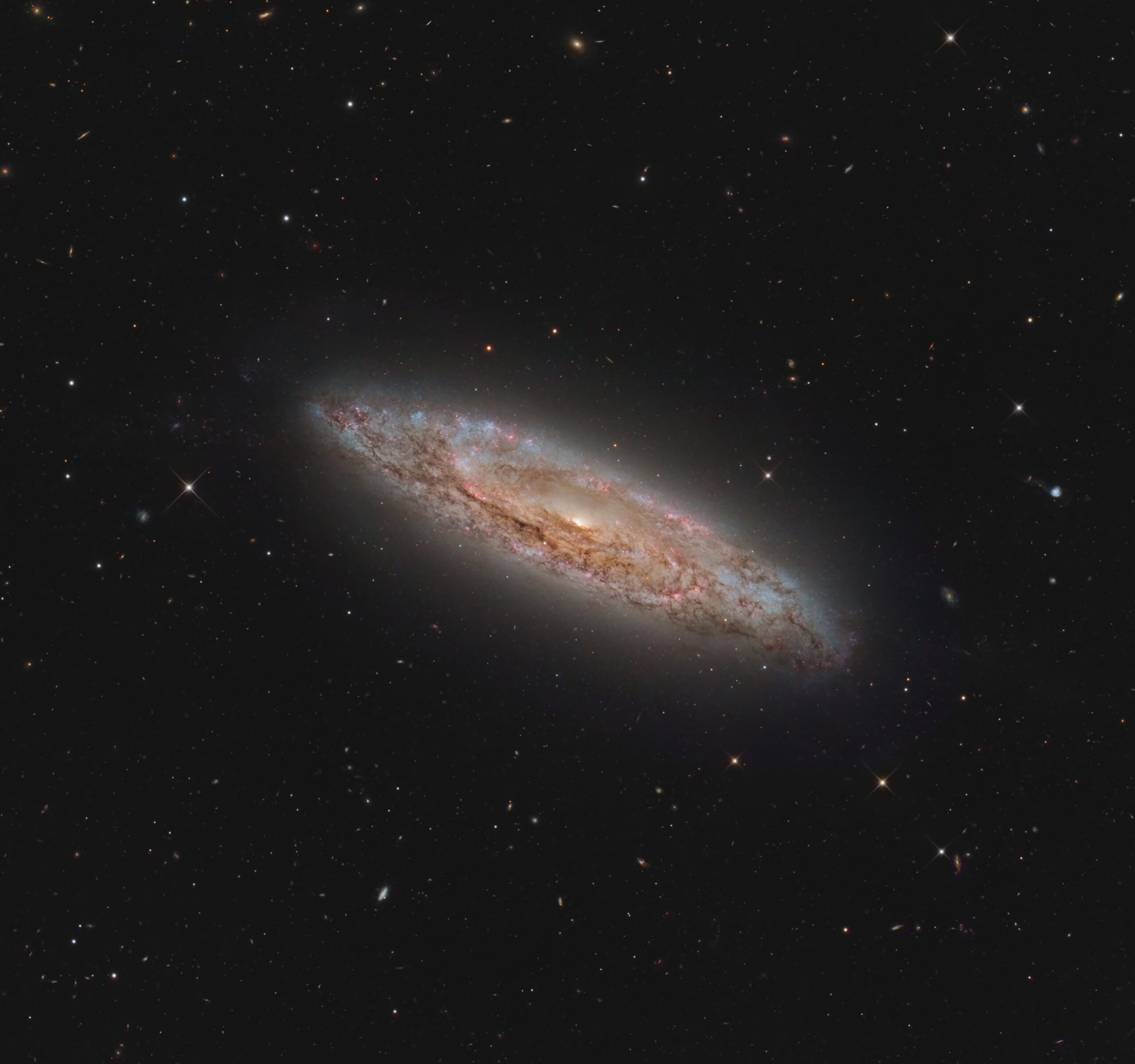
A galaxy split by dust and lit by starbirth
NGC 4527 is a bright intermediate barred spiral galaxy, classified as SAB(s)bc, lying in the constellation Virgo. Its light has travelled about 45.2 million years to reach us, and on the sky it spans about 6.2 × 2.1 arcminutes, corresponding to a physical size of roughly 81,000 × 27,000 light-years.
Seen at this dramatic inclination, NGC 4527 reveals a richly textured disk crossed by strong, uneven dust lanes that partially veil its bright central regions. The warm inner bulge glows through this absorbing material, while the outer spiral structure is laced with bluish stellar light and scattered pink star-forming regions. The result is a galaxy that feels active and layered, with both obscuration and starbirth visible in the same sweeping structure.
This system is especially notable for its disturbed, asymmetrical appearance. The dust lane is not clean or perfectly regular, and the spiral arms show patchy, clumpy structure rather than a highly ordered grand-design pattern. That gives NGC 4527 a more dynamic and physically interesting character, suggesting a disk shaped by internal activity and ongoing star formation rather than pure symmetry.
NGC 4527 is also historically important as the host of Supernova 1991T, one of the best-known Type Ia supernovae ever observed. That event made this galaxy important not only visually, but also in the study of cosmic distance measurement and supernova physics
Imaged in LRGB on the ASA Astrosysteme AZ 1500 at Observatorio El Sauce, Chile.
Image Acquisition and Processing: Mike Selby