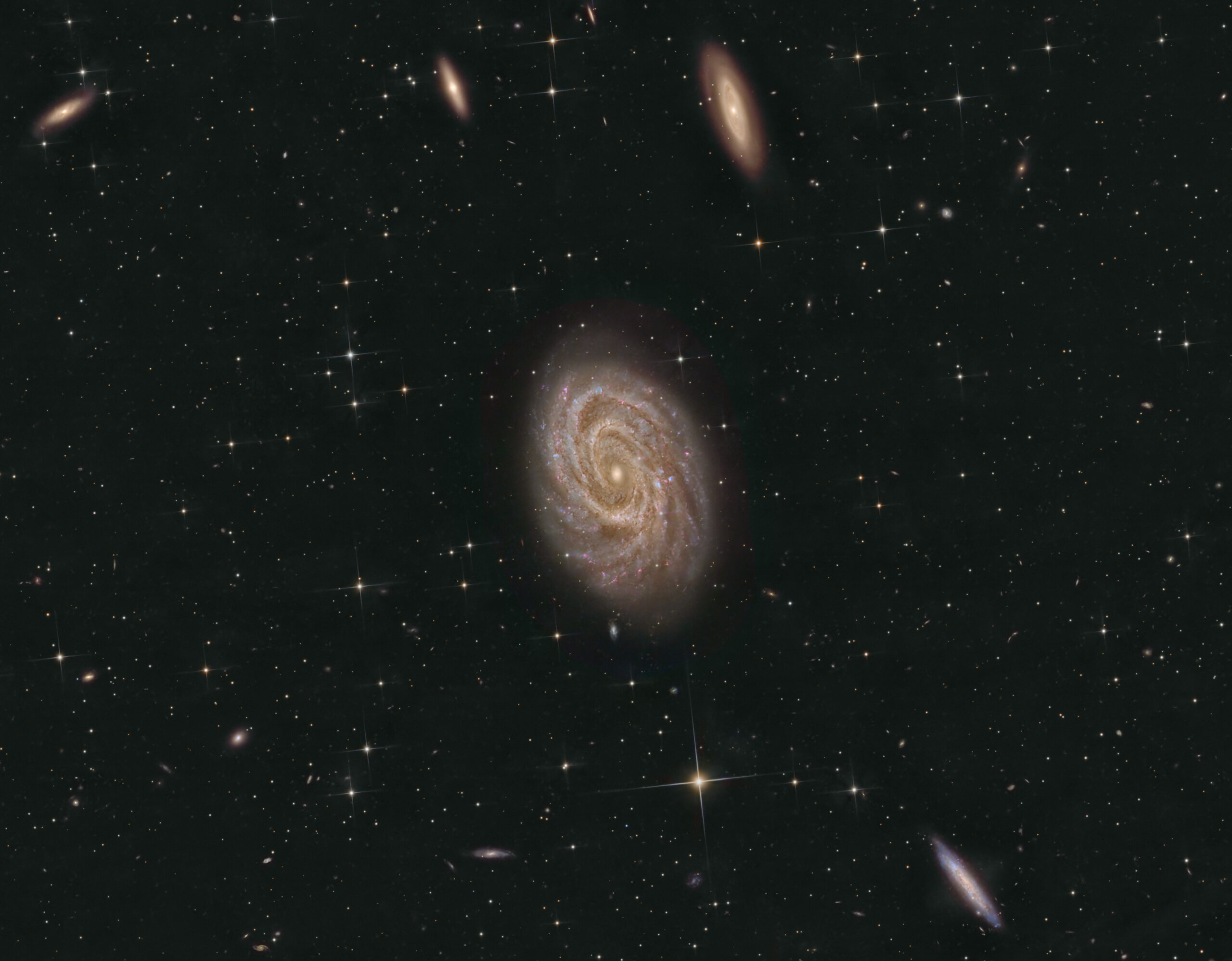
A distant spiral unfolding across deep space, surrounded by a rich background field of galaxies
NGC 4603 is a late-type spiral galaxy in the constellation Centaurus. Catalog classifications list it as SA(s)c? in RC3, with alternative entries such as SA(rs)bc, reflecting some uncertainty in its internal structure. Based on the structure resolved in this dataset, the morphology appears more consistent with SA(rs)bc: an unbarred spiral with a subtle inner pseudo-ring tendency and moderately open arms that retain more coherence than a fully flocculent Sc system, yet are not tightly wound enough for an Sb classification.
NGC 4603 lies at a distance of approximately 115 million light-years (NASA/IPAC Extragalactic Database). In this view, its visible extent is about 3.4 × 2.6 arcminutes, corresponding to a physical size of roughly 115,000 × 88,000 light-years.
The galaxy exhibits a fragmented but structured spiral pattern, with numerous star-forming regions embedded within its arms and faint dust features tracing the inner disk. Its color appears noticeably muted compared to more actively star-forming spirals, with softer blue tones and limited red H II contrast. This is largely due to a combination of factors: the galaxy hosts a moderate, rather than intense, level of star formation; its light is dominated in part by older, more neutral stellar populations; and at this distance many individual star-forming regions are not fully resolved, causing their light to blend into the surrounding disk and reduce overall color contrast. The result is a more subtle, low-contrast chromatic appearance than is typically seen in closer or more active spiral galaxies. The central bulge is compact and luminous, transitioning into asymmetric spiral arms that show a mild lopsidedness, with one side more strongly developed than the other. A subtle inner curvature around the core suggests a weak pseudo-ring, while beyond the main arms a faint, extended envelope reveals a larger low surface brightness disk.
The surrounding field is densely populated with distant galaxies of varying morphology, adding depth and scale to the scene and emphasizing the vast distances along this line of sight.
NGC 4603 is also historically significant as one of the first galaxies beyond the Virgo Cluster in which Cepheid variable stars were measured using the Hubble Space Telescope, contributing to early calibration of the extragalactic distance scale
Imaged in LRGB on the ASA Astrosysteme AZ 1500 at Observatorio El Sauce, Chile.
Image Acquisition and Processing: Mike Selby