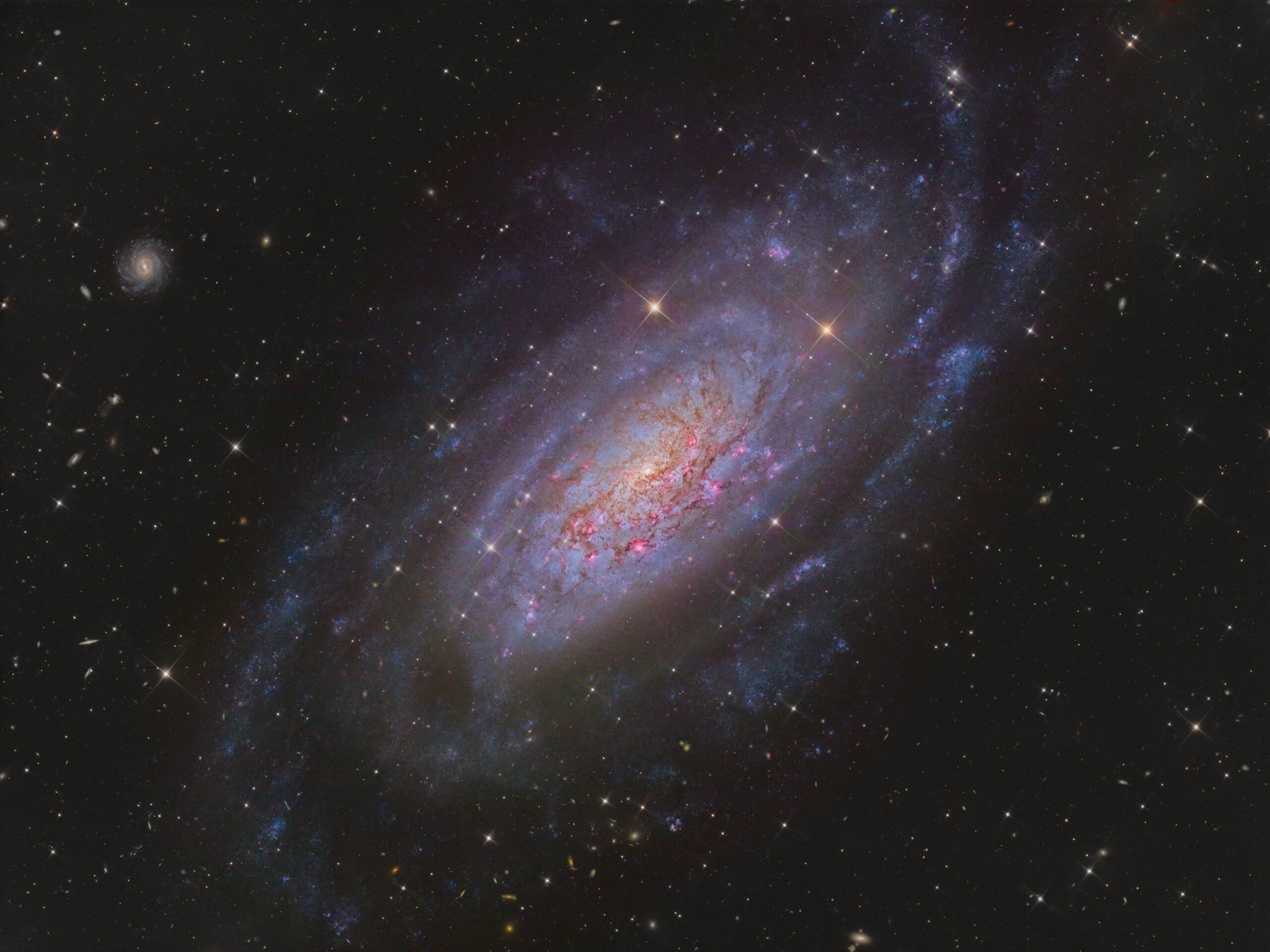
A nearby spiral where individual stars begin to emerge from the galactic tapestry
NGC 3621 is a late-type spiral galaxy classified as SA(s)d, located in the constellation Hydra. It is a flocculent system, meaning its spiral arms are fragmented and irregular, shaped by localized bursts of star formation rather than large-scale density waves. The galaxy lacks both a prominent bar and a significant central bulge, giving it a loose, patchy structure dominated by its disk.
At a distance of about 21.9 million light-years, NGC 3621 spans roughly 66,500 light-years in diameter, with an apparent size of approximately 204 × 97 arcseconds. Its relative proximity makes it particularly valuable observationally, as the disk begins to resolve into individual luminous components rather than appearing fully smooth.
Across the spiral arms, numerous bright blue knots mark active star-forming regions, while pink HII regions trace ionized hydrogen surrounding young, massive stars. In the outer disk and along the brighter arm segments, some of the most luminous supergiant stars and compact stellar groupings can indeed be resolved as discrete points, especially in high-resolution imaging. These are not typical stars like those seen in the Milky Way foreground, but extremely luminous stellar populations and clusters within NGC 3621 itself, standing out against the unresolved background of fainter stars.
Dark dust lanes cut through the inner regions, adding contrast and depth, while the nucleus remains relatively small and subdued. Despite its weak bulge, NGC 3621 hosts a low-luminosity active galactic nucleus, an unusual feature that challenges the conventional link between prominent bulges and central black holes.
This combination of proximity, active star formation, and loosely organized structure makes NGC 3621 an excellent example of how spiral galaxies can evolve and sustain star formation without strong internal drivers
Imaged in LRGB and H alpha on the ASA Astrosysteme AZ 1500 at Observatorio El Sauce, Chile.
Image Acquisition and Processing: Mike Selby