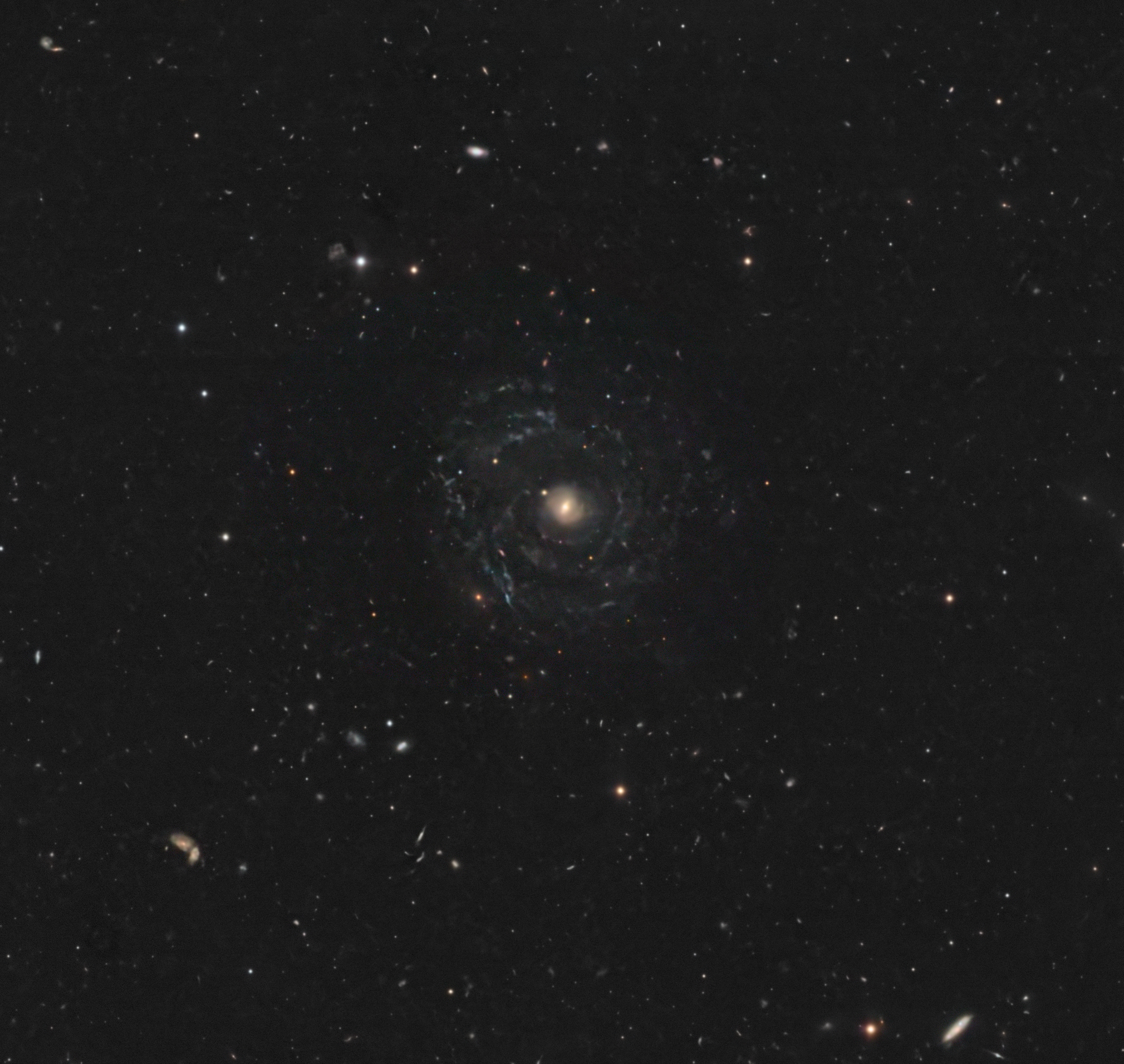
A galaxy so diffuse it nearly vanished into misclassification
Malin 1 is a giant low surface brightness spiral galaxy (SB0/a–SBa LSB) located in the constellation Coma Berenices. The LSB disk has a magnitude of 25.7 mag/arcsec² while the outer disk has a magnitude of 30 mag/arcsec² which has made it virtually invisible in normal surveys.
It was discovered in 1986 by David Malin and Michael Bothun using deep photographic imaging at the Anglo-Australian Telescope. At the time, only its bright central region was visible, leading to its initial classification as an elliptical or lenticular system.
It was only with observations from the Hubble Space Telescope in 2016 that the true nature of the galaxy was firmly established. This data showed that Malin 1 possesses a relatively normal inner barred disk embedded within an enormous, extremely faint outer spiral disk—confirming it as a giant low surface brightness spiral galaxy.
At a distance of approximately 1.2 billion light-years, Malin 1 is among the largest known spiral galaxies. Its bright inner region spans roughly 1 arcminute, while the full extent of its diffuse outer disk reaches about 3 arcminutes, corresponding to an extraordinary physical diameter of nearly 650,000 light-years, vastly exceeding that of typical spirals.
One of the few amateur images to clearly reveal the immense low surface brightness disk of Malin 1, this view captures the delicate, ghostlike spiral structure embedded within an enormous disk of stars so sparsely distributed that they barely rise above the cosmic background. The faint arms trace regions of limited star formation within a system that has evolved in relative isolation, allowing it to grow to an immense scale without ever becoming luminous.
Malin 1 remains an extreme example of galactic structure—where size, mass, and visibility diverge dramatically—offering a rare glimpse into a class of galaxies that challenge conventional models of formation and evolution
Imaged in LRGB on the ASA Astrosysteme AZ 1500 at Observatorio El Sauce, Chile.
Image Acquisition and Processing: Mike Selby