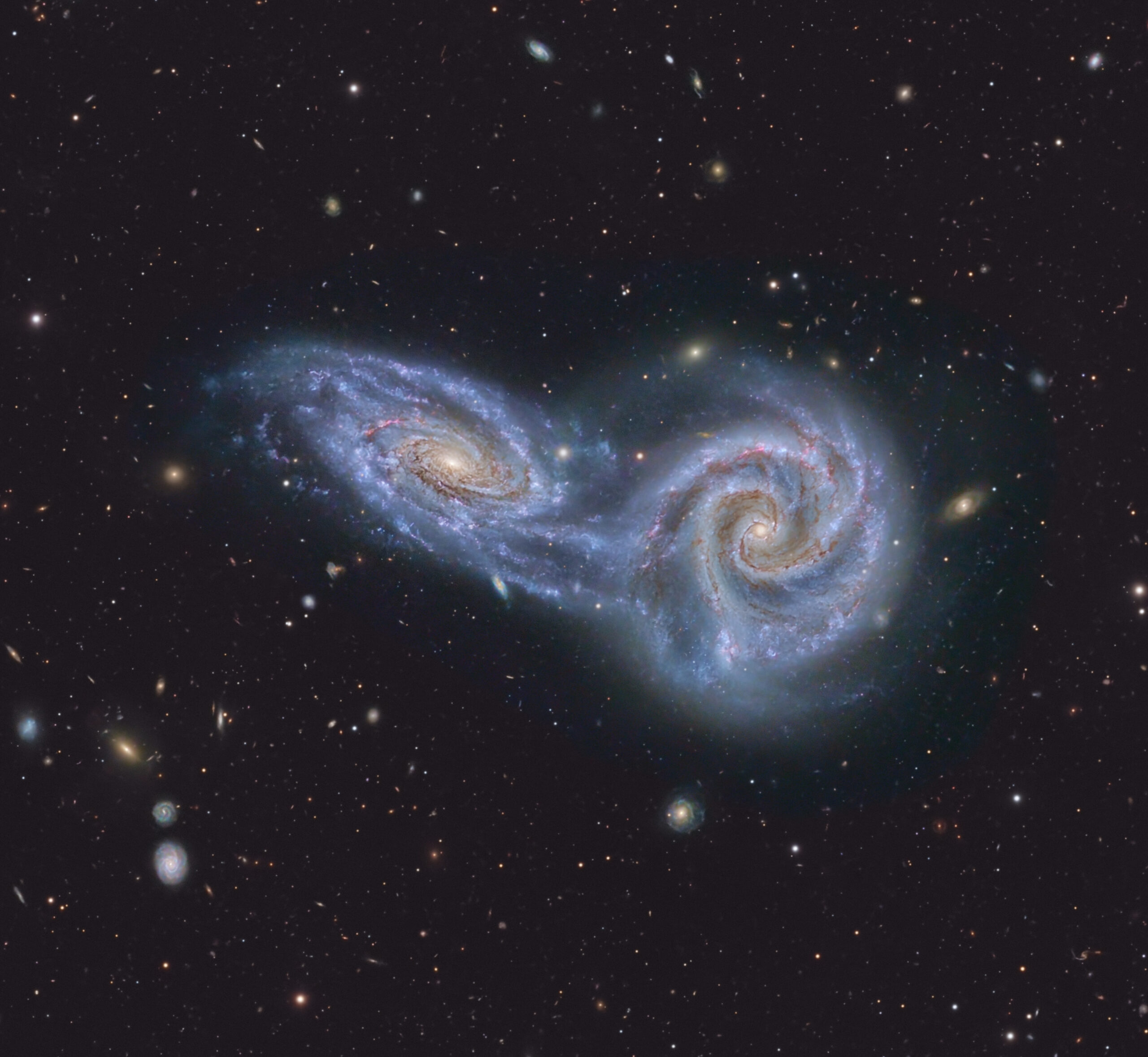
Two spiral galaxies caught mid-encounter, their gravity weaving a tidal bridge of stars that marks the first steps of a future merger
Arp 271 is the interacting galaxy pair formed by NGC 5426 and NGC 5427, two nearly equal spiral galaxies in the constellation Virgo. Both galaxies are classified morphologically as SA(s)c pec, indicating unbarred spiral systems whose structures have been visibly distorted by tidal interaction. Their gravitational encounter has stretched the disks and created a luminous bridge of material between them, revealing a system caught in the early stages of a slow galactic collision.
The pair lies at a mean redshift-independent distance of about 108.7 million light-years. NGC 5426 has an apparent diameter of about 3.02 arcminutes, corresponding to a physical size of roughly 95,500 light-years, while its companion NGC 5427 is of comparable scale. Their similar masses and close proximity make the system a striking example of two spiral galaxies undergoing a major gravitational interaction.
One of the most remarkable features of Arp 271 is the tidal bridge connecting the galaxies. This structure is composed of gas, dust, and stars pulled from their disks by tidal forces. Spectroscopic observations show that hydrogen gas is actually flowing from NGC 5426 toward NGC 5427, making this system one of the clearer examples of intergalactic gas transfer during a spiral–spiral encounter. As this gas is compressed along the bridge and within the distorted spiral arms, it triggers bursts of star formation, visible as reddish H-II regions embedded within the bright blue stellar arms.
The interaction has distorted the two galaxies in different ways. NGC 5427 retains a relatively well-defined spiral structure but shows asymmetric arms and an expanded outer disk shaped by tidal forces. NGC 5426 appears more elongated and disrupted, with its spiral pattern stretched toward its companion and faint outer tidal disturbances beginning to form in its outer disk. These features trace the gravitational torque produced during their close passage.
Arp 271 represents an early stage of a future merger. The galaxies have likely already experienced a first close encounter that produced the tidal bridge and the distortions now visible. Over the next roughly 500 million to about 1 billion years, gravitational forces will continue to draw material from both disks, forming longer tidal tails and gradually shrinking their separation until the two spirals ultimately merge into a single larger galaxy.
This view captures the system during that transitional phase—when two massive spiral galaxies remain distinct, yet are already linked by gravity as tidal forces pull stars, gas, and dust into the luminous bridge between them
Imaged in LRGB on the ASA Astrosysteme AZ 1500 at Observatorio El Sauce, Chile.
Image Acquisition and Processing: Mike Selby