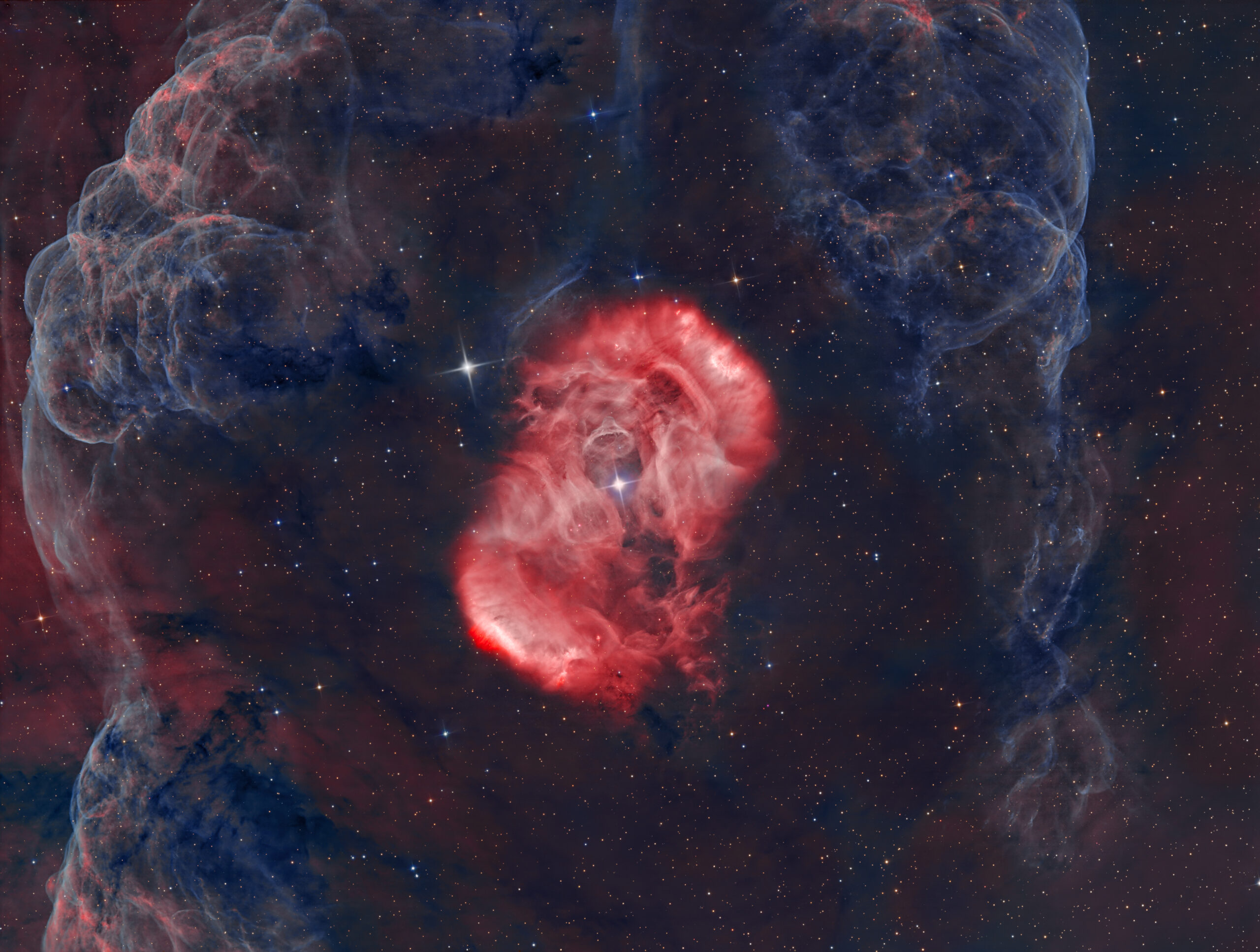
A Rare Glimpse of a Wolf–Rayet Nebula and the Turbulent Legacy of a Massive Star
NGC 6164 and NGC 6165 form a striking emission nebula sculpted by the powerful stellar winds of the massive Wolf–Rayet star HD 148937. Located in the southern constellation Norma, this glowing shell of gas is often called “The Dragon’s Egg.” The nickname comes from its proximity on the sky to the nearby Fighting Dragons of Ara Nebula (NGC 6188), whose sweeping arcs resemble battling dragons—making this compact nebula appear like a luminous egg left behind by those mythical creatures.
The nebula lies about 4,200 light-years from Earth. The bright bipolar ejecta surrounding HD 148937 spans roughly 10 light-years across and appears about 7 × 5 arcminutes in angular size on the sky. Fainter emission extends well beyond the inner shell, revealing a much larger wind-blown cavity carved into the surrounding interstellar medium by the star’s intense radiation and stellar wind.
Several remarkable structures stand out in this view. The central region forms a bipolar shell of hydrogen-rich gas, where two opposing lobes expand away from the central star. Along these lobes, intricate shock-compressed filaments and turbulent arcs trace the collision between fast stellar winds and slower material expelled during earlier evolutionary stages of the star. Surrounding the red ejecta, faint bluish arcs of doubly ionized oxygen outline the larger stellar-wind bubble. In places, thin transition filaments between these layers reveal the complex hydrodynamic interactions that shape the nebula as the Wolf–Rayet wind continues to sweep through the surrounding gas.
NGC 6164 is a rare example of a Wolf–Rayet ejecta nebula, capturing a dramatic phase in the life of a massive star. The powerful winds from HD 148937 continue to sculpt and accelerate the surrounding gas, offering astronomers a glimpse into the processes that shape the final evolution of massive stars before they ultimately end their lives in catastrophic supernova explosions
Imaged in HOO RGB on the ASA Astrosysteme AZ 1500 at Observatorio El Sauce, Chile.
Image Acquisition and Processing: Mike Selby