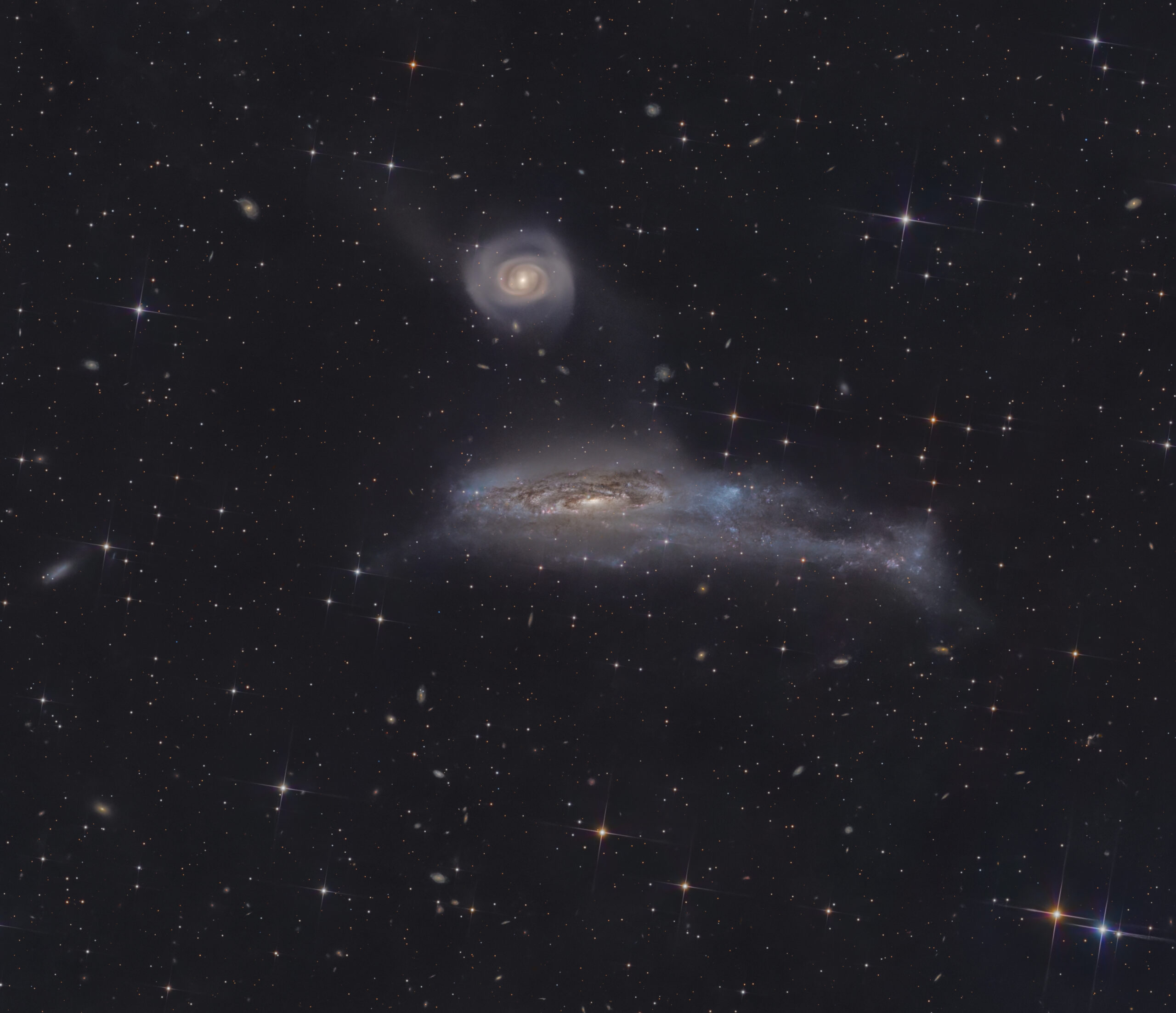
A Tidal Encounter in Vela
In the southern constellation Vela, the disturbed spiral galaxy NGC 3263 is caught in a powerful gravitational interaction with the smaller companion NGC 3262 above it. Rather than a gentle encounter, this system shows the clear signatures of a strong tidal disturbance, where gravity is actively pulling stars and gas out of both galaxies and reshaping their structure.
NGC 3263 is classified morphologically as SB(s)c pec, a barred spiral galaxy with a clearly distorted disk. It lies roughly 140 million light-years away and spans about 3.2 × 1.3 arcminutes on the sky, corresponding to a physical diameter of roughly 130,000 light-years. The galaxy’s bright central bulge sits within a disk crossed by dark dust structure and dotted with blue star-forming regions that trace the spiral arms.
The gravitational interaction is revealed by several striking tidal features. A faint but continuous tidal bridge stretches between NGC 3263 and NGC 3262, a stream of stars and gas drawn outward by their mutual gravitational pull. This bridge appears to originate from a distorted outer spiral arm of NGC 3263, where the arm itself bends and stretches toward the companion galaxy before dissolving into the connecting stream. This subtle structural transition between spiral arm and bridge is a clear sign that the interaction is physically pulling material directly out of the galaxy’s disk.
To the right of NGC 3263, a broad tidal plume extends far beyond the main body of the galaxy. This diffuse stream of stellar debris likely formed as the encounter pulled stars from the outer disk and flung them into intergalactic space. The disk itself appears asymmetric and slightly warped, with one side stretched outward toward the plume while the opposite side remains comparatively compressed.
Although NGC 3262 appears smoother in structure, consistent with a lenticular (S0) galaxy, its outer light distribution is subtly elongated toward NGC 3263, suggesting that it too is participating in the tidal exchange of material. Just below the main bridge there are hints of additional faint debris, indicating that multiple tidal streams may be forming as the interaction unfolds.
These delicate bridges and plumes are the visible traces of immense gravitational forces acting over hundreds of millions of years. Encounters like this can redistribute vast numbers of stars, trigger bursts of star formation in disturbed spiral arms, and eventually lead to mergers that completely transform the galaxies involved. The fragile structures visible here capture a brief moment in that long and dramatic process.
Imaged in LRGB on the ASA Astrosysteme AZ 1500 at Observatorio El Sauce, Chile.
Image Acquisition and Processing: Mike Selby