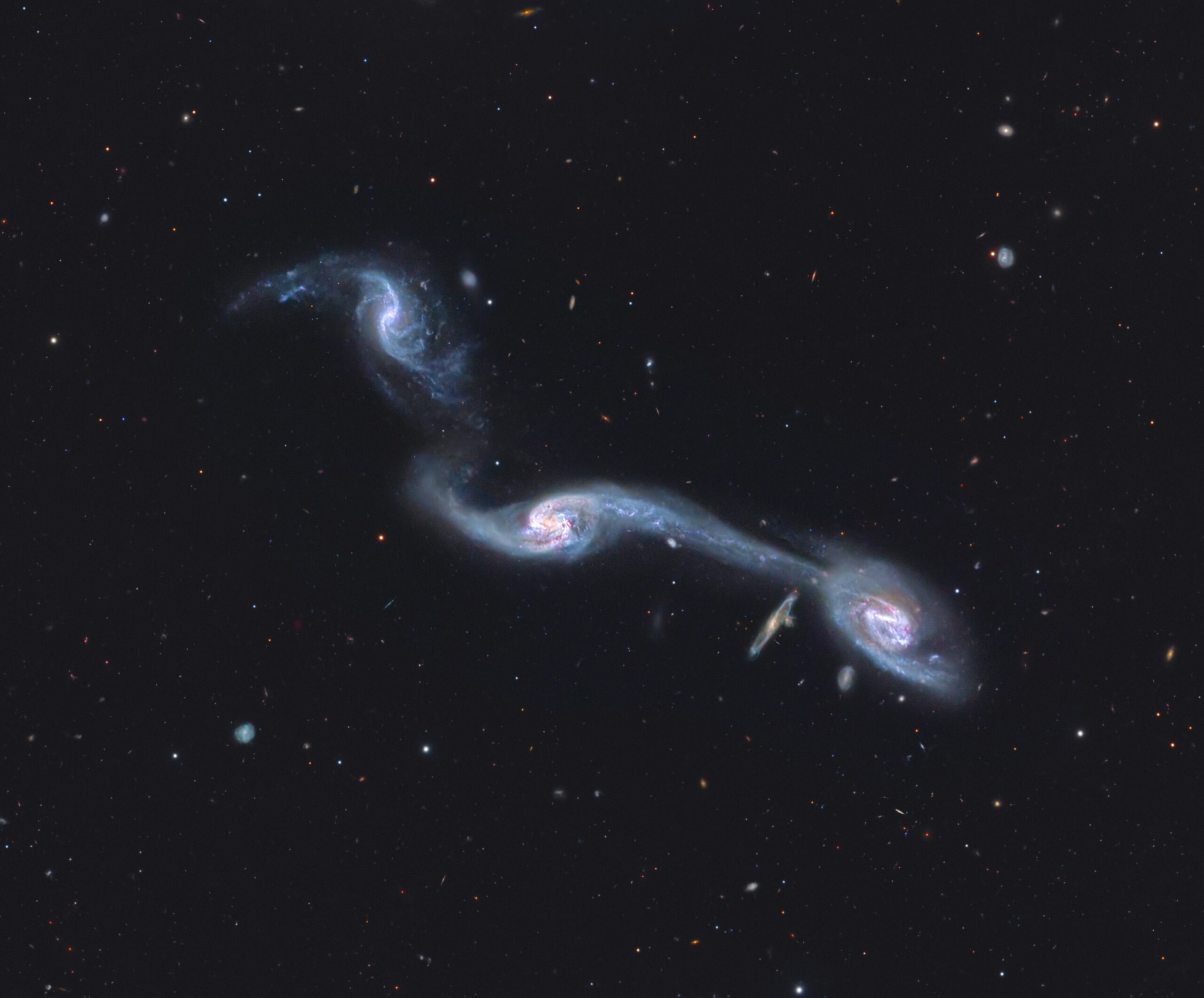
A peculiar triplet bound by gravity and stretched across intergalactic space
Arp 248, also known as Wild’s Triplet, is a system of three interacting spiral galaxies located in the constellation Virgo. The galaxies visible here are PGC 36742 at the upper left, PGC 36733 at the center, and PGC 36723 at the lower right. The central and dominant member, PGC 36733, is morphologically classified as SB(s)b? pec — a barred spiral galaxy whose structure has been visibly distorted by gravitational forces. Its companions are likewise distorted spirals, and together they form a gravitationally bound system connected by luminous tidal streams.
The designation “Arp” refers to the Atlas of Peculiar Galaxies. This catalog specifically highlights galaxies that do not fit the orderly symmetry of normal spirals or ellipticals, but instead show unusual shapes caused by gravitational interaction, tidal disruption, or merging. Arp 248 is classified as a peculiar galaxy system because its members exhibit elongated spiral arms, stellar bridges, and structural distortions that are clear evidence of ongoing gravitational interaction between the galaxies.
According to the NASA/IPAC Extragalactic Database, the system lies at a distance of approximately 287 million light-years. The central galaxy, PGC 36733, has an apparent angular diameter of 111.7 arcseconds, corresponding to a true physical diameter of about 155,000 light-years, making it somewhat larger than the Milky Way. The tidal bridge extending between PGC 36733 and PGC 36723 spans tens of thousands of light-years, representing a vast stream of stars and gas that has been gravitationally pulled from the galaxies during close encounters.
The tidal bridge connecting the central and lower-right galaxies is the most striking feature of this system. This stellar stream is not an illusion of perspective, but a real physical structure formed as gravity pulls stars from one galaxy toward another. The upper-left galaxy, PGC 36742, shows pronounced asymmetry and extended spiral arms, clear evidence that it too is being reshaped by the system’s gravitational forces. Bright blue regions scattered throughout the spiral arms and tidal features mark areas of active star formation, triggered by compression of gas during the interaction.
Arp 248 captures a dynamic phase in galactic evolution, where gravitational forces are actively reshaping galaxies on a scale of hundreds of thousands of light-years. Over the next several hundred million years, continued interaction may further distort their structures and could eventually lead to mergers, transforming these separate spiral galaxies into a more massive and evolved system
Imaged in LRGB on the ASA Astrosysteme AZ 1500 at Observatorio El Sauce, Chile.
Image Acquisition and Processing: Mike Selby