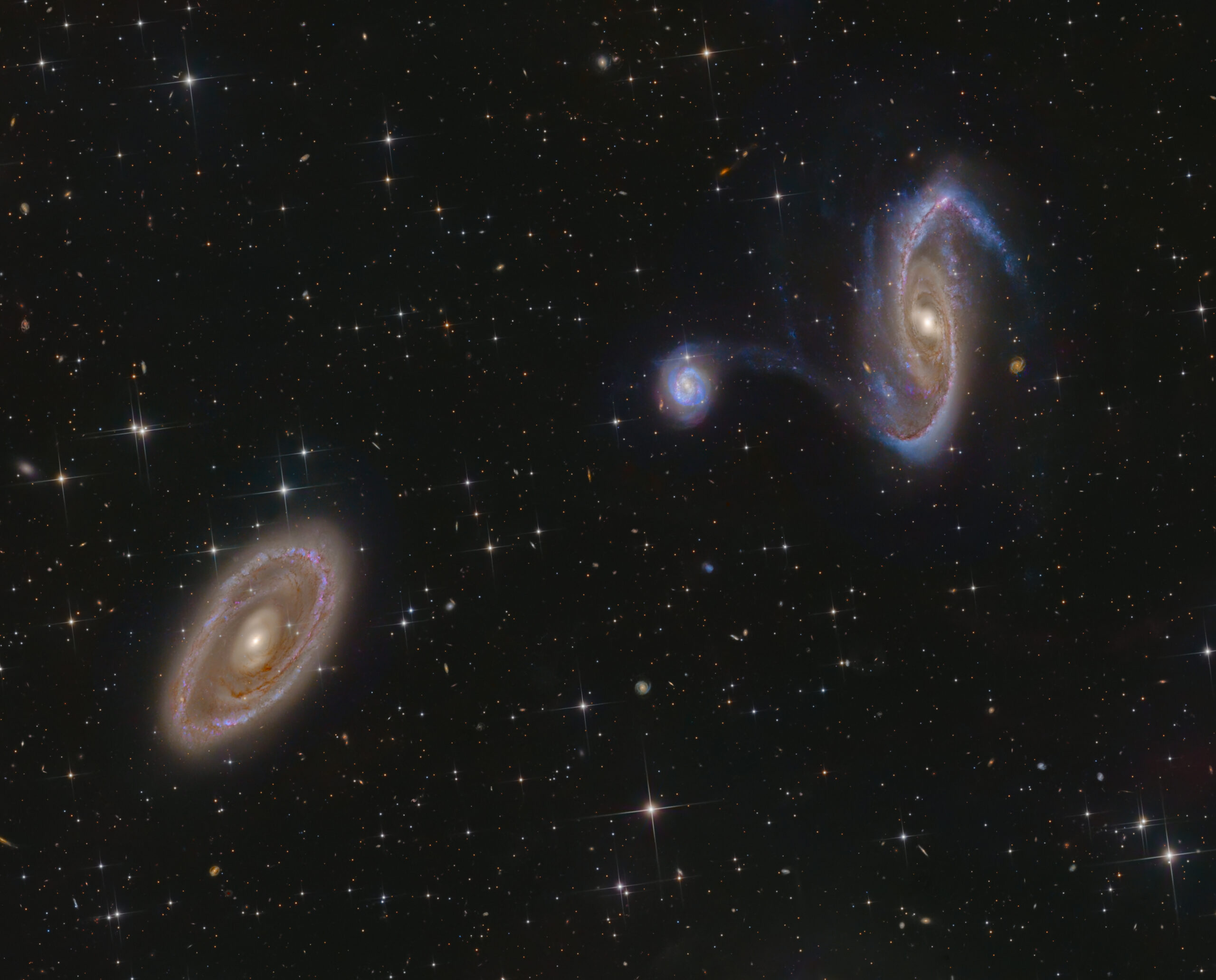
A fragile stellar bridge reveals gravity in the act of reshaping entire galaxies
NGC 3347, NGC 3354, and NGC 3358 form an interacting trio of spiral galaxies in the constellation Antlia, bound together by mutual gravitational forces that are actively altering their structure. NGC 3347, classified SB(rs)b, is the dominant member of the group, displaying a strong central bar surrounded by a well-defined inner ring where star formation traces the dynamical influence of the bar. Its spiral arms are tightly organized and embedded with blue stellar populations, while subtle asymmetry in its outer disk hints at the ongoing gravitational influence of its neighbors. NGC 3354, also an SB(r)b barred spiral, shows pronounced dust lanes along its bar and inner ring, with dark filaments channeling gas toward the core and shaping the galaxy’s evolution. The smaller companion, NGC 3358, classified SAB(rs)c, has a more delicate structure, but its outer disk shows distortion consistent with tidal forces pulling material outward.
NGC 3347 lies approximately 98.4 million light-years from Earth, based on redshift-independent measurements. At that distance, its apparent size of 5.33 × 3.78 arcminutes corresponds to a true diameter of about 152,700 light-years, slightly larger than the Milky Way. NGC 3354 spans about 2.7 × 1.8 arcminutes, corresponding to roughly 80,000 light-years, while NGC 3358 measures approximately 1.4 × 1.0 arcminutes, or about 40,000 light-years across. Their shared distance and clear physical interaction confirm that they form a genuine gravitationally bound system.
The most striking feature of this group is the faint tidal bridge connecting NGC 3354 and NGC 3358. This tenuous stream of stars has been drawn outward by tidal forces during a close encounter, forming a luminous connection between the galaxies. Such tidal bridges are direct evidence of gravitational interaction, where differential forces distort galactic disks and redistribute stars into extended streams. These encounters not only reshape the galaxies’ structure but also compress gas clouds, triggering new waves of star formation. Subtle distortions in the outer disks of both NGC 3354 and NGC 3358 reinforce the evidence that this interaction is ongoing, capturing a transient phase in their long-term evolution.
This image preserves a moment in a slow cosmic transformation. Over hundreds of millions of years, repeated gravitational encounters will continue to alter their shapes, redistribute mass, and possibly lead to future mergers. The faint stellar bridge visible here is a direct imprint of gravity at work across tens of thousands of light-years, revealing the dynamic and ever-changing nature of galaxies
Imaged in LRGB on the ASA Astrosysteme AZ 1500 at Observatorio El Sauce, Chile.
Image Acquisition and Processing: Mike Selby