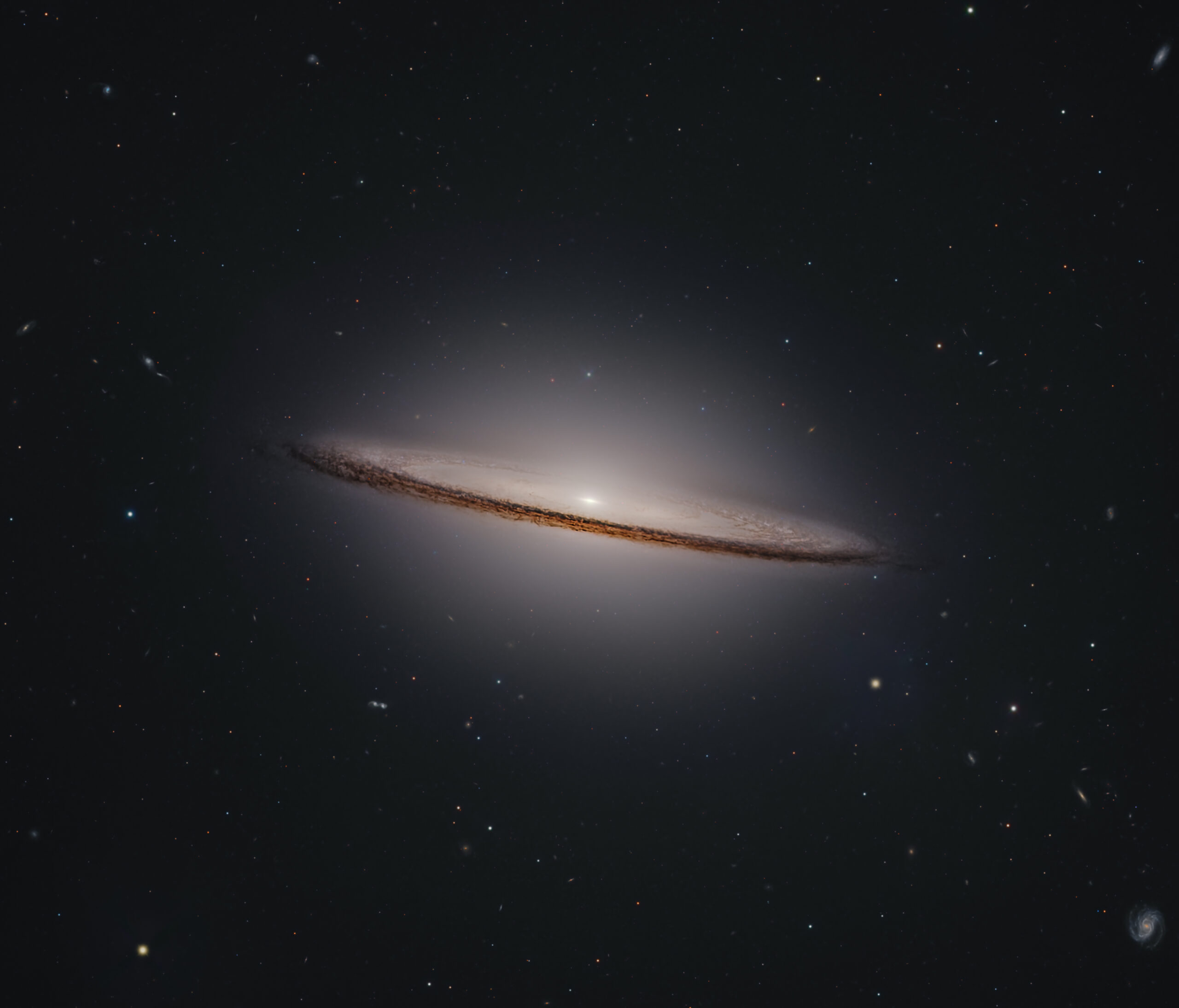
A luminous stellar metropolis suspended in perfect equilibrium
Messier 104, widely known as the Sombrero Galaxy, is a massive unbarred spiral galaxy of morphological classification SA(s)a located in the constellation Virgo. Seen nearly edge-on from Earth, its extraordinary structure reveals both the flattened disk of a spiral system and the immense spheroidal bulge more typical of elliptical galaxies, making it one of the most visually and structurally distinctive galaxies in the nearby universe.
At a precisely measured distance of approximately 31.1 million light-years, Messier 104 spans an apparent angular size of about 8.7 × 3.5 arcminutes, corresponding to a true physical diameter of roughly 88,000 light-years. With an integrated visual magnitude of 8.0, it is one of the brightest galaxies in the Virgo region and easily identifiable by its remarkable symmetry and intense central luminosity.
The galaxy’s most defining feature is its sharply defined equatorial dust lane, a dense band of interstellar dust silhouetted against the brilliant stellar bulge behind it. This dust disk contains vast reservoirs of cold gas and obscuring material, marking the location of the galaxy’s flattened spiral structure. Above and below the disk, an enormous halo of ancient Population II stars extends far into space, forming a nearly spherical stellar envelope that reflects the galaxy’s long and complex evolutionary history. The immense central bulge, containing billions of old stars and harboring a supermassive black hole with a mass of approximately one billion solar masses, dominates the galaxy’s gravitational architecture.
Messier 104 represents a transitional form between classical spiral and elliptical galaxies, offering insight into how galaxies accumulate mass, evolve dynamically, and stabilize over cosmic time. Its unusually large bulge relative to its disk suggests an early epoch of rapid mass assembly, followed by a long period of structural stability. The faint halo surrounding the galaxy traces the outermost gravitational boundary of its stellar population, revealing the full scale of its stellar empire and the enduring legacy of its formation.
Imaged in LRGB on the ASA Astrosysteme AZ 1500 at Observatorio El Sauce, Chile.
Image Acquisition and Processing: Mike Selby