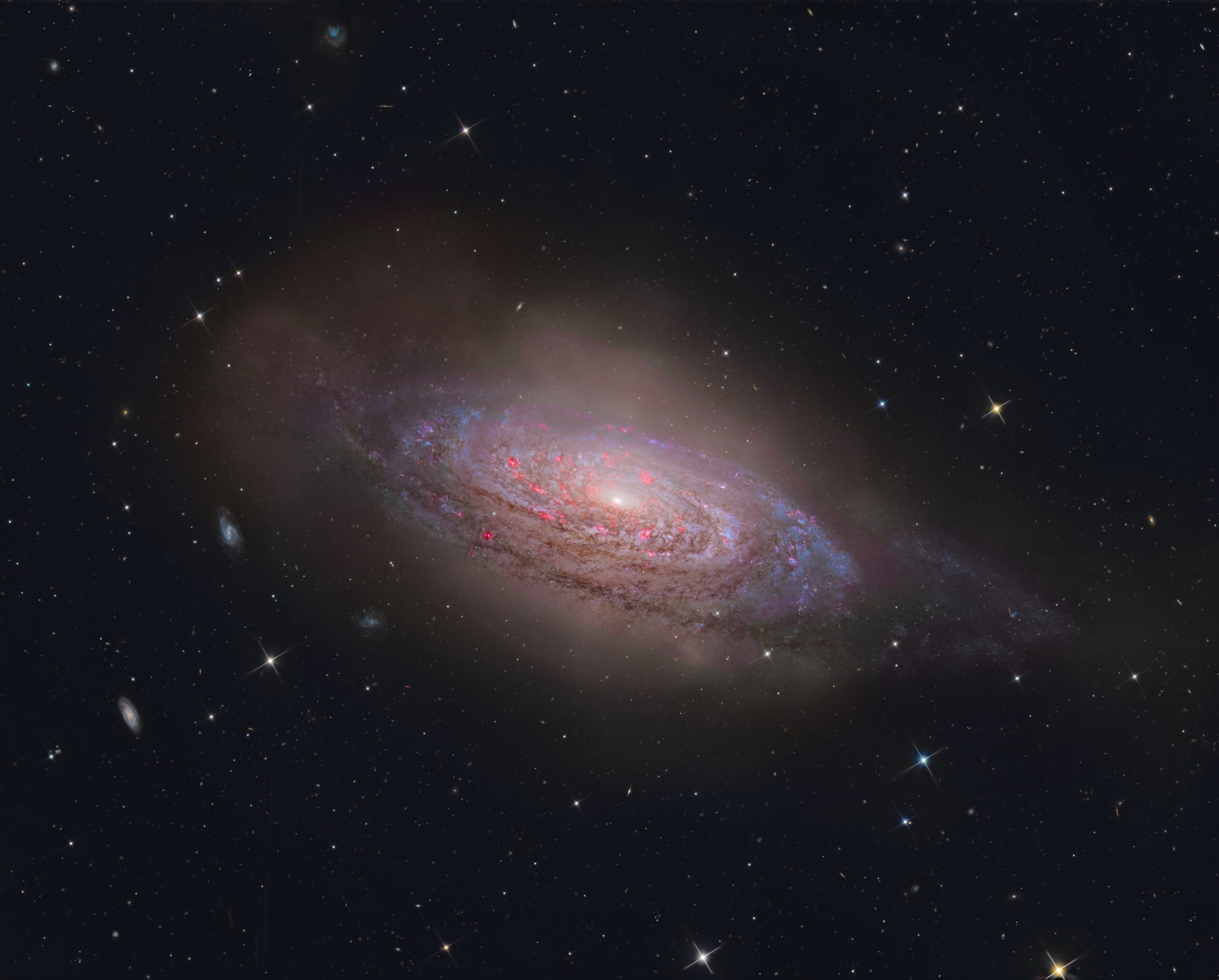
A spiral galaxy wrapped in the ghostly remnants of its past
NGC 3521 is a flocculent spiral galaxy classified as SAB(rs)bc, located in the constellation Leo. Unlike grand design spirals with well-defined arms, its structure is chaotic and fragmented, with broken dust lanes and scattered stellar regions forming a complex and irregular disk. Surrounding this active inner region is a vast and asymmetric stellar halo, revealing the accumulated debris of smaller galaxies long since absorbed.
Using the Average NED-D redshift-independent metric distance, NGC 3521 lies approximately 37 million light-years from Earth. It spans an apparent angular size of 11.0 × 5.1 arcminutes, corresponding to a true diameter of about 118,000 × 55,000 light-years. With an integrated magnitude of 9.0, much of its full extent lies within its extremely faint outer envelope, which stretches far beyond the bright visible disk.
The inner disk is filled with fragmented dust lanes and luminous blue stellar populations, while numerous red Hα emission regions trace ongoing star formation across its chaotic structure. These dust lanes extend deep into the disk without forming continuous spiral arms, a defining characteristic of flocculent spiral galaxies. Surrounding this active region lies an immense diffuse halo composed of faint stellar streams, asymmetric plumes, and tidal debris. The highly uneven distribution of this outer halo, along with visible stellar streams and diffuse plumes, preserves the remnants of smaller galaxies that were gradually disrupted and assimilated over billions of years.
These extended stellar halos provide a direct record of how spiral galaxies grow over time. NGC 3521’s unusually massive and asymmetric halo, combined with its fragmented internal structure and ongoing star formation, reveals a galaxy shaped by repeated gravitational interactions and accretion. Its present form reflects a long evolutionary history, where successive mergers and gradual growth have built the complex and dynamic system visible today
Imaged in LRGB and H alpha on the ASA Astrosysteme AZ 1500 at Observatorio El Sauce, Chile.
Image Acquisition and Processing: Mike Selby