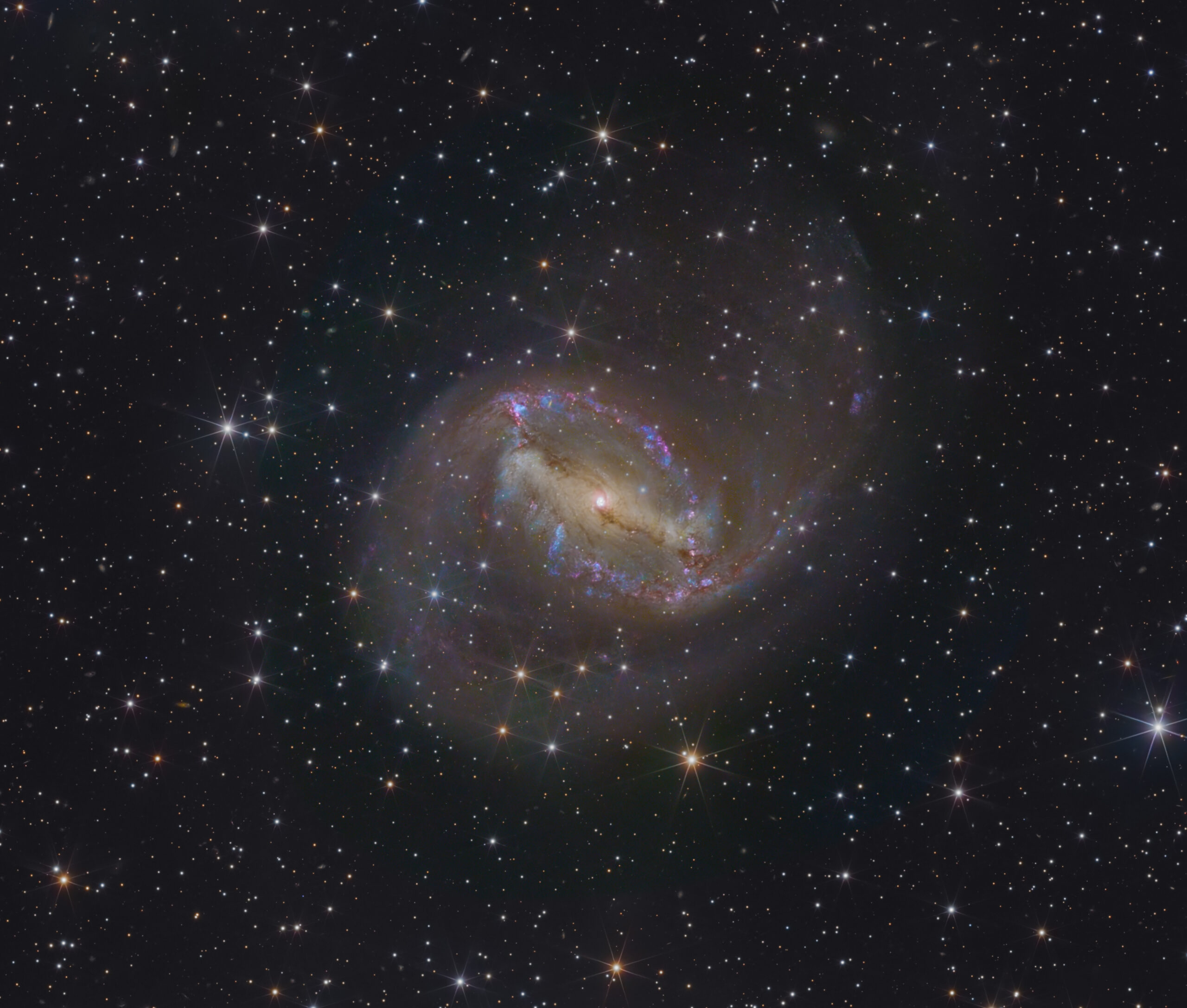
Where symmetry fractures and a spiral finds its form
NGC 2566 is a barred spiral galaxy in the constellation Puppis whose structure departs in subtle but compelling ways from classical spiral symmetry. Classified morphologically as SB(rs)bc, it belongs to the family of moderately wound barred spirals, yet its internal geometry reveals a system that is dynamically active rather than fully settled. A warm, elongated bar dominates the central region, but the way the spiral arms emerge from it is uneven and offset, giving the galaxy a slightly displaced, evolving character rather than a perfectly balanced form.
Located at a distance of approximately 80 million light-years, NGC 2566 spans about 3.6 × 2.5 arcminutes on the sky, corresponding to a physical diameter of roughly 90,000 light-years. Though compact in apparent size, the disk extends well beyond the bright core, with faint outer structure emerging against a deep background of stars and distant galaxies.
What makes NGC 2566 especially distinctive is how its structure diverges from a textbook barred spiral. The bar does not connect cleanly into two equally developed arms; instead, the arms emerge in an asymmetric pattern, one side appearing more coherent while the other is looser and fragmented. The partial inner ring implied by its “(rs)” classification is irregular rather than smooth, indicating that material is still being redistributed by the bar and has not yet settled into a stable resonance structure.
The star-forming regions reinforce this picture of a galaxy in transition. Rather than forming continuous chains along the arms, they appear as localized, patchy knots, each marking a pocket where gas has accumulated and collapsed. These discrete H II regions trace how star formation is being triggered in uneven bursts, guided by the bar’s gravitational influence rather than by a uniform density wave. Dark dust lanes cut across parts of the disk and occasionally decouple from the stellar arms, underscoring that gas, dust, and stars are not yet fully aligned into a stable pattern.
NGC 2566 is therefore not simply a barred spiral, but a system still being shaped from within. Its asymmetric arms, fragmented inner structure, and clustered star formation reveal a galaxy caught in the process of self-reorganization. What appears as a delicate interplay of light and dust is the visible imprint of gravitational forces redistributing matter across a disk still finding its equilibrium—where broken symmetry gives rise to form
Imaged in LRGB and Hydrogen Alpha on the ASA AZ1500 at Observatorio El Sauce, Chile
Image acquisition and processing: Mike Selby