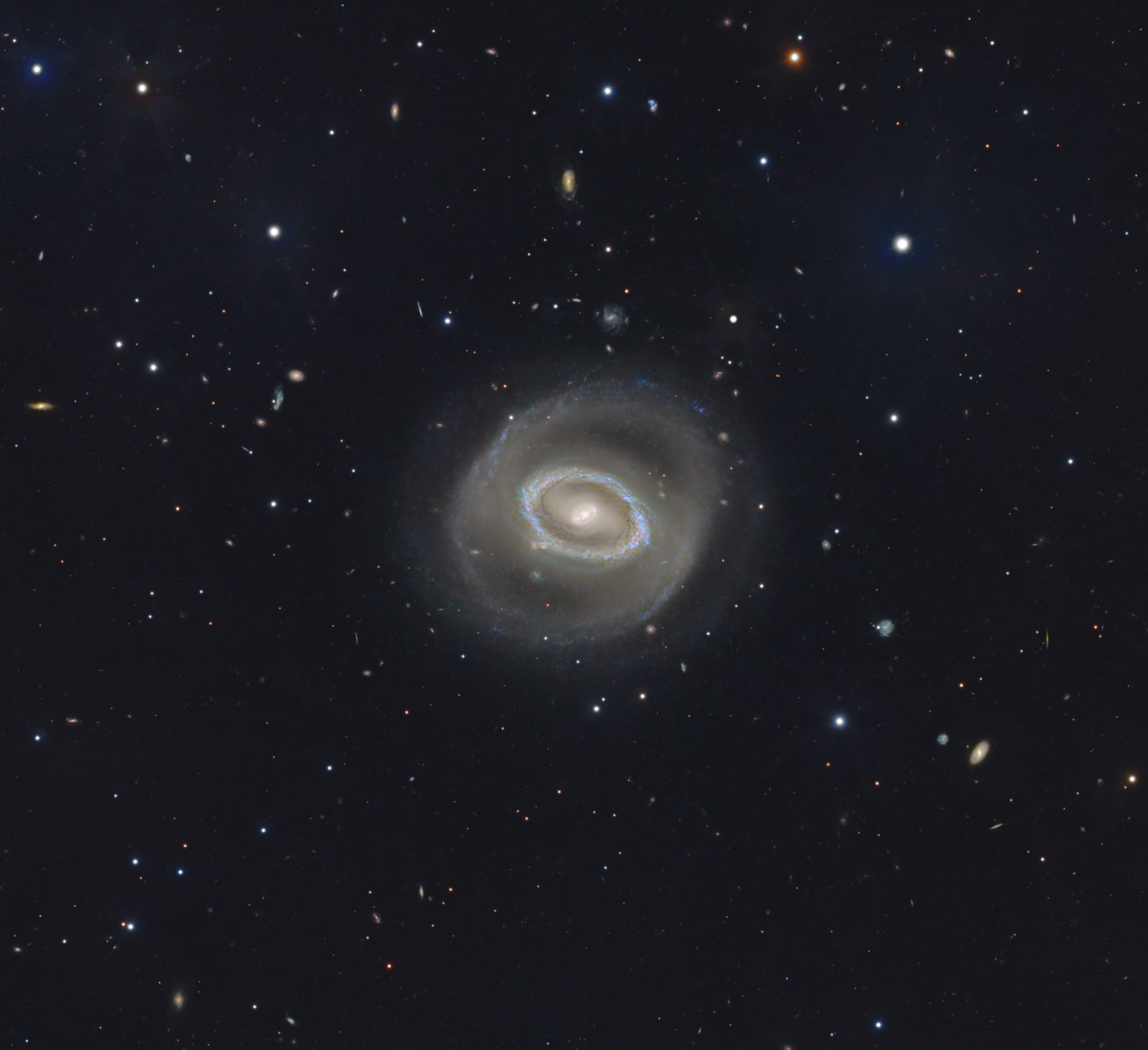
A star-forming jewel wrapped around a restless heart
NGC 3081 is a barred spiral galaxy classified as SAB(rs)bc, located in the constellation Hydra. It is a well-studied Seyfert 2 galaxy, meaning its compact core hosts an active supermassive black hole that subtly influences the surrounding structure and star formation.
At a distance of approximately 86 million light-years, NGC 3081 spans about 3.6 × 2.9 arcminutes on the sky, corresponding to a physical diameter of roughly 90,000 light-years. Its integrated visual magnitude is about 11.0, placing it comfortably within reach of medium-to-large amateur telescopes under dark skies.
The most striking feature is its circumnuclear star-forming ring, glowing blue with clusters of young, massive stars. This ring is not a visual coincidence—it marks a gravitational resonance zone driven by the galaxy’s inner bar, where gas is compressed, slowed, and funneled into orbiting streams that ignite sustained bursts of star formation. Crossing through this region is the inner bar, a dynamical structure that channels material inward and helps regulate both the ring and the active nucleus.
Beyond the ring, faint spiral arms unwind into a soft outer disk, laced with subtle dust lanes and patchy star-forming knots. The galaxy’s layered architecture—core, ring, bar, and disk—offers a textbook example of how galactic dynamics, resonances, and black-hole activity intertwine to shape long-term evolution.
In a single frame, NGC 3081 reveals both serenity and tension: a luminous ring of newborn stars circling a quietly energetic core, frozen mid-dance in a cosmic balance that has likely persisted for hundreds of millions of years.
Imaged in LRGB on my Planewave CDK 1000 at Observatorio El Sauce, Chile
Image acquisition and processing: Mike Selby