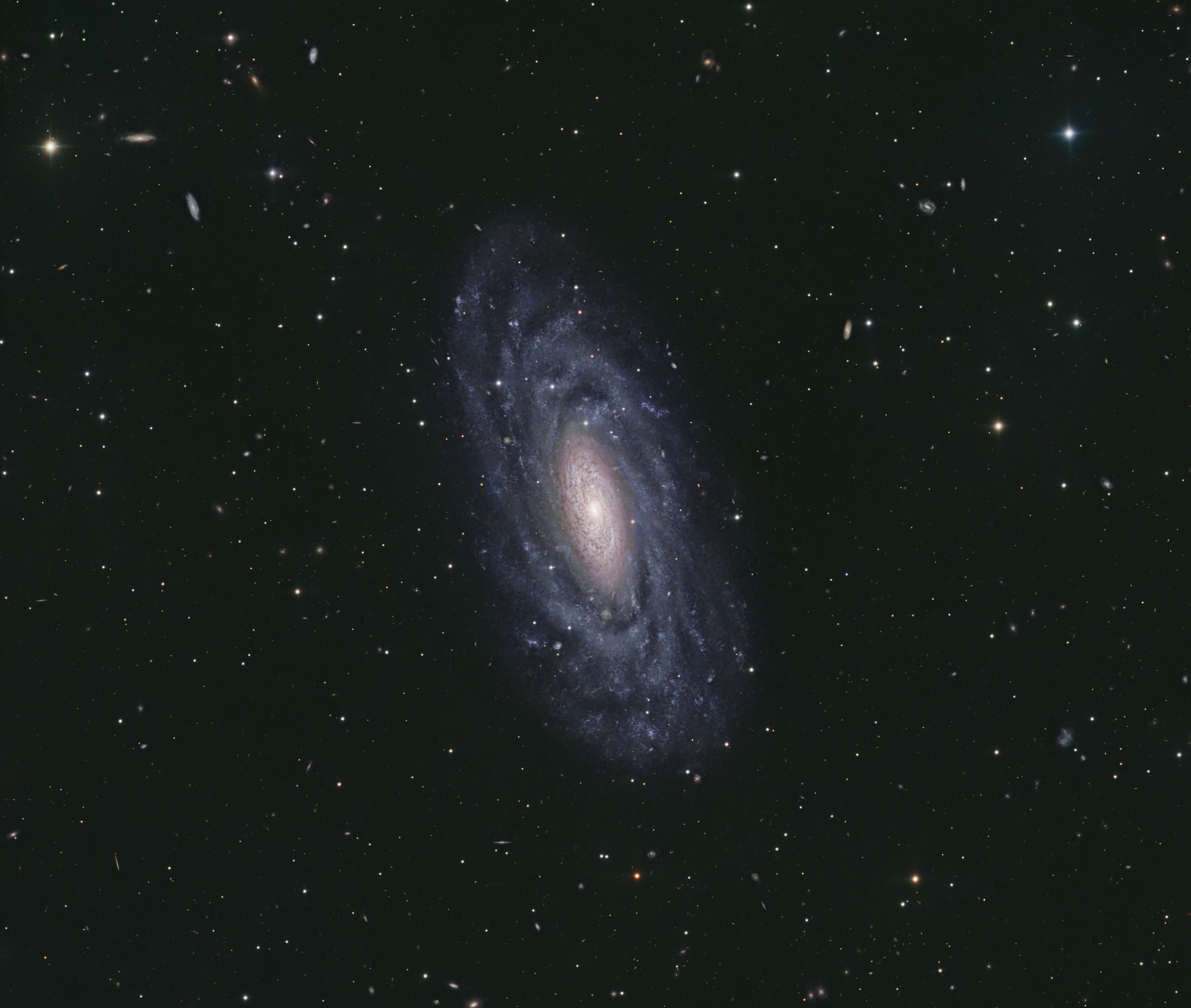
A Spiraling Jewel in Columba
NGC 2090 is a graceful SA(rs)c spiral galaxy located in the southern constellation Columba, the Dove. Seen at a moderate inclination, it presents an elongated disk with a luminous central bulge embedded in a loosely wound, flocculent system of spiral arms that give the galaxy a soft, organic appearance rather than a rigid grand-design symmetry.
This galaxy lies at a distance of approximately 40 million light-years. Its apparent angular size of about 4.9′ × 2.4′corresponds to a physical diameter of roughly 45,000 light-years, placing it among the more modestly sized spiral systems in the nearby universe. With an integrated visual magnitude near 11.2, it sits just beyond the reach of small telescopes and reveals its full structure only through long-exposure imaging.
The disk shows a warm, neutral stellar bulge transitioning into cooler, blue-toned spiral arms marked by scattered star-forming knots. Narrow dust lanes arc smoothly along the inner arms, creating gentle contrast between arm ridges and inter-arm gaps. Just outside the bulge, a faint inner pseudo-ring — the feature encoded by the “(rs)” in its classification — marks a resonance zone where the spiral arms first take shape, hinting at localized gas accumulation and enhanced star formation within the inner disk.
The outer spiral pattern is mildly asymmetric, with one side of the galaxy showing stronger arm texture and more prominent blue star-forming regions than the other. This lopsidedness suggests slow secular evolution or the lingering effects of a weak past gravitational perturbation rather than any recent major interaction. Despite being an unbarred spiral, NGC 2090 maintains well-organized dust lanes, indicating that its internal gas dynamics are driven primarily by spiral density structure rather than bar-induced inflow, a hallmark of a dynamically quiet disk.
Beyond the galaxy itself, a rich field of distant background galaxies fills the surrounding sky, with numerous faint edge-on and face-on systems scattered across the frame. These remote galaxies, lying hundreds of millions to billions of light-years beyond NGC 2090, anchor the scene in a far deeper cosmic context and highlight the galaxy’s place within a much larger extragalactic landscape.
Together, these subtle features — the inner pseudo-ring, asymmetric outer disk, coherent dust lanes, and surrounding background population — make NGC 2090 more than a simple spiral portrait. It stands as a quiet but revealing example of spiral galaxy evolution in a relatively undisturbed environment, where gentle internal processes continue to shape its structure and star-forming activity over cosmic time.
Imaged in LRGB on my Planewave CDK 1000 at Observatorio El Sauce, Chile
Image acquisition and processing: Mike Selby