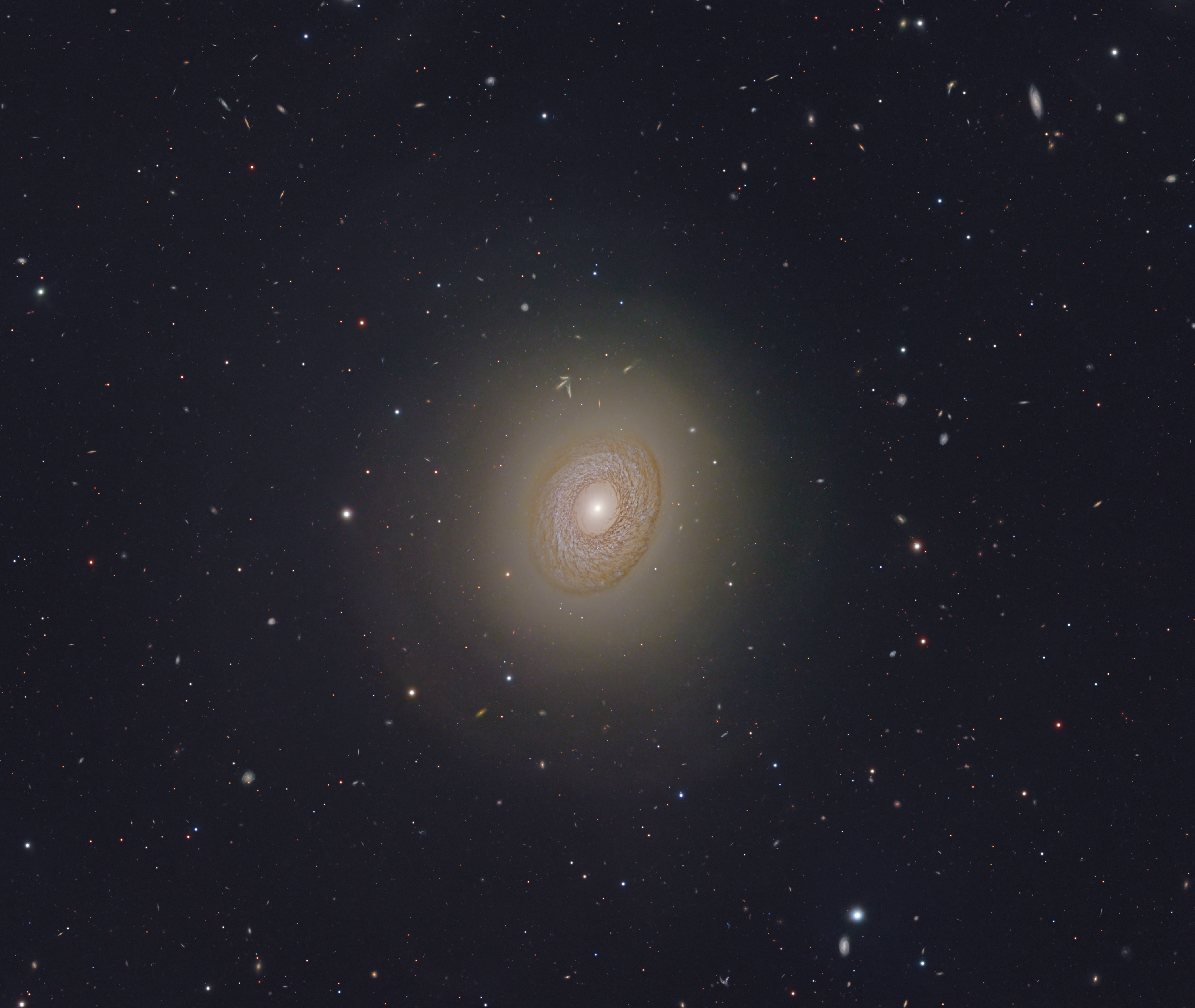
NGC 2775 — A spiral caught between order and decay
NGC 2775 is a luminous spiral galaxy in the constellation Cancer, catalogued as SA(r)ab, combining a dominant classical bulge with a faint inner ring and tightly wound, fragmented spiral arms. Although its overall symmetry suggests a well-ordered system, closer inspection reveals a transitional morphology that hints at a more complex evolutionary history.
Located at a distance of approximately 67 million light-years, NGC 2775 subtends about 4.3 × 3.3 arcminutes on the sky, corresponding to a physical diameter of roughly 85,000 light-years. With an apparent magnitude near 10.4, it is among the brighter spiral galaxies in Cancer, yet its low-contrast arms and smooth outer disk give it a deceptively subdued appearance.
Structurally, the galaxy is dominated by an unusually large and luminous bulge whose stellar population is old and dynamically relaxed, more reminiscent of an elliptical galaxy than a typical spiral nucleus. Surrounding this core is a diffuse, dust-rich ring and a network of tightly wrapped spiral segments rather than fully developed grand-design arms. These inner dust lanes and filamentary arc fragments trace the residual interstellar medium, revealing a system in which large-scale star formation has largely faded, leaving behind a fossil spiral pattern.
Beyond its inner ring, NGC 2775 shows subtle large-scale asymmetries in its faint outer disk and halo, with the low-surface-brightness envelope appearing slightly elongated and uneven. This lopsided structure is a classic signature of past tidal disturbance or minor accretion rather than long-term isolation. Its spiral pattern is not a true grand-design form but instead breaks into fragmented arcs that follow dust lanes rather than star-forming knots, marking it as an anemic or gas-depleted spiral in transition toward quiescence.
Astrophysically, NGC 2775 is often described as a bridge between a classical spiral and a lenticular galaxy. Its scarcity of prominent star-forming regions, combined with its dominant bulge and faint extended halo, suggests that gravitational interactions or minor mergers in the past may have stripped gas from its disk and accelerated the aging of its stellar population. What remains is a galaxy in a late evolutionary phase, slowly drifting toward dormancy while still preserving the delicate imprint of its spiral origins.
Surrounding this fading spiral is a remarkably rich background field populated by dozens of distant ellipticals, spirals, and edge-on systems, placing NGC 2775 within a deep extragalactic vista that spans billions of light-years in depth. This layered cosmic backdrop emphasizes both the scale of the universe and the quiet, transitional state of a galaxy nearing the end of its star-forming life.
Imaged in LRGB on my Planewave CDK 1000 at Observatorio El Sauce, Chile
Image acquisition and processing: Mike Selby