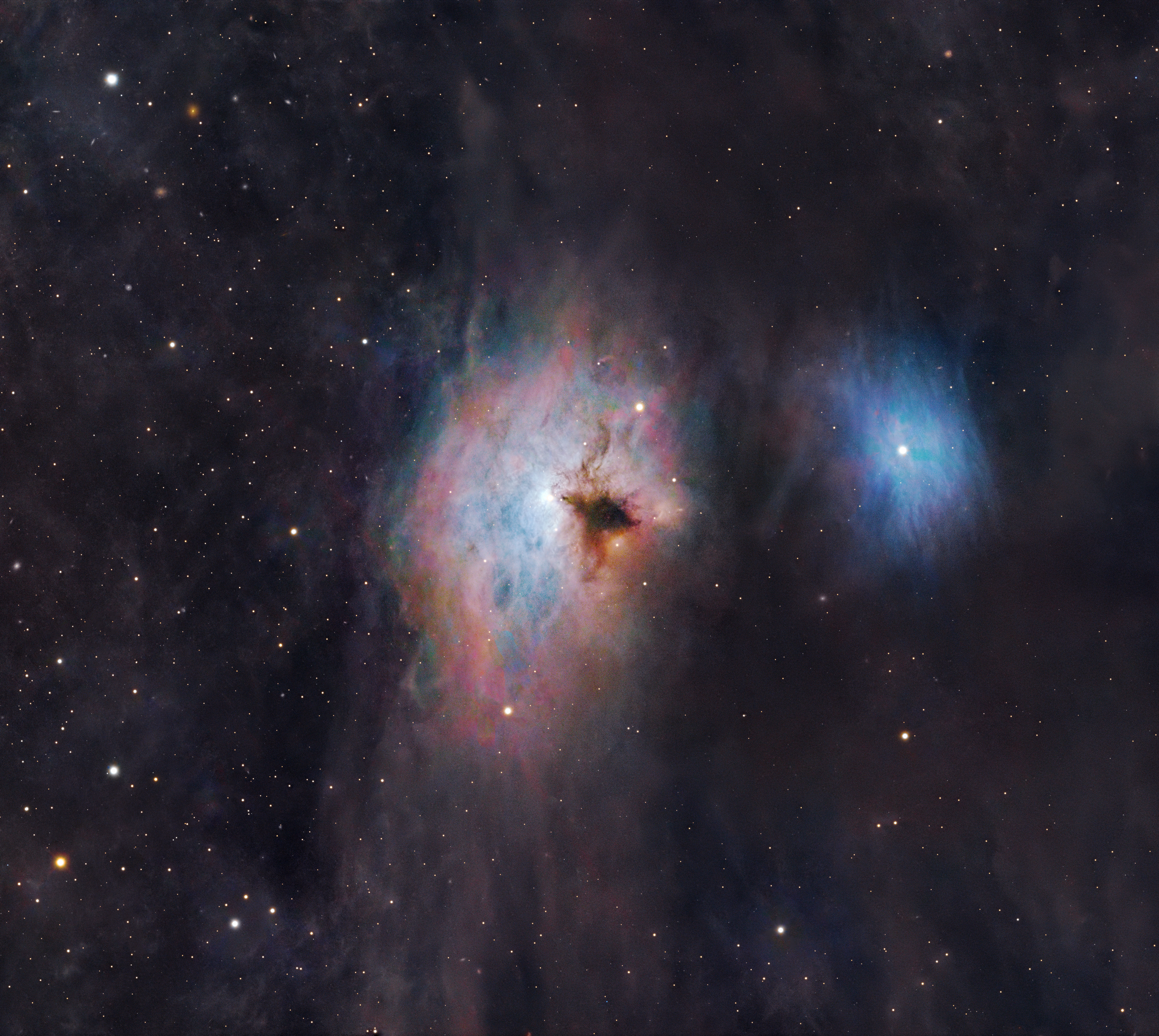
A Luminous Oasis in a Sea of Dust — NGC 2149 in Orion
This image presents NGC 2149, a compact reflection nebula embedded within the dense molecular environment of the Orion complex. Unlike emission nebulae, NGC 2149 does not generate its own light; its soft blue glow arises from starlight scattered by fine interstellar dust grains. The illumination is provided by the nearby B-type star HD 42023, whose hot, blue-weighted radiation is reflected by surrounding dust rather than ionizing it. At the heart of the nebula, a dense and nearly opaque concentration of dust blocks part of this light, carving a sharply defined dark cavity that gives NGC 2149 its striking three-dimensional character.
NGC 2149 lies at an estimated distance of approximately 1,600 light-years. On the sky, the brightest reflection structure spans about 7 × 5 arcminutes, corresponding to a physical extent of roughly 3.4 × 2.4 light-years. While the luminous core appears compact, it is embedded within a much more extensive reservoir of gas and dust that stretches well beyond the immediately visible boundaries, revealing that the object is only a small illuminated window into a far larger molecular complex.
To the right of NGC 2149 lies vdB 66, a faint and delicate reflection nebula cataloged by van den Bergh. This subtle structure does not possess its own illuminating source; instead, it reflects the same starlight from HD 42023 that lights the denser core of NGC 2149. Where NGC 2149 reveals a sharply sculpted cavity shaped by dense dust, vdB 66 appears as a wispy veil of pale blue light, tracing lower-density filaments within the same cloud. Together, they form a continuous illumination geometry, revealing different layers of the same dusty environment.
Encircling both regions is an intricate web of extremely faint dust and molecular filaments, delicately etched across the field. These structures trace the fine texture of the interstellar medium and show how a single luminous star can carve contrast across a complex three-dimensional cloud through scattering, absorption, and subtle radiation pressure. Because the illuminating star is not hot enough to significantly ionize hydrogen, the scene is dominated by reflected starlight rather than emission: there are no strong H-alpha fronts, only the quiet interplay of light with cold dust. NGC 2149 and vdB 66, illuminated by HD 42023, thus record how illumination interacts with interstellar matter, exposing the physical processes that organize, erode, and ultimately prepare dust and gas for future generations of stars.
Imaged in LRGB on my Planewave CDK 1000 at Observatorio El Sauce, Chile.
Image acquisition and processing: Mike Selby