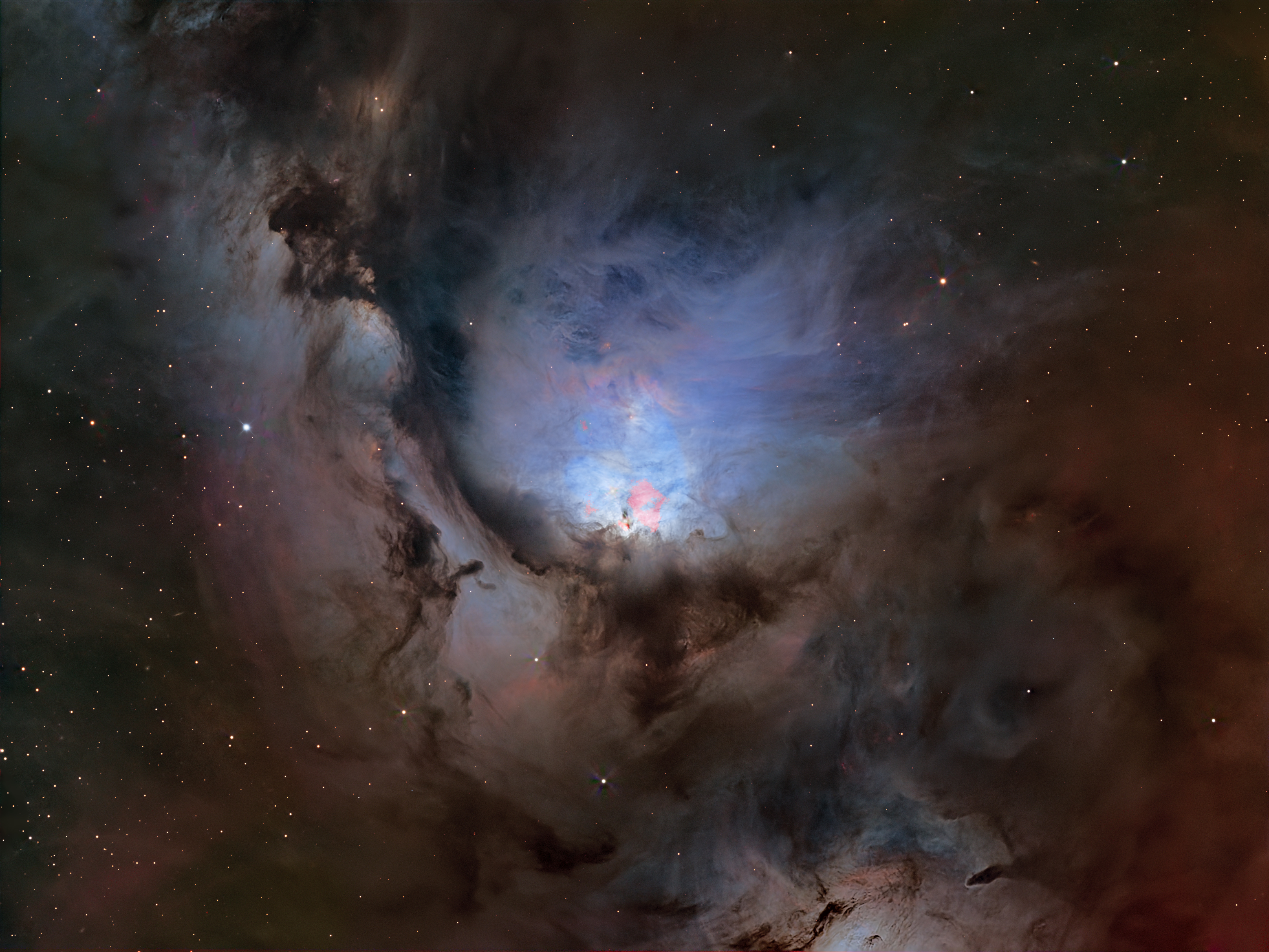
A chamber of light carved into Orion’s dark heart
NGC 2068, a luminous reflection nebula in the constellation Orion, forms part of the complex surrounding the brighter nebula M78 and lies embedded within the Orion Molecular Cloud. Illuminated primarily by young B-type stars hidden within its core, this region glows as starlight scatters off fine interstellar dust rather than through emission alone, revealing the delicate physics of reflection in a dense star-forming environment.
At a distance of approximately 1,300 light-years, NGC 2068 spans about 8 × 6 arcminutes, corresponding to a physical size of roughly 3 light-years across. Though compact on the sky, its apparent structure conceals a remarkably complex three-dimensional geometry shaped by radiation pressure, stellar winds, and the slow collapse of cold molecular material.
The image reveals a deeply excavated cavity whose concave walls are traced by overlapping sheets of dust, foreground extinction lanes, and turbulent shear layers where illumination fades gradually into shadow. The brightest blue core marks the principal reflection zone, while faint embedded H-alpha emission knots signal ongoing low-level star formation within the cavity floor. Multiple dust strata intersect the line of sight, producing a sculptural interplay of silhouettes, veils, and back-illuminated filaments.
NGC 2068 offers a subtle yet revealing glimpse into the earliest stages of stellar evolution, where light first emerges from within its natal clouds and sculpts the surrounding medium into complex, transient architecture — a fleeting chamber of illumination within one of the Galaxy’s richest nurseries.
Imaged in LRGB and Hydrogen Alpha on my Planewave CDK 700 at Observatorio El Sauce, Chile
Image acquisition and processing: Mike Selby