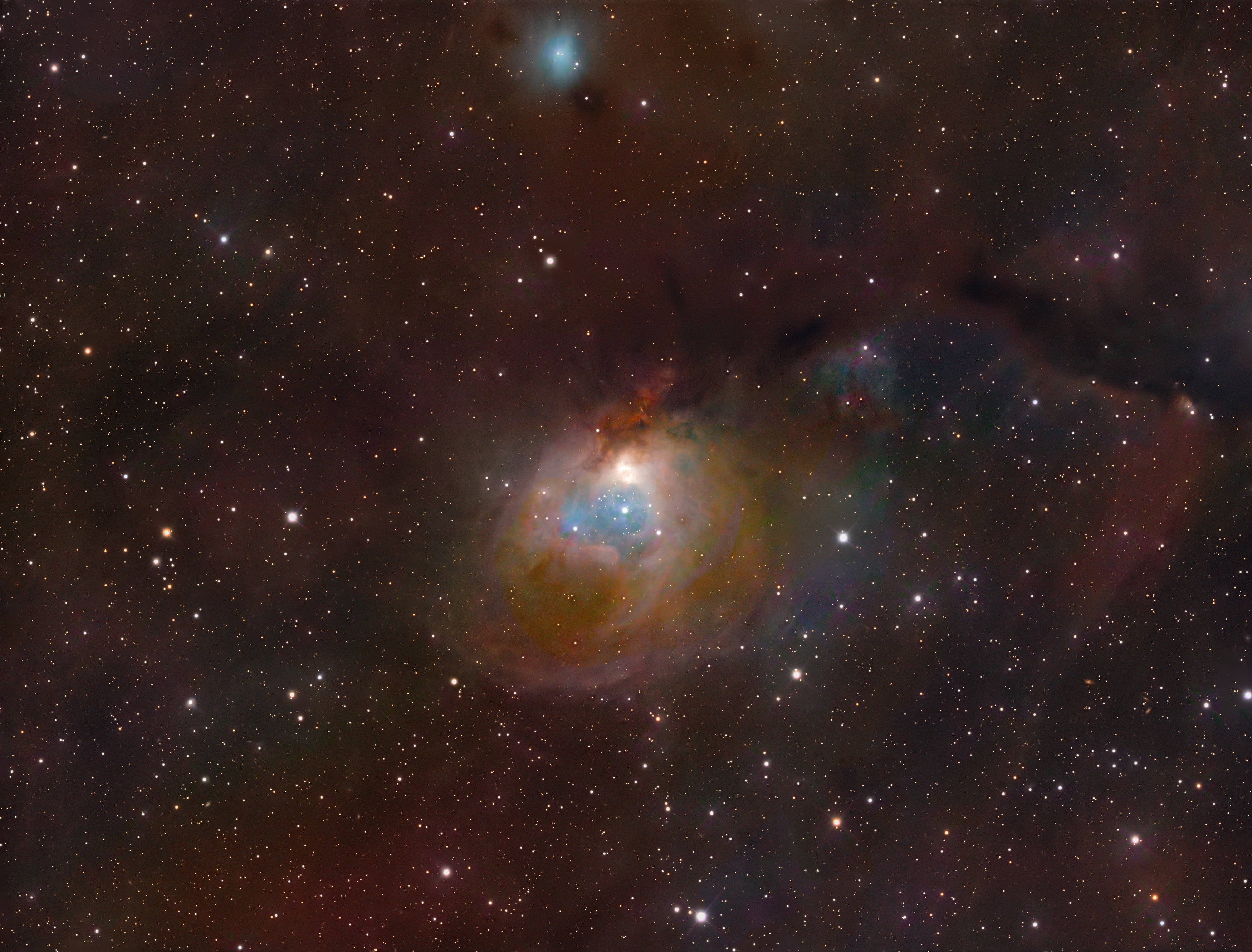
NGC 2316 — Light carved from a sea of darkness
Rarely imaged, NGC 2316 is a compact mixed emission–reflection nebula embedded within a dense dark nebula in the constellation Monoceros. At its center, a small cluster of young, hot stars illuminates its surroundings in two distinct ways: dust grains scatter their light to produce the cool blue reflection core, while nearby gas is weakly ionized, adding a subtle emission component to the surrounding structures.
At a distance of roughly 5,000–6,000 light-years, NGC 2316 spans about 6.4 arcminutes on the sky, corresponding to a physical size of approximately 9–11 light-years. Despite its modest apparent extent, the internal structure is striking. A bright central cavity is encircled by warmer filaments, arcs, and partially obscured regions shaped by radiation and stellar winds as newly formed stars push back against their natal cloud.
The color structure reveals the underlying physics. Blue tones trace scattered starlight in the reflection-dominated core, while amber and reddish hues mark areas where faint emission blends with absorption by denser dust. Enveloping the entire object is the parent dark nebula itself: thick molecular material that blocks background starlight, forming the surrounding black lanes and giving the impression that the nebula has been hollowed from a much larger, light-absorbing complex.
NGC 2316 is therefore not simply an isolated glow, but a window into a star-forming cloud in the process of transformation—a region where radiation, dust, and gravity are actively reshaping a dark molecular pocket into a visible stellar nursery, revealing how light quite literally emerges from interstellar darkness.
Imaged in LRGB on my Planewave CDK 1000 at Observatorio El Sauce, Chile
Image acquisition and processing: Mike Selby