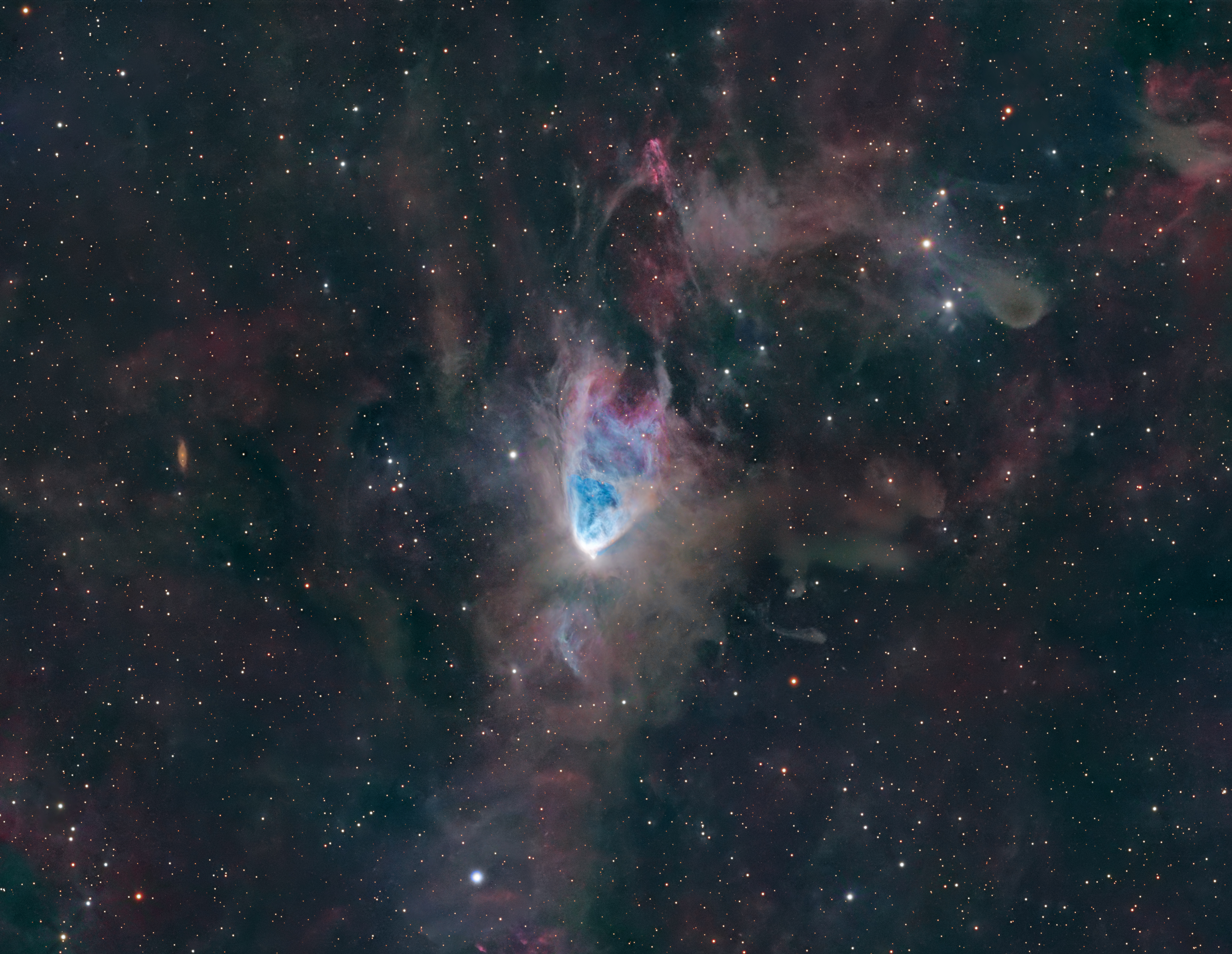
A beam of starlight carving its way through darkness
NGC 2261, better known as Hubble’s Variable Nebula, is a compact reflection nebula in the constellation Monoceros, illuminated by the young, irregular variable star R Monocerotis embedded at its apex. Located at a distance of approximately 2,500 light-years, this object spans only about 2 arcminutes on the sky, corresponding to a physical size of roughly 1.5 light-years, yet it displays one of the most dynamic illumination patterns known among reflection nebulae.
The sharply defined blue wedge marks the hollow cavity cleared by stellar winds and outflows from R Mon, while the surrounding fan-shaped envelope traces dust layers that scatter and redirect the star’s light into space. Above the core, stratified streamers and faint arcs reveal overlapping sheets of dust, while subtle reddish filaments indicate regions where weak emission and reflection coexist. To the right, a detached reflection patch records light escaping the cavity and illuminating a more distant dust layer, demonstrating how the beam propagates through a complex three-dimensional environment.
What makes NGC 2261 exceptional is its variability: changes in the circumstellar disk and inner dust alter the direction and intensity of the emerging beam, causing the nebula’s shape and brightness to evolve on timescales of months. This shifting pattern provides a rare, real-time view of how young stars carve cavities, cast moving shadows, and illuminate the dusty remnants of their birth clouds as they emerge from formation.
Imaged in LRGB on my Planewave CDK 1000 at Observatorio El Sauce, Chile
Image acquisition and processing: Mike Selby