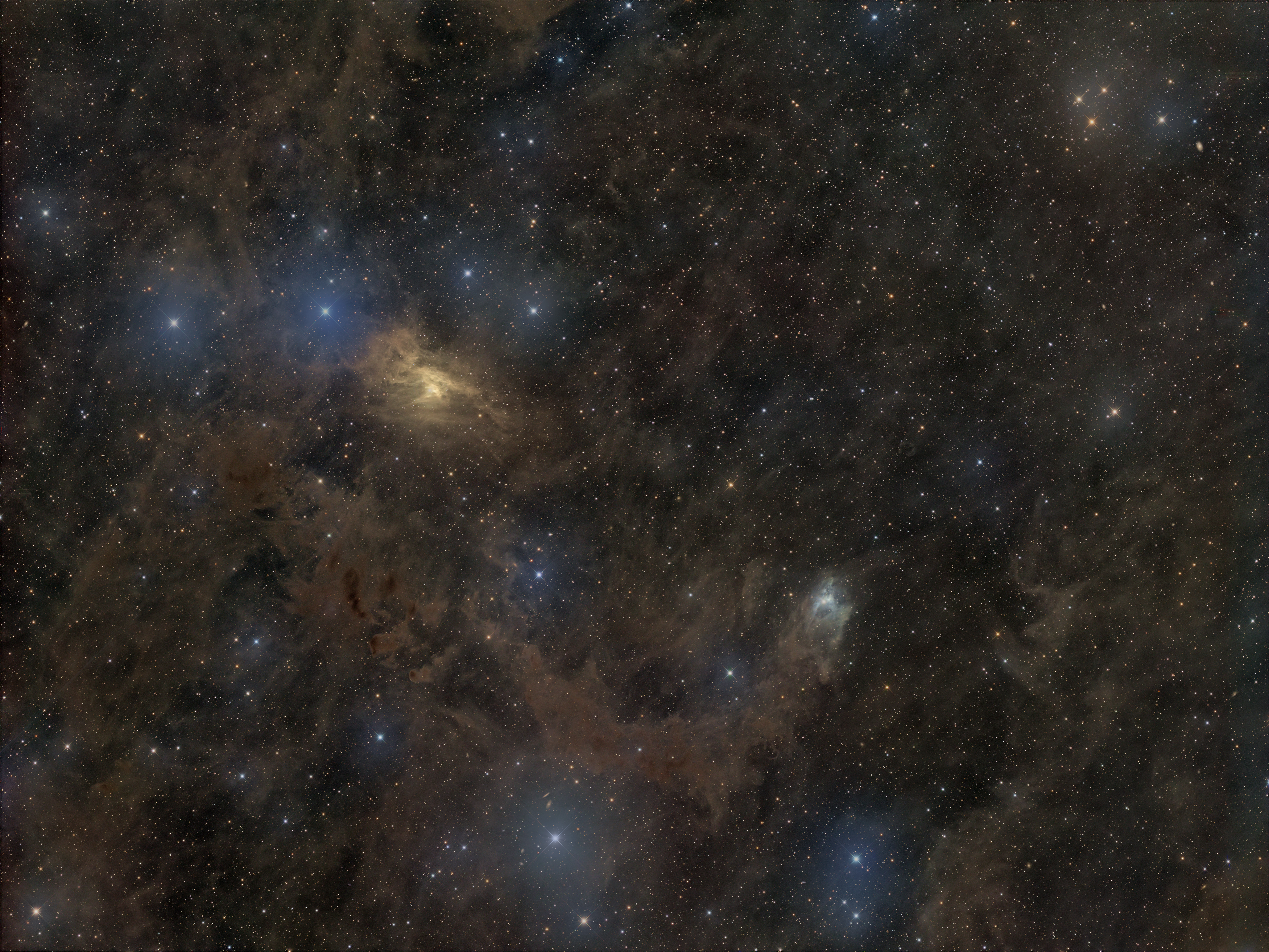
Two nebulae shaped by the Milky Way’s vast dust tapestry — VdB 35 and VdB 37
This wide-field view centers on the pair of van den Bergh objects VdB 35 and VdB 37, embedded within a richly structured region of the Milky Way where interstellar dust is the dominant presence. These are not bright emission nebulae, nor are they classic star-centered reflection nebulae. Instead, they are dense concentrations of dust within a much larger network of faint molecular material—often described as Galactic cirrus or integrated dust—revealed by scattered starlight across the field.
VdB 35 lies within the brighter, warm-toned dust concentration toward the upper left of the frame. On the sky it spans roughly 10–12 arcminutes, forming layered sheets and curved lanes that partially extinguish the background star field and give the cloud its three-dimensional character. VdB 37 appears lower in the field as a smaller, cooler-toned dust knot, extending about 5–6 arcminutes, surrounded by delicate filaments that merge into the surrounding dust network. Although these nebulae are visually distinct, they are not isolated structures but part of a continuous system of overlapping veils within the local interstellar medium.
Crucially, neither VdB 35 nor VdB 37 is illuminated by a single dominant star. Their visibility comes from the combined light of nearby early-type field stars together with the broader Galactic radiation field. Rather than producing a compact, radial reflection pattern, this diffuse illumination grazes the dust sheets, softly revealing their texture and form. The blue stars in the field act as spectral anchors, but they do not define the structures themselves; instead, they trace the dust that surrounds and permeates the region.
Distances to objects of this type are inherently uncertain, but they are generally placed within the local Milky Way dust layer at roughly a few hundred light-years to about one thousand light-years from the Sun. At these distances, the apparent sizes of VdB 35 and VdB 37 correspond to structures only a few light-years across, emphasizing how finely structured the interstellar medium can be on small physical scales.
Taken together, VdB 35 and VdB 37 offer a quiet but revealing view of the Milky Way’s hidden framework—a portrait of interstellar matter shaped not by a single source of light, but by the vast stellar environment of our Galaxy.
Imaged in LRGB on my Planewave DR 350 at Observatorio El Sauce, Chile.
Image acquisition and processing: Mike Selby