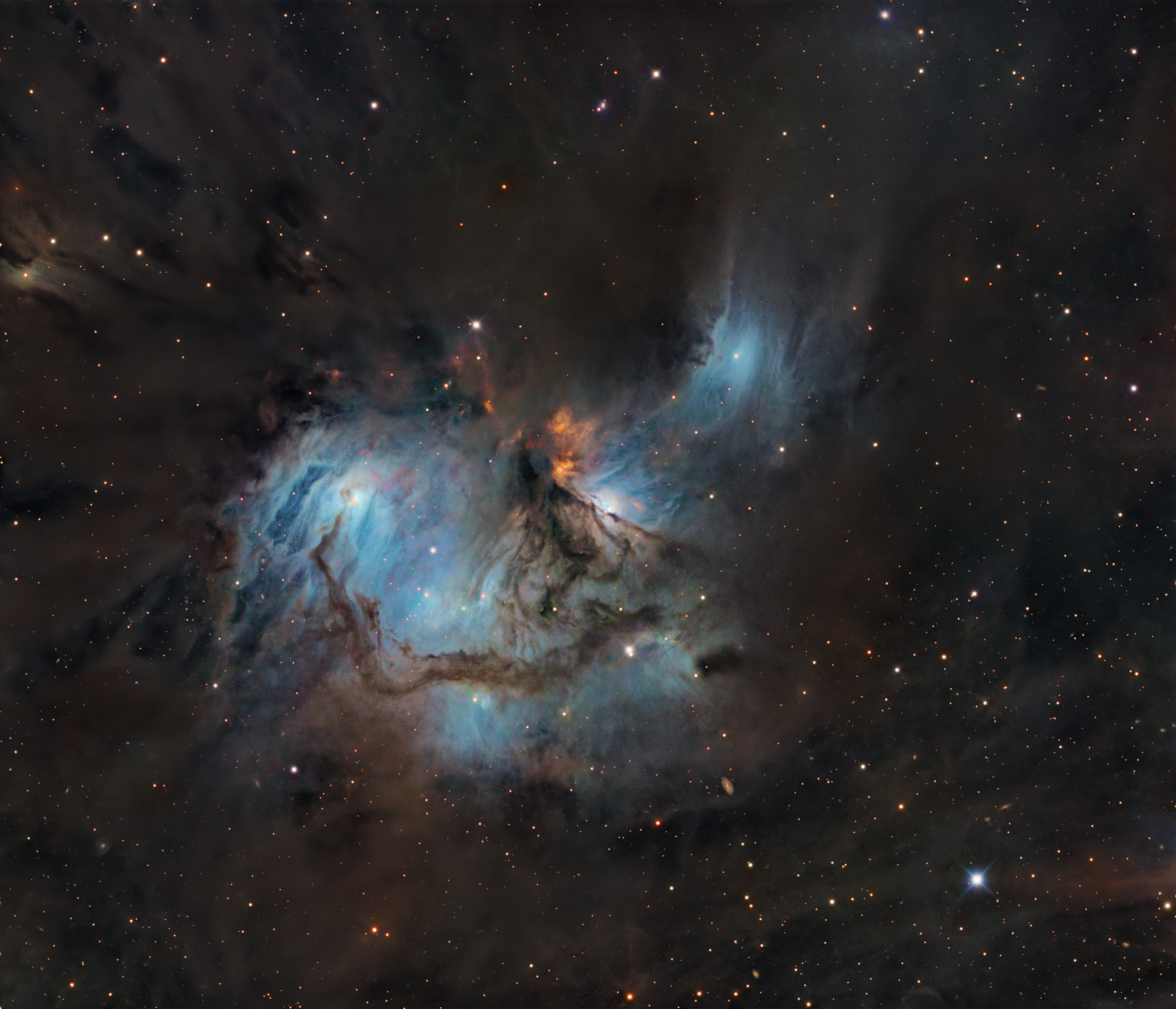
Where blue starlight carves through darkness
This reflection nebula, cataloged as NGC 2183 in the constellation Monoceros, lies embedded within the Monoceros R2 molecular cloud complex at a distance of roughly 2 700 light-years from Earth. Rather than glowing from ionized hydrogen like an emission nebula, this region shines because young, hot stars illuminate surrounding dust, their blue light scattering through the cloud and painting the scene with soft, ethereal luminosity.
NGC 2183 is part of a larger star-forming environment that includes nearby NGC 2170 and related dust structures, all shaped by gravity, turbulence, and radiation pressure. The striking blue plumes trace channels where starlight escapes more freely, while the thick dark lanes reveal colder, denser clouds blocking the light behind them. Subtle warm tones close to the core mark areas where dust has been heated more intensely, creating a delicate balance between cool reflection light and gentle thermal glow.
What makes this field especially compelling is the sense of depth and physical structure. Wisps of dust stretch across space, layered clouds overlap each other, and embedded young stars quietly sculpt their surroundings. Far from being a quiet region, Monoceros R2 is a surprisingly active stellar nursery: dense molecular clouds are collapsing into new stars, stellar winds carve cavities and ridges through the dust, and radiation continuously reshapes the surrounding material. It is a living, evolving structure—beautiful, energetic, and transient on cosmic timescales—captured here in a rare moment of balance between chaos and elegance.
Imaged in LRGB on my Planewave CDK 1000 at Observatorio El Sauce, Chile.
Image acquisition and processing: Mike Selby