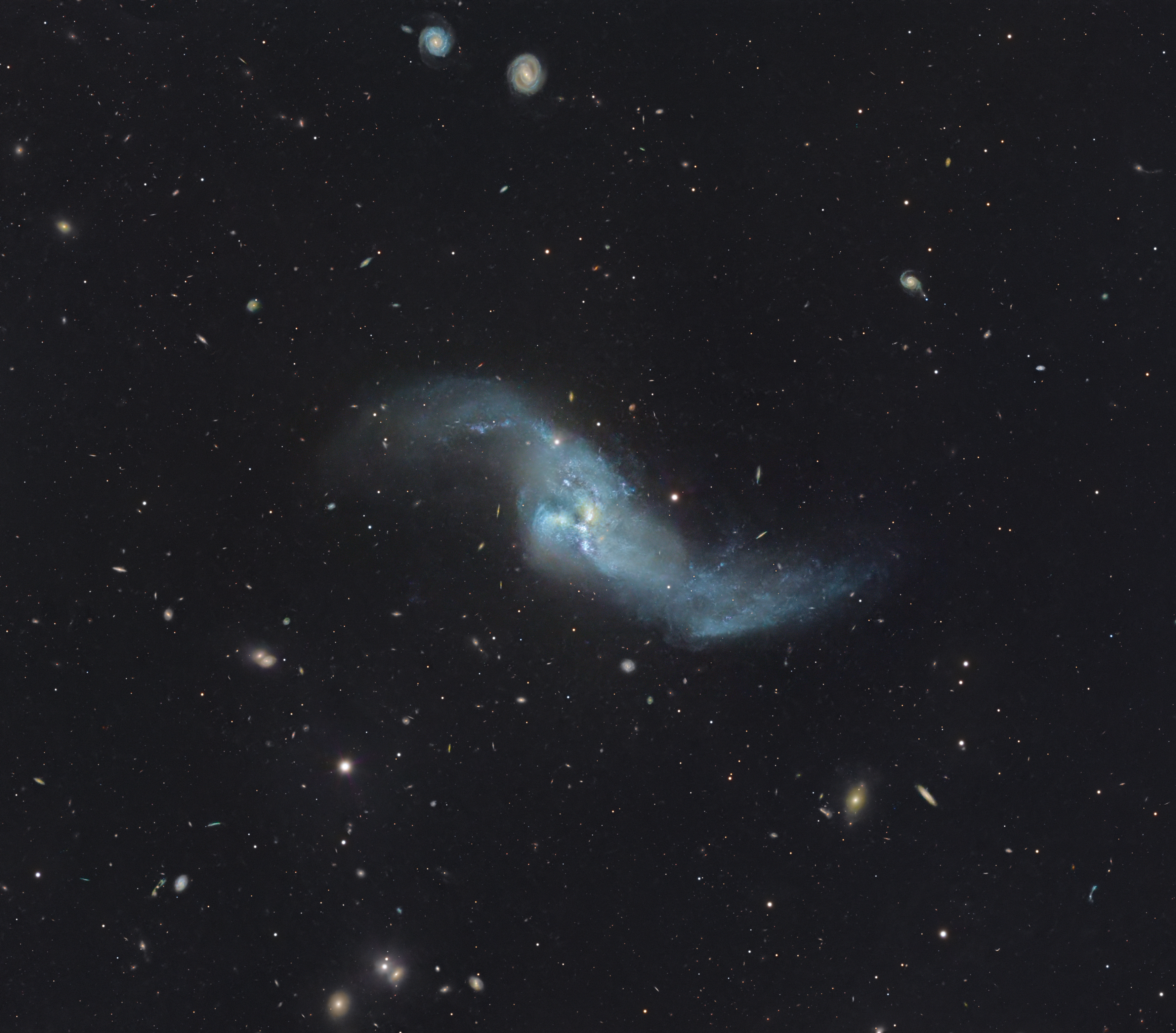
Two become one in a violent cosmic courtship
NGC 1487 is a compelling example of a galaxy merger caught in mid-transformation, where two once-separate galaxies are in the process of dissolving into a single, chaotic remnant. Rather than showing the ordered symmetry of a spiral, it is classified as a peculiar interacting galaxy (Pec / merger remnant), dominated by tidal debris, warped stellar streams, and luminous knots formed by gravitational violence.
At a distance of roughly 100 million light-years, NGC 1487 spans about 60,000 light-years from end to end, with an apparent size of approximately 3.3 × 1.7 arcminutes on the sky. Its most striking feature is the long, bluish tidal plume, composed largely of young stars born as gas clouds were compressed and flung outward during the encounter. These extended structures show how dramatically mergers can redistribute stars far beyond any original galactic disk.
The bright central region is especially intriguing. It is not a settled galactic nucleus, but an overlap zone where material from both progenitor galaxies has collided, triggering intense star formation and producing a temporary concentration of light. In systems like NGC 1487, such features can masquerade as a core even though the merger has not yet relaxed into a stable galaxy.
Much of NGC 1487’s mass and light now resides outside any recognizable spiral or elliptical structure, illustrating how mergers erase the original identities of galaxies and scatter stars across vast scales. Set against a deep background rich with distant galaxies, this scene captures a fleeting phase of evolution — a moment when gravity is actively rewriting the architecture of a future galaxy yet to fully emerge.
Imaged in LRGB on my Planewave CDK 1000 at Observatorio El Sauce, Chile.
Image acquisition and processing: Mike Selby