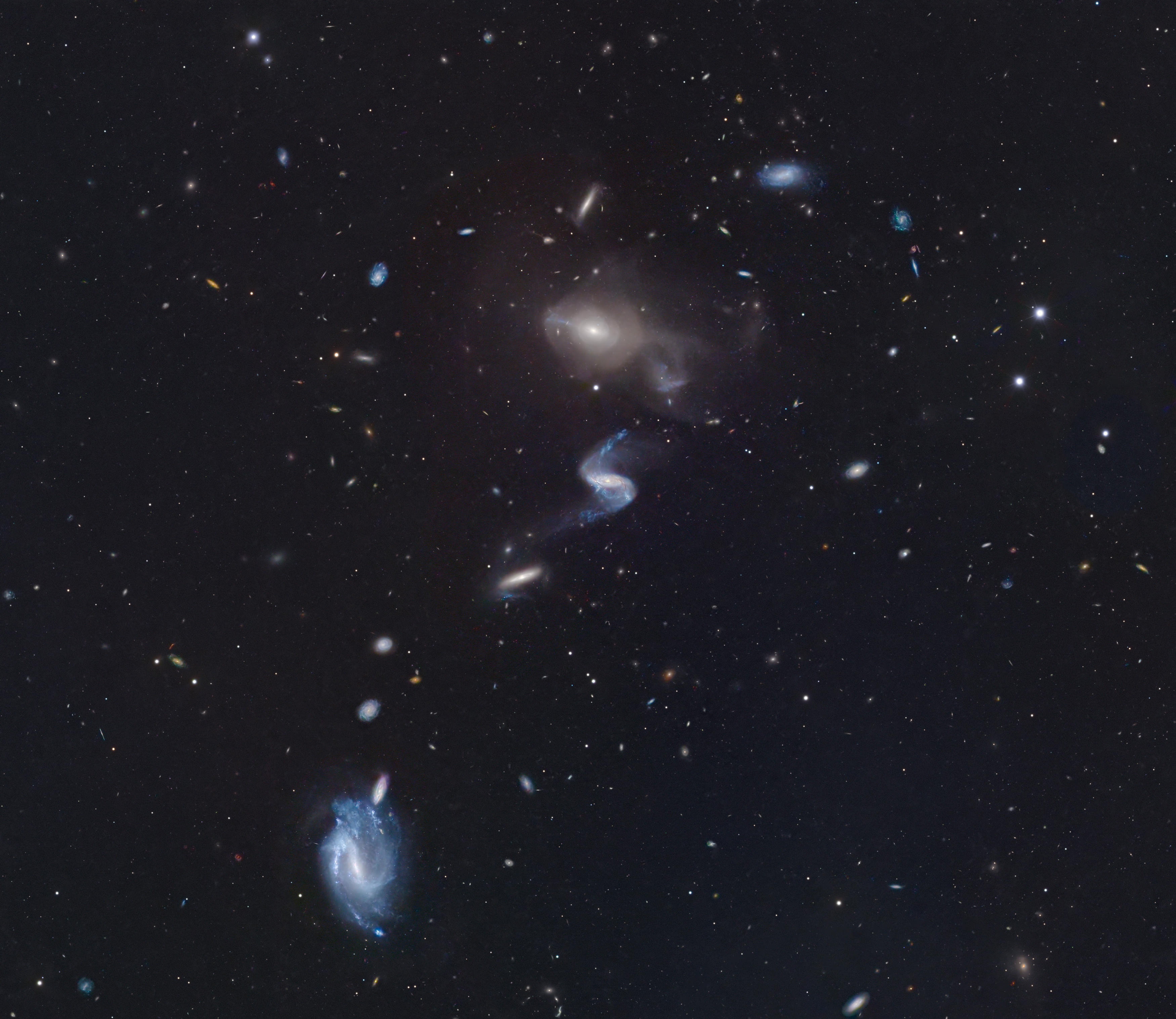
A fragile chain of galaxies, bound together by gravity and deep time
This field captures Arp 332, a compact interacting galaxy chain in the constellation Eridanus, anchored by NGC 1230, an early-type disk galaxy classified as SA0/a. At a distance of roughly 500 million light-years, NGC 1230 spans about 80–90 thousand light-years, appearing smooth and bulge-dominated at first glance, yet showing subtle outer asymmetries that already hint at long-term gravitational disturbance.
Nearby lies NGC 1229, a barred spiral (SB(s)b pec) and the most visibly distorted member of the chain. Its asymmetric arms and uneven star-forming regions betray sustained tidal forcing rather than a single violent encounter. NGC 1228, a lenticular galaxy (S0 / SA0 pec), appears dynamically heated and structurally simplified, likely shaped by the same repeated interactions that gradually transform spirals into smoother disks. Completing the chain is IC 1892, a late-type barred spiral (SB(s)d) whose blue, clumpy star formation and uneven disk suggest ongoing tidal triggering.
A particularly striking feature of this image is the presence of faint tidal bridges and a shared tidal envelope connecting several members of the chain. A tidal bridge is formed when gravity pulls stars and gas out of galaxies during close passages, stretching this material into diffuse streams that can link neighboring systems. Unlike dramatic collision tails, these bridges are often broad, extremely faint, and only visible in deep images, recording repeated encounters over hundreds of millions of years rather than a single moment of disruption. What is seen here is the accumulated imprint of slow, persistent gravitational interactions within a compact group environment.
Beyond Arp 332, the frame is crowded with distant background galaxies, many whose light has travelled billions of yearsto reach us. They form a deep cosmological backdrop, placing this nearby interacting chain within the far larger structure of the universe.
When the light from Arp 332 began its journey toward Earth, our planet was in the late Cambrian to early Ordovician period. Complex life was just beginning to flourish in the oceans, trilobites were abundant, and no life had yet colonized land. Since then, Earth has witnessed mass extinctions, the rise and fall of dinosaurs, and the emergence of observers capable of capturing and understanding this ancient light.
This image is not just a portrait of interacting galaxies, but a record of slow galactic evolution, written in faint tidal light and spanning half a billion years of cosmic history.
Imaged in LRGB on my Planewave CDK 1000 at Observatorio El Sauce, Chile.
Image acquisition and processing: Mike Selby