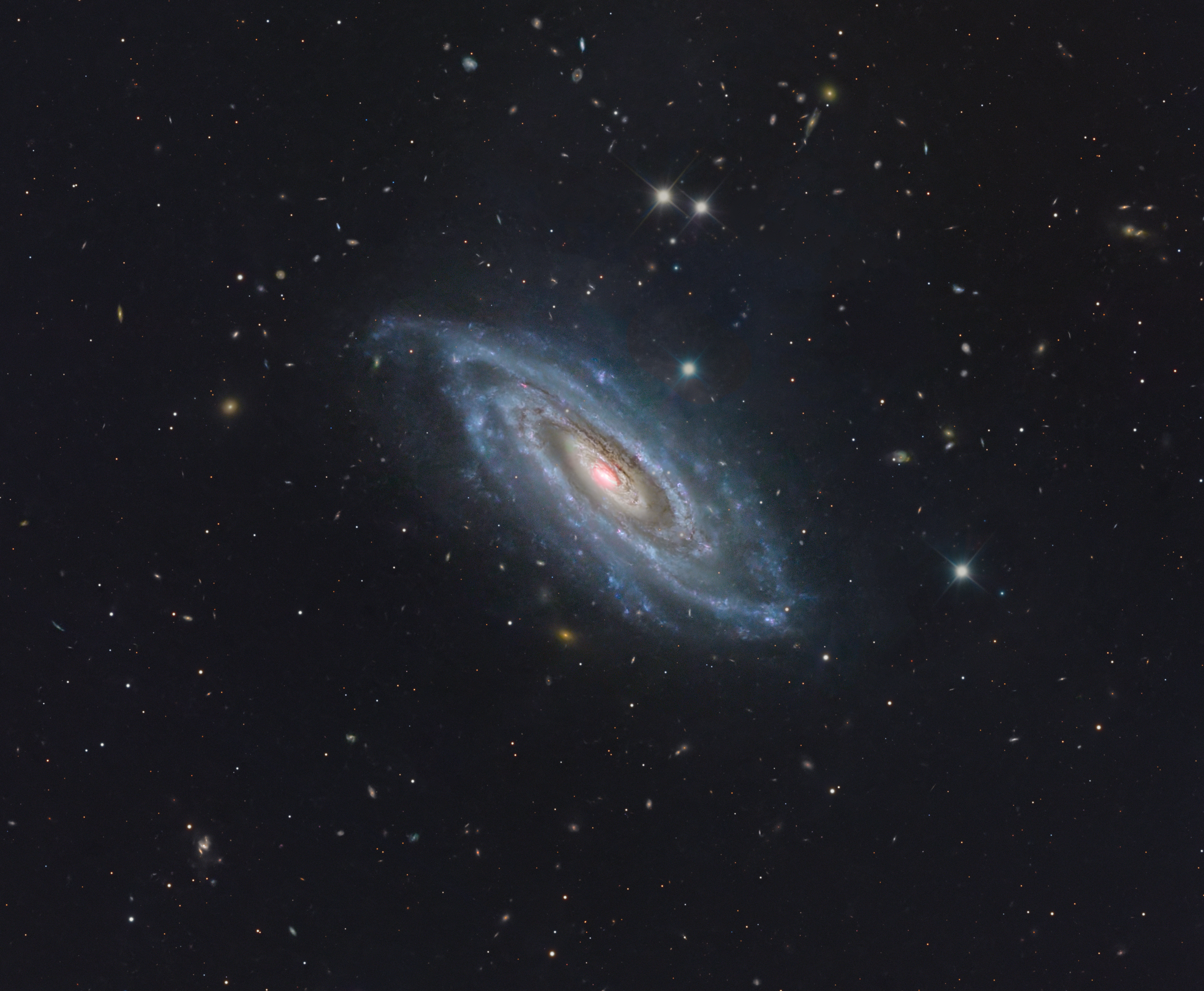
A galaxy balanced on the edge of symmetry
NGC 1964 is a beautifully structured barred spiral galaxy of type SBbc, located in the southern constellation Columba at a distance of roughly 60–65 million light-years. On the sky it spans about 6.0 × 2.9 arcminutes, corresponding to a true physical size close to 100,000 light-years, broadly comparable to the Milky Way, with an overall brightness near magnitude 11.
At the heart of the galaxy, a bright stellar bar anchors the structure, crossed by sharply defined dust lanes that cut through a warm central glow with striking clarity. From this bar, two large spiral arms unwind into space — but not perfectly evenly. One arm is broader and more filamentary, while the opposite arm remains tighter and more structured, giving the galaxy a subtle sense of imbalance without disorder. Around the brighter spiral structure lies a faint extended stellar envelope, showing that the visible arms sit embedded within a larger disk. The slight tilt of the outer regions adds depth and dimensionality, giving the impression of a living galaxy in gentle motion rather than a static form.
Barred spirals like NGC 1964 demonstrate how internal gravitational structure shapes galactic evolution. The bar helps redistribute gas and angular momentum, guiding star formation and influencing the future of the galaxy. Here, that interplay between order and asymmetry is beautifully written in light, framed by a rich background populated with countless distant galaxies, each another quiet universe in the deep southern sky.
Imaged in LRGB on my Planewave CDK 1000 at Observatorio El Sauce, Chile.
Image acquisition and processing: Mike Selby