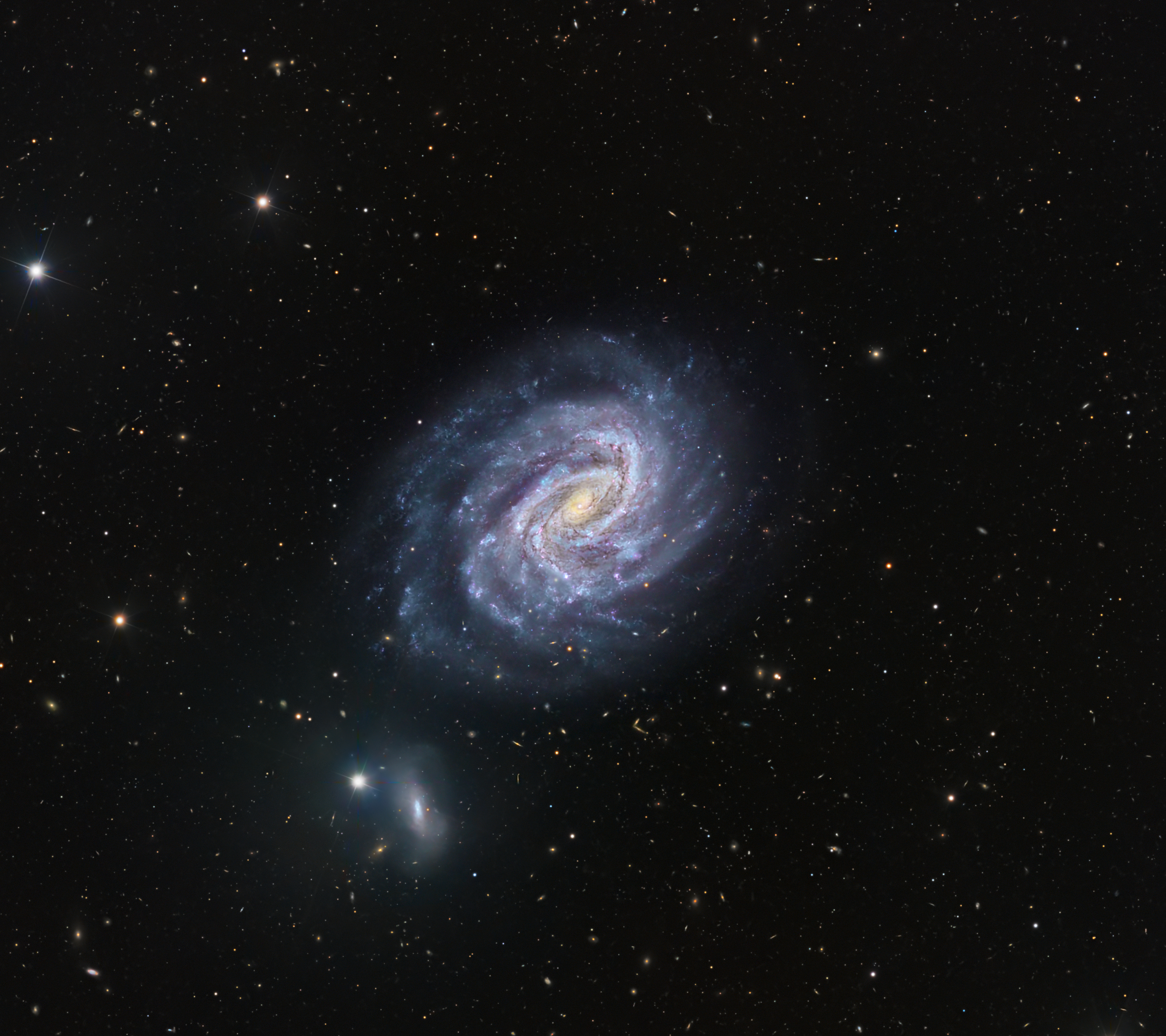
A spiral galaxy shaped by broken arms and ancient stellar explosions
In the southern constellation Eridanus, the nearly face-on spiral NGC 1187, classified as SAB(r)c, lies about 60 million light-years away and spans roughly 75,000 light-years, with an apparent size of 3.9 × 3.1 arcminutes. Its faint bar and inner ring lead into a warm, dust-threaded disk that breaks into loosely wound, flocculent spiral arms. The galaxy shows clear arm asymmetry—one side forming broad curves while the opposite side fractures into scattered blue knots and fading extensions. These uneven structures suggest slow dynamical shaping over time, rather than the perfect symmetry seen in classical grand-design spirals.
NGC 1187 also carries a notable supernova history, having produced at least two recorded explosions — SN 1982R and SN 2007Y — evidence of massive stars forming and dying within its spiral arms. Even though the events are long faded, they mark the galaxy as an active environment with continuing stellar evolution.
Below the main galaxy sits its compact companion PGC 11469, placed beside a bright foreground star. At roughly 25,000 light-years across, this small satellite shows a blue, irregular profile and signs of disturbance and localized star formation. Its gravitational influence may contribute to some of the arm asymmetries visible in NGC 1187’s outer disk.
Across the surrounding field, numerous faint background galaxies — tiny spirals, delicate edge-ons, and small ellipticals — add depth to the scene and emphasize the rich extragalactic environment around this subtly distorted spiral.
Imaged in LRGB on my Planewave CDK 1000 at Observatorio El Sauce, Chile.
Image acquisition and processing: Mike Selby