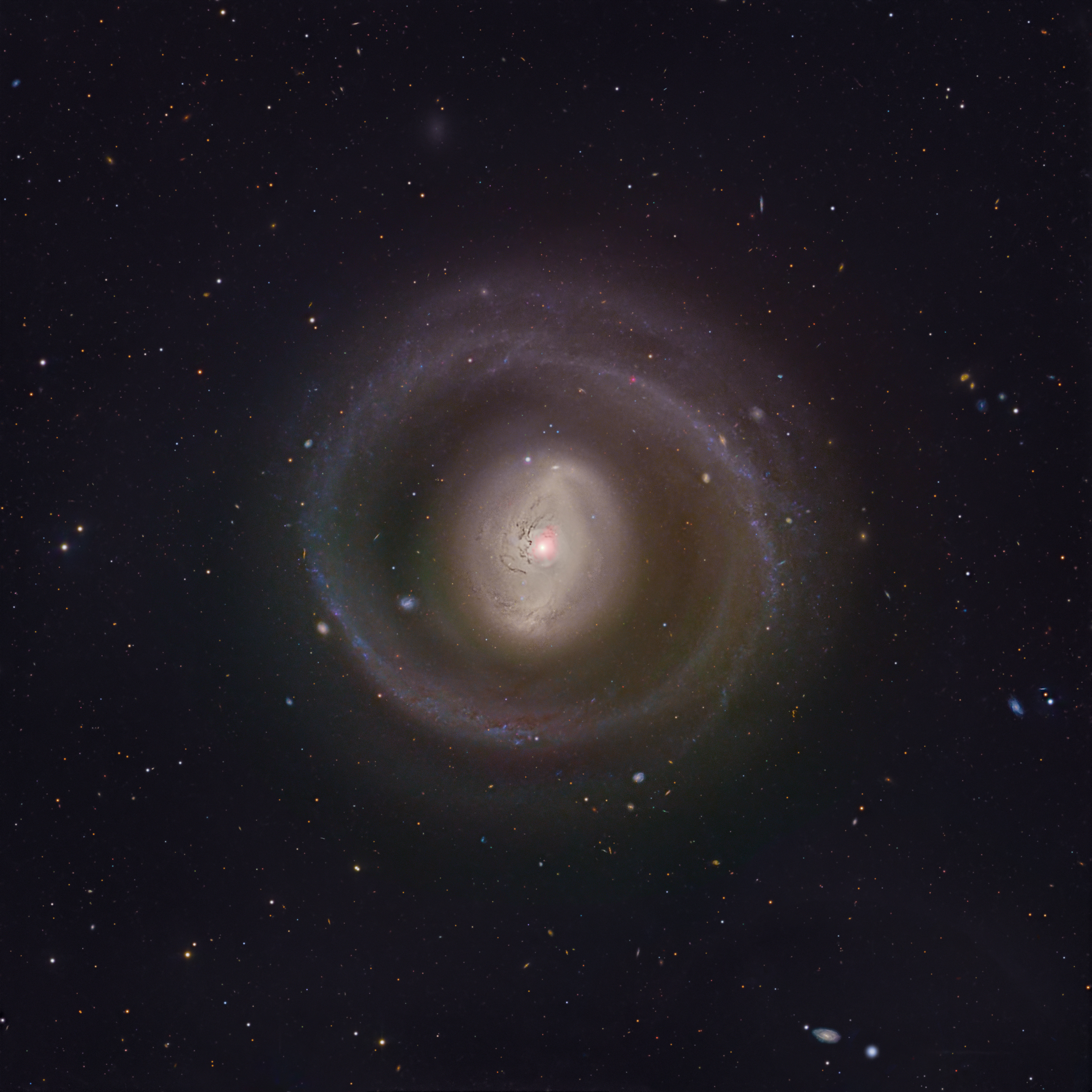
Tracing the quiet geometry of an ancient galaxy
NGC 1291 in Eridanus is classified as (R)SB(s)0/a, an early-type barred galaxy whose defining feature is the vast outer ring encircling a bright, smooth central lens. Located about 33 million light-years away, its apparent size of 10.4 × 9.4 arcminutes corresponds to a physical diameter of roughly 85,000 light-years, similar to the scale of the Milky Way.
The inner region appears serene from afar, yet closer inspection reveals delicate dust spirals and faint Hα knots forming a subtle inner pseudo-ring embedded within the lens. These structures trace slow bar-driven gas inflow, feeding the nucleus over long periods. The pronounced color contrast between the warm central lens and the cooler, bluer ring highlights the layered evolutionary history of this system.
The outer ring is particularly striking—fragmented arclets, faint star-forming patches, and asymmetric wisps shape its textured appearance. The western side shows slight warping and a mild brightness imbalance compared with the smoother eastern arc, signatures of slow secular evolution rather than recent interaction. Extending beyond all of this is a very low-surface-brightness stellar envelope, a diffuse halo rarely captured so clearly and giving the galaxy its soft, ghostlike perimeter.
Surrounding the system are numerous background galaxies—tiny edge-ons, pale ellipticals, and faint blue spirals. Several lie projected directly against the outer ring, adding depth and enhancing the impression of clumpiness along its edge.
Imaged in LRGB and H alpha on my Planewave CDK 1000 at Observatorio El Sauce, Chile.
Image acquisition and processing: Mike Selby
[12/10/25, 8:37:07 PM] Gowri: Thank you so much!
[12/10/25, 8:39:33 PM] Mike Selby: Thank you