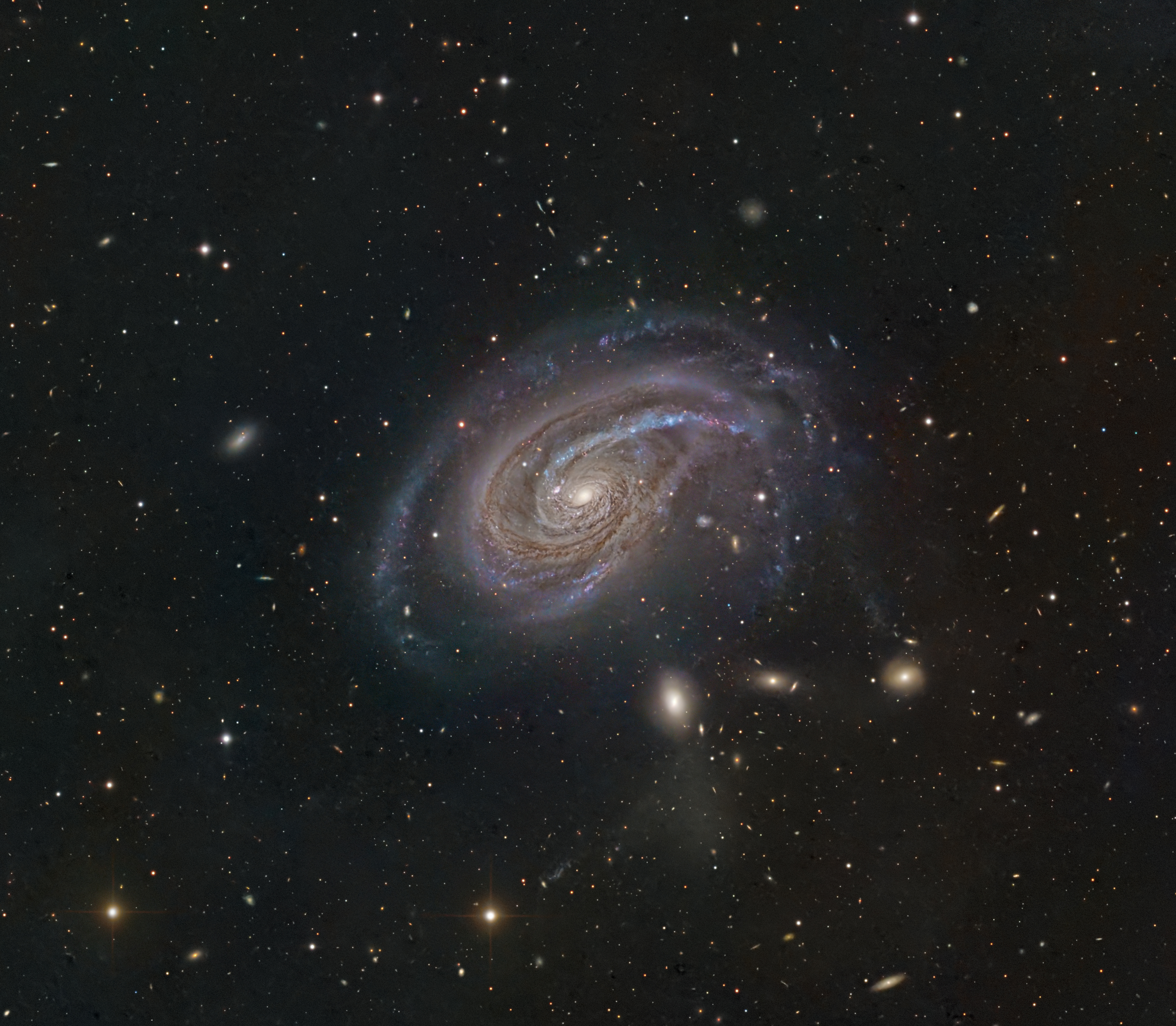
A spiral galaxy caught mid-stride in a quiet gravitational dance
NGC 772 (Arp 78) is an asymmetric spiral galaxy in the constellation Aries, catalogued as SA(s)b and lying roughly 130 million light-years away. It spans about 7.2 × 4.3 arcminutes on the sky, corresponding to a physical extent near 270,000 light-years—more than twice the size of the Milky Way. The galaxy’s most dramatic feature is the immense outer arm that sweeps far beyond the rest of the disk, pulled outward by the nearby companion NGC 770. This gravitational interaction not only distorts the spiral structure but also triggers localized star formation, most visibly along the extended tidal arm, where compressed gas has produced a scattering of young blue stellar clusters.
The inner disk reveals tightly wound dust lanes wrapped around a bright central bulge, with small pockets of star-forming activity embedded within the spiral arms. These inner regions show only modest star birth, while the dominant activity is concentrated in the tidal arm where the gravitational influence of NGC 770 has enhanced gas density and ignited new star formation. Surrounding the main galaxy is a deep background filled with distant galaxies of many types—elongated edge-on disks, orange ellipticals, and faint high-redshift systems—adding depth and structure to the field. The combination of tidal distortion, asymmetric star-forming regions, and extensive faint outer debris makes NGC 772 a vivid example of how even a small companion can reshape the evolution of a massive spiral galaxy.
Imaged in LRGB on my Planewave CDK 1000 at Observatorio El Sauce, Chile.
Image acquisition and processing: Mike Selby