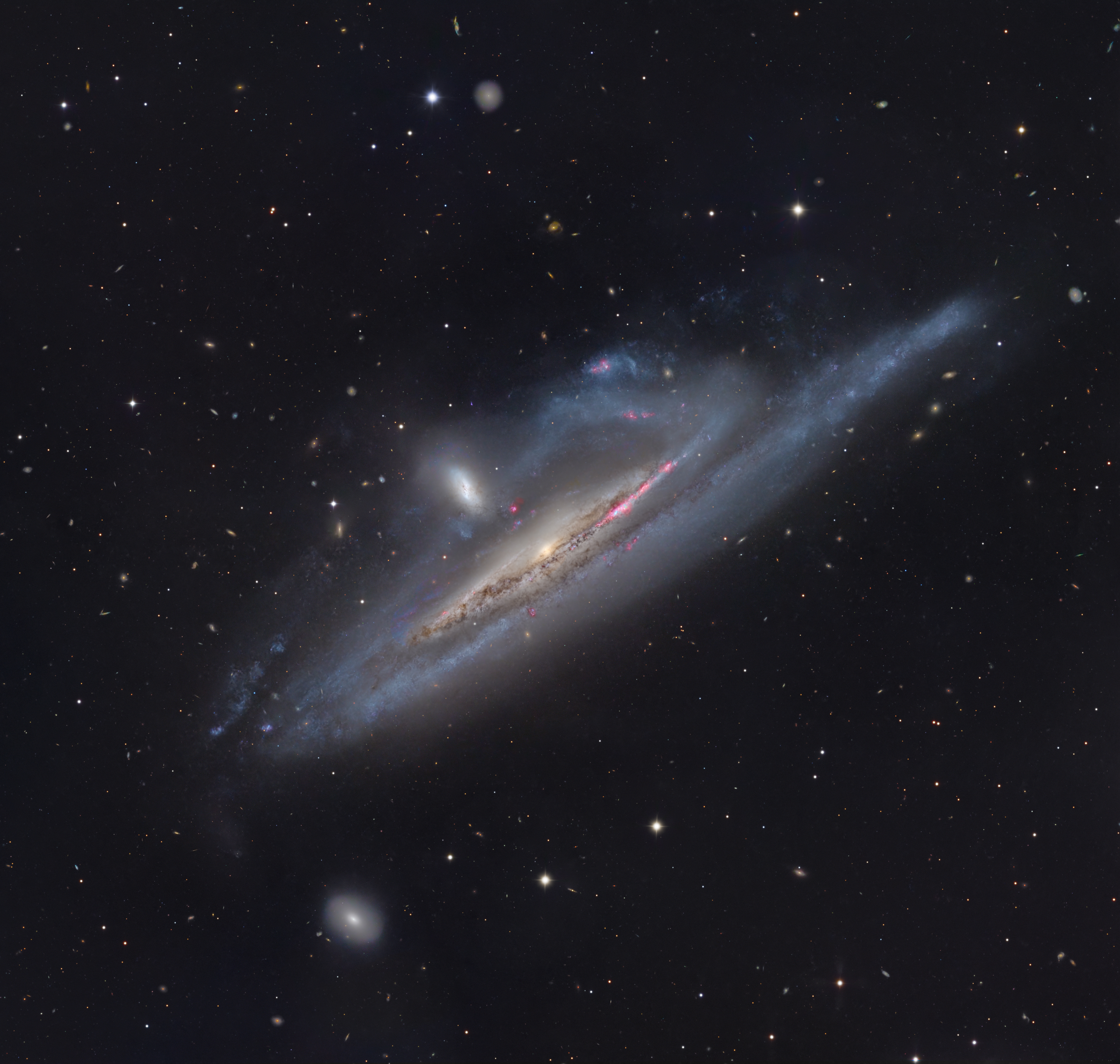
Where tides sculpt stars and stretch the very shape of a galaxy
NGC 1532 is a spectacular SB(s)b peculiar barred spiral in the southern constellation Eridanus, caught in a slow-motion gravitational collision with its compact companion, NGC 1531. This interaction has reshaped the galaxy’s disk into sweeping arcs, warped planes, and luminous filaments that curve outward in defiance of symmetry.
Located about 49 million light-years away and spanning roughly 120,000 light-years in diameter, NGC 1532 stretches across the sky with an apparent size of about 11.8 arcminutes. Seen nearly edge-on, its central region reveals a sharply curved dust lane bending across the bulge, while a bright chain of Hα-emitting star-forming clusters outlines a compressed leading edge where tidal forces have triggered bursts of new stellar activity.
The disk itself is visibly warped, rising on one side and dipping on the other, a hallmark of tidal deformation. A diffuse streamer of blue-tinged material flows from the lower-left edge of the galaxy, contrasting with the long tidal extension sweeping outward to the right. Above the mid-plane, several small detached blue knots appear as tidal star-forming condensations, early precursors of potential dwarf clusters.
NGC 1531 lies embedded within a surrounding tidal envelope of gas and dust stripped from the larger galaxy, creating a striking sense of motion and interaction. Beneath the system, a faint, nearly transparent ultra-low-surface-brightness plume arcs into the halo — a delicate trace of matter drawn out over millions of years.
The surrounding field is dotted with distant background galaxies, adding depth and scale to this dramatic gravitational encounter.
Imaged in LRGB and H alpha on my Planewave CDK 1000 at Observatorio El Sauce, Chile.
Image acquisition and processing: Mike Selby