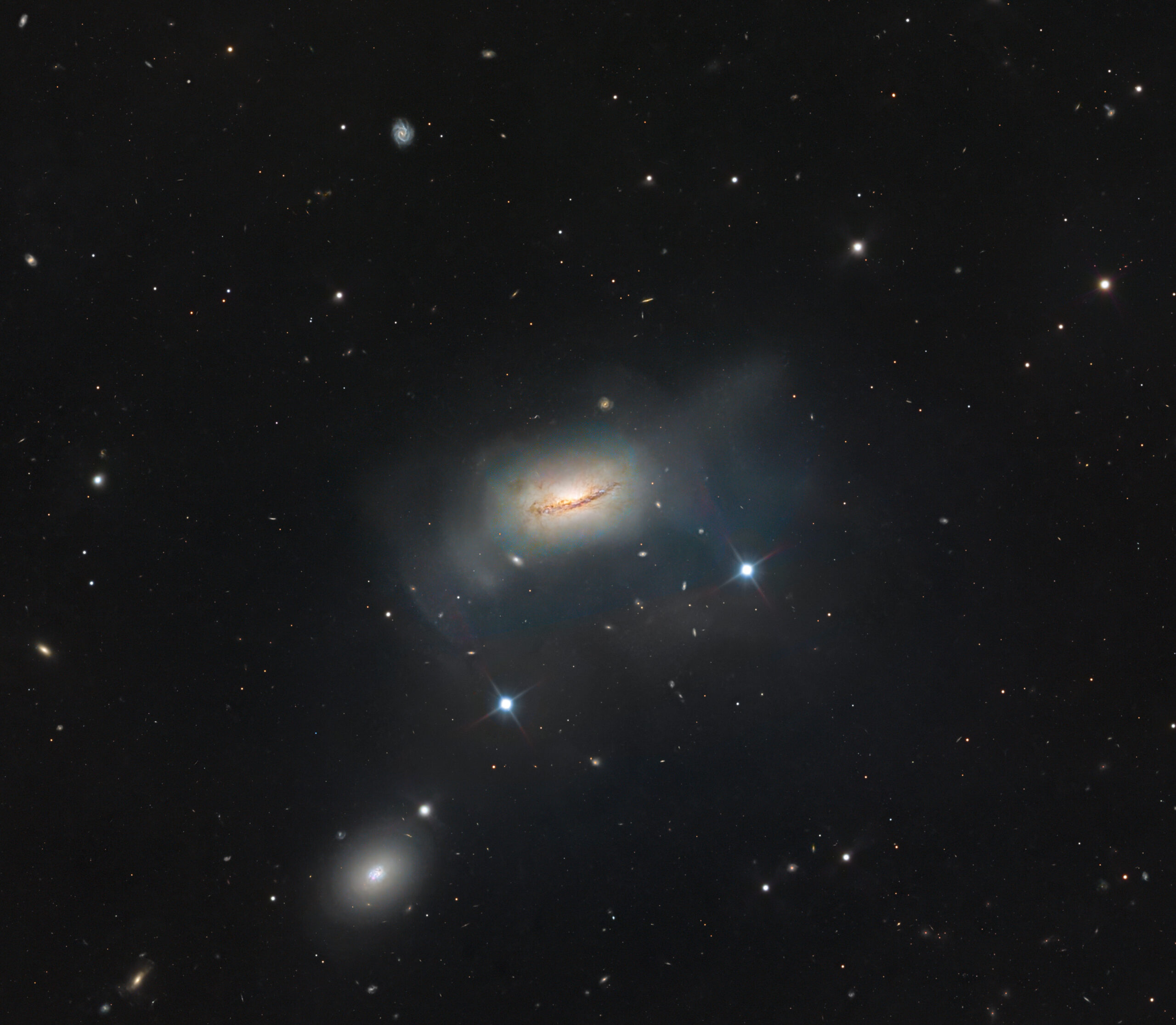
Where starlight rises through a storm of its own making
NGC 1482 stands in Eridanus as an early-type disk galaxy undergoing profound internal change. Classified as (R’)SAB0/a pec, it combines the structure of an S0/a system with the chaos of an intense, dust-obscured starburst. Dark dust lanes cut sharply across the luminous central region, while the nucleus drives a remarkable bipolar superwind — broad, shock-excited cones of gas and dust that extend far beyond the stellar disk. These outflow plumes are unusually well collimated, tracing the powerful release of energy from the galaxy’s inner star-forming ring.
At a distance of about 76 million light years, NGC 1482 spans roughly 2.5 × 1.1 arcminutes, corresponding to a physical size of about 55,000 × 24,000 light years. The outflow stretches still farther into space, forming a faint halo marked by wisps, filaments, and subtle twists in the outer dust lanes — signatures of a galaxy reshaping itself from the inside out.
Below it lies NGC 1481, a quiet S0 companion with an apparent size of 1.04′ × 0.78′ and a physical diameter of around 20,000 light years. Its smooth, rounded luminosity profile provides a visual counterpoint to the turbulent energy above, emphasizing the contrast between a stable lenticular system and a galaxy driven by powerful internal feedback.
The field is dotted with distant background galaxies, adding depth and scale to the scene. Together they frame a system where dust, gas, and starlight interact under extraordinary conditions — a galaxy whose inner fire sends material flowing outward in vast, sculpted winds.
Imaged in LRGB on my Planewave CDK 1000 at Observatorio El Sauce, Chile.
Image acquisition and processing: Mike Selby