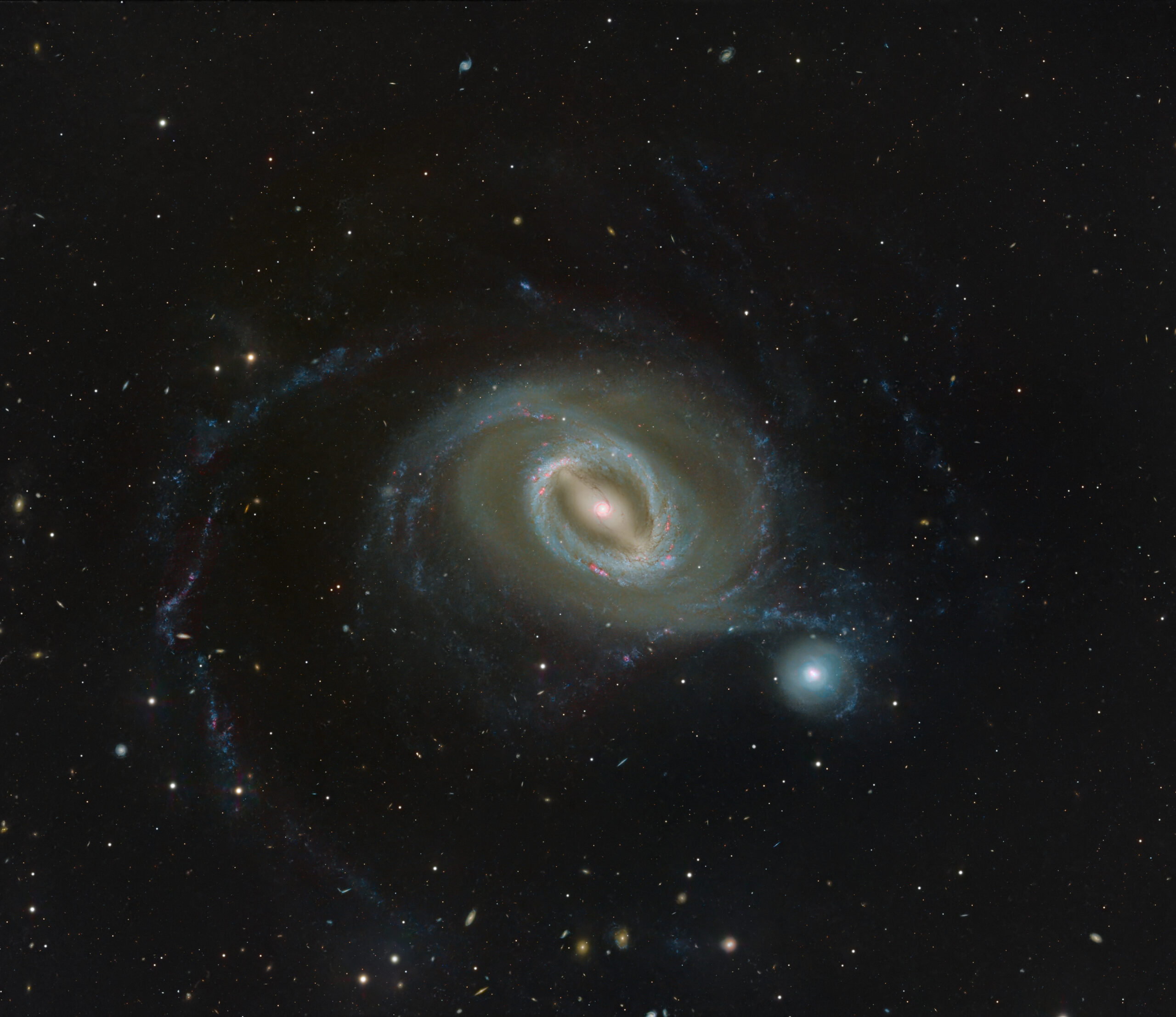
A barred galaxy wrapped in a ghostly outer ring of starlight
In the constellation Horologium, the barred spiral NGC 1512 lies about 38 million light-years away and spans roughly 70,000 light-years, with an apparent size of 8.9 × 5.6 arcminutes. Its central bar funnels gas into a compact nuclear ring where dense knots of Hα emission mark vigorous star formation. This bright inner structure sits inside a broad stellar lens — a smooth, faintly brown region of older stars that forms the transitional zone between the bar and the outer disk.
Beyond this calm interior, NGC 1512 unfolds into an enormous XUV disk, where delicate blue spiral arms and diffuse arcs stretch far beyond the galaxy’s traditional optical boundary. These outer structures contain scattered star-forming knots and faint tidal asymmetries, revealing the true reach of the galaxy’s extended star-forming environment.
Below NGC 1512 sits its interacting companion, NGC 1510, a compact dwarf/BCD-like system with an angular size of 1.3 × 0.7 arcminutes, corresponding to a physical width of roughly 14–16 thousand light-years. Its bright blue core, flocculent envelope, and localized Hα emission reflect star formation amplified by its gravitational encounter with NGC 1512. The interaction between the two galaxies has helped shape the asymmetric clumps and twists seen in the vast outer arms of NGC 1512.
Across the broader field, faint spirals, distant ellipticals, and slender edge-ons form a richly populated deep backdrop, adding further depth and scale to this intricate southern galaxy pair.
Imaged in LRGB and H alpha on my Planewave CDK 1000 at Observatorio El Sauce, Chile.
Image acquisition and processing: Mike Selby