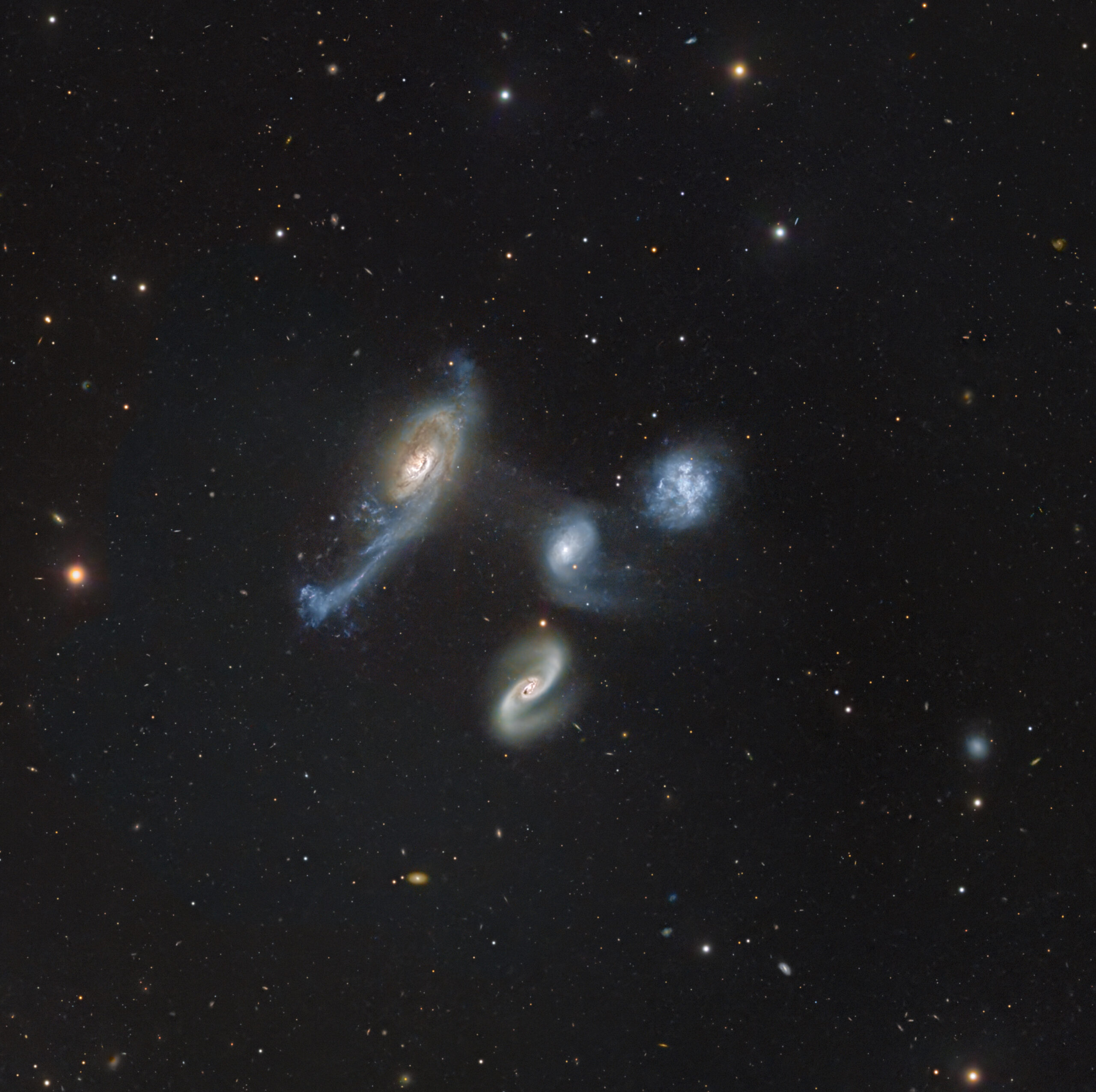
A quartet of galaxies playing a gravitational symphony in blue.
In the southern constellation Phoenix, four galaxies—NGC 92, NGC 89, NGC 88, and NGC 87—come together to form Robert’s Quartet, a compact interacting group about 163 million light-years away. The name honors Australian astronomer W. F. Roberts, who first recognized that these four galaxies are a true physical association rather than a chance alignment.
At the top of the ensemble, NGC 92 (SABc pec) leads the performance. Its inner disk spans roughly 30,000 light-years, yet the gravitational encounters within the group have drawn out a dramatic 50–60 kly tidal tail, lined with distinct blue star-forming knots. These bright condensations—clearly visible here—are classic signs of tidally induced OB associations and may even mark the earliest stages of tidal dwarf galaxy formation. The warped dust lanes and asymmetric arm structure in its core reveal just how deeply the interactions have disrupted the galaxy.
Beneath it, NGC 89 (SA0/a pec) shows a sharply etched dust lane cutting across its bulge, with its outer disk subtly twisted under the tidal pull of its neighbors. To the right, NGC 88 (SB0/a) displays a smoother disk beginning to shear at the edges, a quieter but unmistakable response to the group’s shared gravity.
NGC 87 (IBm) contributes the most chaotic voice to the quartet. Its flocculent, foam-like structure and numerous blue knots betray active, widespread starburst activity triggered by the group’s gravitational dynamics. Though only about 12,000 light-years across, its response to the encounter is one of the most visually dramatic.
Faint tidal haze threads between the galaxies, forming a diffuse bridge from NGC 92 toward NGC 89 and NGC 88. This gently glowing material—captured here without clipping or over-smoothing—is evidence of stars and gas being transferred between the members as they slowly reshape one another. Numerous background galaxies pepper the scene, some hundreds of millions of light-years farther away, adding an unexpected depth behind this already intricate cosmic ensemble.
Imaged in LRGB on my Planewave CDK 1000 at Observatorio El Sauce, Chile.
Image acquisition and processing: Mike Selby